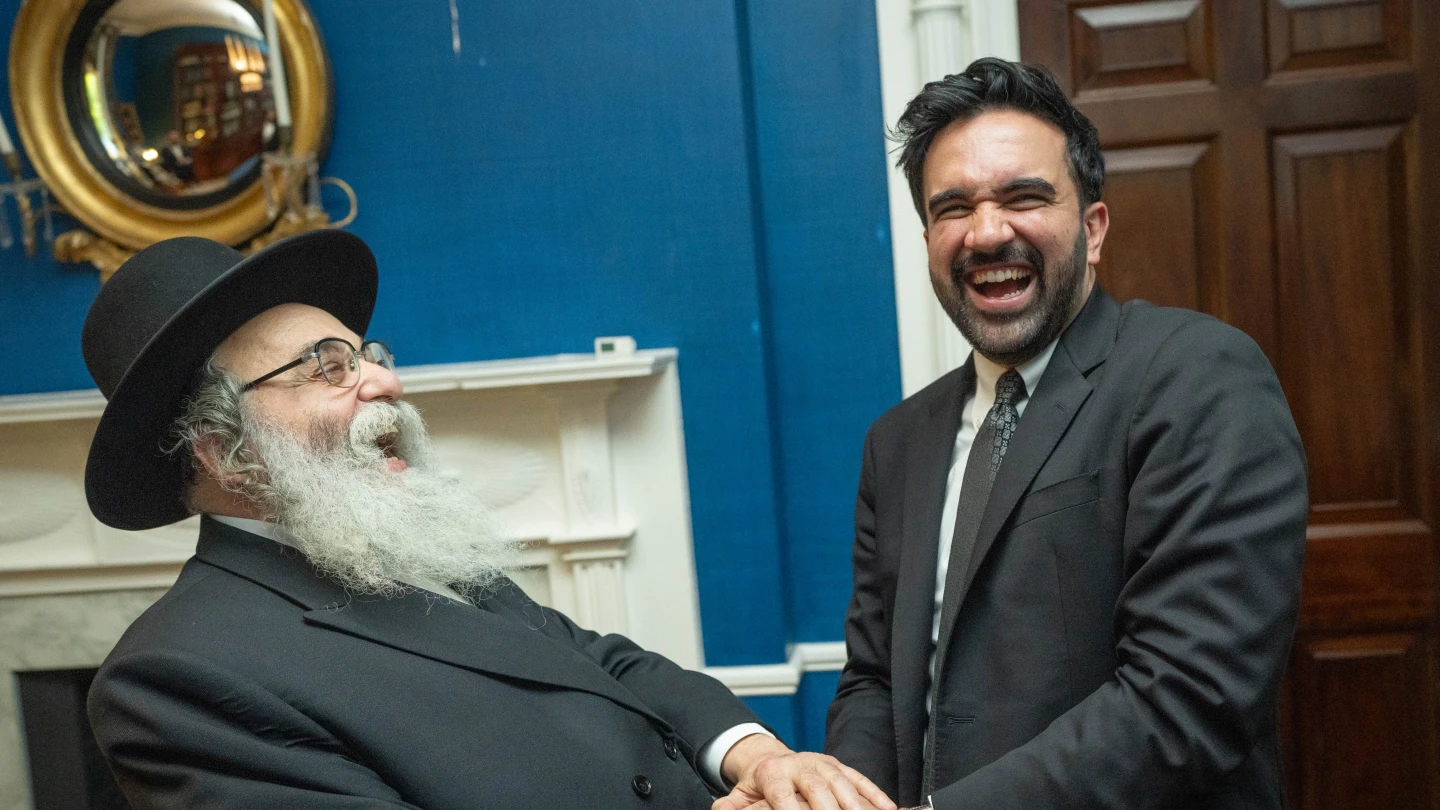
Israel always prefers to live in peace, but if that is not possible, it knows how to strike, Blue and White lawmaker Eitan Ginzburg told JNS, discussing Iran in a sit-down interview at his Knesset office in Jerusalem.
What matters, Ginzburg said, is not what could have been, but the decisions made in real time.
“The U.S. decided not to strike. Not everything depends on us,” he said.
Ginzburg expressed hope that Israel and Iran could one day restore the relationship that existed in the 1970s and earlier.
“I hope we will see the day when Iran is again led by its sovereign people. Israel wants to live in peace, and the people of Iran want that too. I hope we will see a change,” he added, emphasizing his trust in the IDF and in the nation to act in accordance with Israel’s security interests.
Ginzburg, who served as in the Knesset in 2019–22, including as communications minister in 2021, returned to the parliament as an opposition legislator in July 2025 following the resignation of Gadi Eisenkot.
Ginzburg has initiated several pieces of legislation, including the so-called “Uber law,” co-sponsored by Likud lawmaker Moshe Passal, which seeks to regulate and enable ride-sharing services in Israel and passed its preliminary reading on Jan. 21.
Asked about his ability to legislate as an opposition lawmaker, Ginzburg said the work goes beyond initiating bills.
“One needs to know which bills to advance and how to work together with ministers and coalition members to resolve issues,” he said.
The “Uber law” was supported by Transport Minister Miri Regev, Ginzburg said.
“It’s a good bill, something that exists all over the world aside from Israel. It’s good for the people,” he added.
One of the most significant reforms in years, the “Uber law” is expected to change the way people commute, much as the cellular reform that began in 2012 transformed how Israelis communicate by significantly lowering prices.
“This is something we need. It was stopped for many years because of politics, and now we managed to break the pattern,” he said.
The right to be forgotten
Ginzburg’s other initiatives include a bill to prohibit the photographing of suspects in courthouses, which has advanced for second and third (final) readings in the Knesset plenum; an amendment to the Water and Sewerage Corporations Law that would transfer the operation of water and sewage services to local authorities, aimed at improving efficiency and reducing costs; and legislation to limit the state’s right to appeal citizens’ acquittals.
Addressing the bill prohibiting the photographing of suspects in courthouses, Ginzburg said that while such a law already exists, current practice allows suspects to be photographed until a judge enters the courtroom.
“People get arrested at 6 a.m., taken from their beds and brought to court—women without makeup, in their pajamas. More than 50% of those arrested are not indicted, but their pictures remain online indefinitely. If there is an indictment, then fine,” Ginzburg said.
“While the right to know is important, the right to be forgotten and respect for a person are also important. I wanted balance,” he added.
Regarding Blue and White party leader Benny Gantz no longer ruling out joining a government led by Prime Minister Benjamin Netanyahu, Ginzburg said the move is part of an effort to dismantle the “Anyone but Bibi” approach, which he argued has failed to produce results.
He added that the current coalition is not the only government constrained by those at its ideological margins, noting that the 2021-22 Lapid-Bennett government faced similar challenges.
“Gantz says we need a Zionist, liberal government that speaks to the majority of Israelis in the center and serves both the majority and the minorities—without allowing minorities to take over,” Ginzburg said.
“Once we create a government with a clear direction, whoever wants to join can join—but the direction must reflect the majority and the Israeli mainstream,” he added.
Ginzburg, co-chairman of the Knesset–U.S. House of Representatives parliamentary friendship group alongside MK Boaz Bismuth, said it was of great significance that Israel currently has a U.S. president who strongly supports it.
He said his role is to ensure strong relationships with members of Congress from both the Republican and Democratic parties.
“Our interest is for America to be on our side. It is our best friend, and we need its support. We are in a difficult region, with difficult neighbors, and in a delicate position at the U.N. We receive assistance in both the security and political arenas, among others,” he said.
While disagreements between friends are inevitable, it is essential to ensure that the foundation of the relationship remains solid, Ginzburg said.
“Israel is still a consensus issue in the U.S., though there are fringe voices in both the Democratic and Republican parties. The mainstream still supports Israel. Our role is to maintain and strengthen that support—not to ignore our interests, but to find ways to work through differences,” he said.
“Every Israeli government has known how to work with the American administration. We are a sovereign country and can have disputes, but we have no friend like America, and it is always good to have it standing by our side,” Ginzburg said.