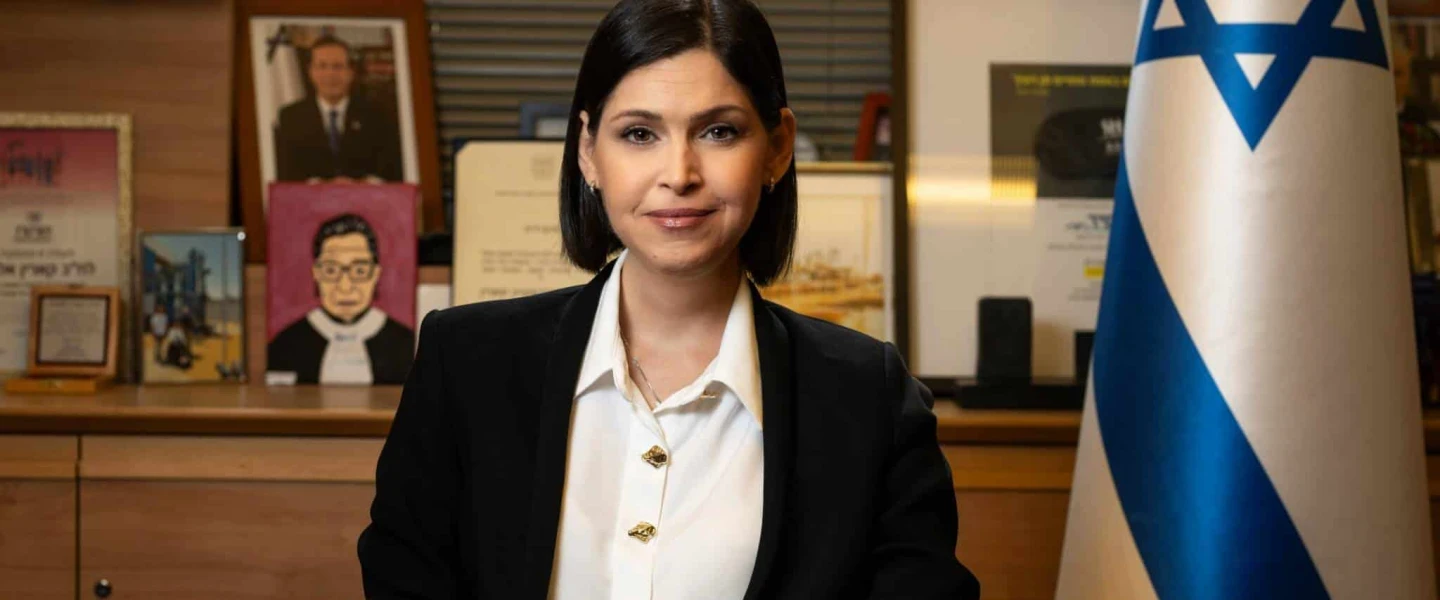
Israel should not move to the next stage of President Donald Trump’s 20-point peace plan for Gaza until the remains of Master Sgt. Ran Gvili are returned by Hamas, Yesh Atid Party lawmaker Karine Elharrar told JNS last week.
“There was an agreement and all hostages were supposed to return within 72 hours of the agreement [being signed on Oct. 9]. It didn’t happen, and there is a family waiting for their son,” said Elharrar, who served as Israel’s infrastructure, energy and water minister under Yair Lapid.
Gvili’s body is the last of those it captured on Oct. 7, 2023, that it is still holding.
Any subsequent progress must be conditioned on clear parameters, including the exclusion of Turkish or Qatari forces from Gaza, Elharrar told JNS during an interview in her Knesset office last Wednesday. Egypt, she added, should play a leading role in future arrangements.
“They have experience combating the Muslim Brotherhood ideology, which they oppose. They know how to do this. It’s a win-win,” she said.
The first phase of the U.S.-brokered ceasefire agreement with Hamas went into effect on Oct 13. However, the plan, brokered by the Trump administration, has hit an impasse as Hamas refuses to disarm.
Hamas leader Khaled Mashaal on Dec. 6 repeated calls for Israel’s destruction, rejecting U.S.- and U.N.-backed demands to disarm the Iranian-supported terrorist group and demilitarize the Gaza Strip.
Axios reported last week that Trump is expected to announce the establishment of the Board of Peace this week as part of Phase 2 of the ceasefire agreement.
Iran
In the Islamic Republic, nearly 500 protesters have been confirmed killed and about 11,000 arrested during the past two weeks of unrest, according to a rights group, as Trump said on Sunday that his administration is considering tough measures against the clerical regime and will decide on a response soon.
The number of confirmed fatalities has reached 544, including 483 protesters and 47 members of the security forces, with an additional 579 reported deaths under investigation, the Fairfax, Va.-based Human Rights Activists News Agency (HRANA) reported on Sunday.
Elharrar cautioned that Israel cannot afford recurring cycles of confrontation with Iran similar to those it has experienced with Hamas, warning that such a dynamic would be too destabilizing.
“Whether we are ready—I sure hope so. The objective should be that there will no longer be an enemy of the State of Israel there, and until the regime changes, it won’t happen,” she said.
While calling the now-uncertain prospect of normalization with Saudi Arabia a missed opportunity, Elharrar said she currently opposes the establishment of a Palestinian state, an issue that increasingly surfaces in normalization negotiations, arguing that neither side is ready.
“It is possible to take steps to improve the situation without bringing about a state in any way or manner. Yesh Atid was never for a Palestinian state; we were for separation,” she explained. “We were for separating from the Palestinians, but we need to take care of our borders and ensure the security of the State of Israel,” she added.
U.S.-Israel relations
Elharrar said Israel has effectively lost Democratic Party support and that backing for the Jewish state, once bipartisan, has become partisan, with divisions now visible even among Republicans.
“We need to work on them being unanimous because it used to be, and it served us and our interests, being a consensus issue in the U.S.,” she said.
Lebanon
Turning to Hezbollah, Elharrar said Israel must act with decisive force.
“We don’t have the privilege of leaving them on our border. We have citizens and residents of Israel’s north to protect. ... We can’t abandon them or evacuate them every time. We need to ensure their security and act with force. There must be a security belt that no one approaches,” she said.
The Lebanese Armed Forces said on Thursday it has completed the first phase of its plan to disarm Hezbollah, expanding its control in the country’s south as part of efforts to “extend the state’s authority exclusively through its own forces over the entirety of Lebanese territory.”
In a statement, the army said it had “achieved the objectives of the first phase” of the plan, which focused on “expanding the Army’s operational presence, securing vital areas, and extending operational control” in the South Litani Sector, excluding land “that remains under Israeli occupation.”
The Israeli Prime Minister’s Office in a statement on Thursday noted that the ceasefire agreement “states clearly that Hezbollah must be fully disarmed,” calling this “imperative for Israel’s security and Lebanon’s future.” The PMO added that Lebanese efforts are “an encouraging beginning” but “far from sufficient,” given Hezbollah’s Iranian-aided rearmament efforts.
In a separate statement, Israel’s Foreign Ministry said that “despite the statements published today in Lebanon, the facts remain that extensive Hezbollah military infrastructure still exists south of the Litani River.”
The goal of disarming Hezbollah in southern Lebanon “remains far from being achieved” the statement continued.
Israel continues to hold five strategic hilltop positions inside Southern Lebanon along the border, citing the need to prevent Hezbollah from rebuilding its attack capabilities near Israeli communities.
Meanwhile, the Israeli military conducted strikes throughout Southern Lebanon on Sunday night in response to Hezbollah’s “continuous violations” of the ceasefire, killing terrorists and destroying military sites.
“Following the strikes conducted earlier today, in which shafts used for weapons storage in Southern Lebanon were struck, the Israel Defense Forces completed an additional strike,” the IDF said.
“As part of the strike, an underground site used for arms storage belonging to Hezbollah in Lebanon was struck,” the statement continued.
According to the military, it notified the Lebanese Armed Forces of the existence of the site last week, but the LAF failed to dismantle it.
Knesset
Elharrar, a member of the Judicial Selection Committee, said that since entering the Knesset she has more often found herself blocking legislation than advancing it.
She said her legislative efforts have focused on survivors of the Nova music festival and residents of kibbutzim affected by Hamas’s Oct. 7 massacre. Of the initiatives she advanced, only one has passed, simplifying the process for Oct. 7 survivors to receive automatic recognition and benefits without navigating exhausting bureaucratic hurdles.
Looking ahead to the next election, Elharrar said the legislative agenda and the cost of living would be the dominant issues, alongside growing demands for equal military service for all.
“My focus is the legislative world and welfare. This is especially important after Oct. 7 and with the shortage of social workers. People are eligible for therapy, but there aren’t enough professionals. There aren’t enough psychiatrists or psychologists. Public services are lacking in this area,” she said.
The rising cost of living cannot be reversed without direct government action, said Elharrar.
“We need to create reforms. When we were in government, the economy minister at the time, Orna Barbivay, introduced a strong reform that sought to adopt the European model to lower the cost of living. We need to push forward, establish a cost-of-living cabinet and find solutions,” she said.
Israel’s next government should be a “servants’ alliance,” grounded in values of coexistence and Zionism, said Elharrar. She pointed to her tenure under Lapid as a period of effective governance that produced legislation, reforms and international agreements, including the Israel-Lebanon Maritime Agreement over the Karish and Qana gas fields, which she continues to defend.
At the time, Lapid described the accord as “a historic achievement that will strengthen Israel’s security, inject billions into Israel’s economy, and ensure the stability of our northern border”.
In 2024, Knesset members Dan Illouz (Likud) and Zvi Sukkot (Religious Zionism Party) sent a letter to Prime Minister Benjamin Netanyahu urgently demanding that the agreement be canceled “following the daily attacks coming from Lebanese soil since October 7.”
“There was a long dispute over the line running through the commercial, non-territorial waters between Israel and Lebanon. The negotiations were started by Yuval Steinitz, my predecessor,” said Elharrar. “We reached an agreement, and in that agreement we effectively gave up part of the reservoir. But that part was dry and partially territorial waters, and it was a win-win,” she said.
“Despite Hezbollah, we signed an agreement with Lebanon, and there was recognition of the legitimate government of Israel. In my view, it was a good start,” she added.
Israel’s policy toward Hezbollah since 2022 did not demonstrate sufficient force, she said, but the maritime agreement helped strengthen Lebanon’s government, which she said was the correct approach.
Addressing Israel’s gas relationship with Egypt, Elharrar said Israel holds leverage that has not been fully utilized.
“Gas can be sold to anyone. Even the European Union wants gas because of the crisis with Russia. But aside from money, we don’t get recognition or a political agreement or a commitment to help with the issue of Gaza,” she said.
“In my opinion, we are missing out because we have something they really want, and we can get something out of them as well,” she added.
In December, Netanyahu announced the approval of the country’s largest-ever natural gas export agreement—a deal worth 112 billion shekels ($34.9 billion) that will send fuel to Egypt through 2040.
Egypt then described the deal as a “strictly commercial” arrangement with no political dimensions.
Elharrar also discussed her work on children’s rights, including leading a discussion in the Knesset’s Special Committee for the Rights of the Child aimed at preventing abused children from being returned to the homes where the abuse occurred.
“I wanted these matters to be handled by one authority instead of moving from the police to the Ministry of Welfare. I wanted one body to provide answers and a permanent home for the children,” she said.
She also worked to amend the Child Foster Care Law to expand the number of families recognized as orphan families and to raise the age at which individuals can still be recognized as orphans, a must as Israel faces tragic scenarios following Hamas’s Oct. 7 massacre and Israel’s subsequent two-year war on Gaza.