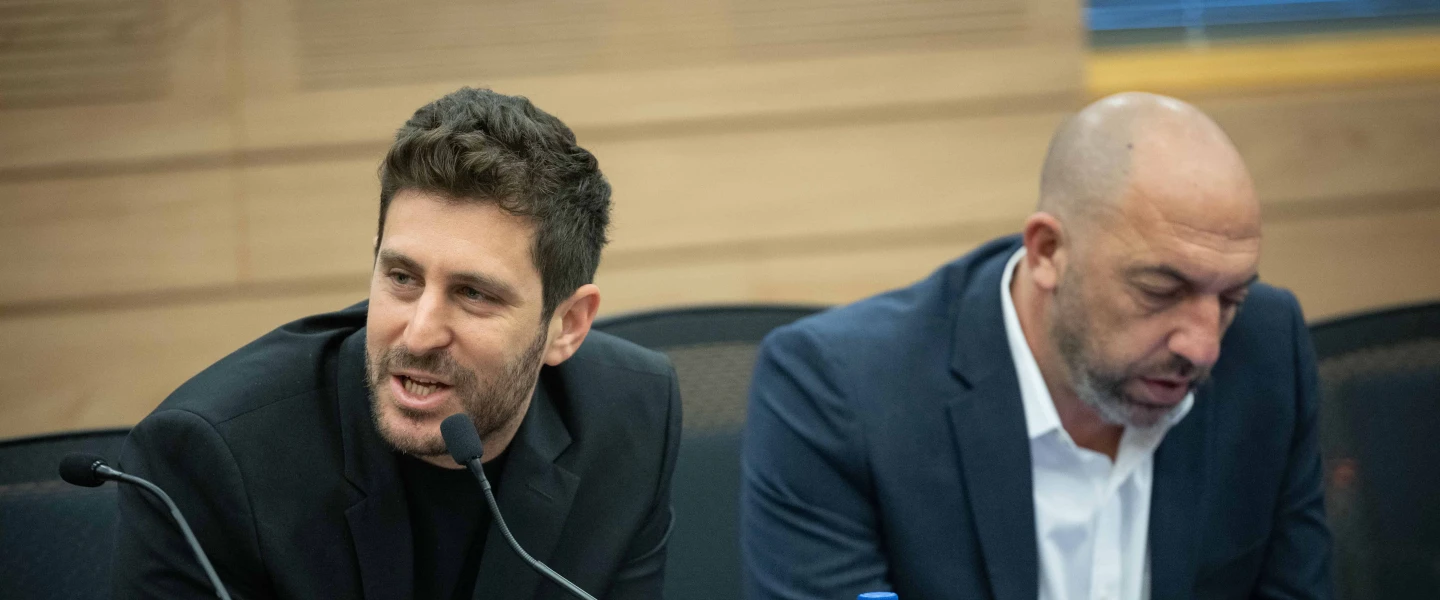
Israel must coordinate with U.S. President Donald Trump on Iran, but should act independently if Washington ultimately decides against a strike, Likud lawmaker Moshe Passal told JNS in an interview at his Knesset office on Wednesday.
“We have no choice. It is as if we had an opportunity to kill Hitler 81 years ago and we didn’t do it. This is the new Nazism that wants to destroy us and we must do everything we can to destroy them first,” he said.
While Israel must carefully choose the appropriate timing, it cannot afford to ignore the threat in the hope that it will resolve itself, he added.
Rising tensions amid nationwide protests in Iran and a brutal regime crackdown have led Washington to weigh in an intervention. Rights groups have reported a death toll possibly as high as 30,000. Tehran has blamed the United States, Israel and European leaders for the nationwide protests that shook the country earlier in January.
In recent weeks, Washington has increased the movement of military assets into the Middle East, expanding both defensive and offensive capabilities.
The Trump administration and Israeli Foreign Minister Gideon Sa’ar also both welcomed the European Union’s designation last week of Iran’s Islamic Revolutionary Guard Corps as a terrorist organization.
“We must act even if it means paying a very heavy price—that is the reason the State of Israel was created. Nobody will take care of it for us. We must be strong. We are strong, and we have shown it in the last Iran war,” said Passal, referring to the 12-day conflict in June.
Passal also stressed the importance of toppling the Iranian regime and exploiting what he described as the widespread opposition to it among the Iranian population. “The most important element in bringing down the regime is arming the Iranians,” he said. “We saw how they were shot at with automatic weapons. Beyond strikes, arming the population is key, and I hope it is part of Israel’s and America’s plans,” he added.
Born in 1989, Passal is serving his first term in the Knesset. He served in the Israel Defense Forces’ Artillery Corps and later in the Budget Division of IDF Ground Forces.
A member of the Knesset’s Economic Affairs Committee, Passal also emphasized the importance of opening Israel’s market to greater competition. Together with Blue and White Party lawmaker Eitan Ginzburg, he co-sponsored the so-called “Uber law,” which seeks to open the ride-hailing industry to additional companies.
“If we want to live in a country with competition, where the cost of living goes down, we need to open the market,” he told JNS. “The main problem is import barriers. There are industries that are cheap, such as the clothing industry, because anyone can import. They don’t need to know regulations as much. Wherever there are importers and competition, it is cheap. Wherever there are regulations and boards deciding, it is expensive,” he said.
Within the political right, Passal said, there remains a leftist approach to economic policy. “Here in Israel, the left and right divisions are more political than economic,” he said, adding that even right-wing coalitions can adopt left-leaning economic positions.
A proponent of Israeli sovereignty over Judea and Samaria and a member of the pro-sovereignty Knesset Land of Israel Caucus, Passal said that those who argue the timing is not right will always find reasons to delay such a move.
“David Ben-Gurion could have said, ‘Why now?’ Even more after Oct. 7, there is no space for another country here, and the sooner we cut off this dream, the better it will be. As long as they [Palestinians] hold on to that hope, it is fueling terror. We must state the truth: A Palestinian state will not be. The de facto Palestinian state is in Jordan,” he said.
“I look at the UAE, where they do not teach children that Jews have horns or that matzah is prepared during Passover with the blood of non-Jews, and I say to myself that perhaps through a lengthy deradicalization process, in 50 or 60 years there may be some form of autonomy for the Palestinians, but no state. Whoever does not hate us and is not involved in terror can live here,” he added.
As chair of the Israel-Argentina Knesset Friendship Committee, Passal recently traveled to Argentina, where he praised Argentine President Javier Milei as a strong admirer of the Jewish people.
“We felt the love of the people there. Milei symbolizes a change in South America, and together with Paraguay, Honduras and Chile—where leadership is also changing—there is a movement of countries joining what I call the countries of light, supporting Israel and standing with us against terror,” he said.
“After what happened in Venezuela, that country too will eventually support Israel. My hope is that one day Brazil will also join this initiative, although that is not the case now, and perhaps Spain as well, which, although located in Europe, is influenced by trends in South America. These changes are very encouraging,” he added.
Although the Knesset is currently unable to advance legislation due to the refusal of Haredi factions to vote, Passal said he continues to focus on what he considers the most urgent issues, including the proliferation of illegal weapons in Israel.
“I organize many confidential discussions to assess how prepared we are. There are between 300,000 and 700,000 illegal weapons in the country that could one day be used not for criminal purposes but for terror. We need to address this. It is already too large a mission for the police alone. The Israel Security Agency [Shin Bet] and the army must act to rid the country of illegal weapons,” he said.
Passal also discussed legislation he is promoting to expand housing benefits for combat soldiers and reservists, which he said he hopes to advance.
In December, Attorney General Gali Baharav-Miara asked Prime Minister Benjamin Netanyahu to dismiss National Security Minister Itamar Ben-Gvir over alleged political interference in police operations. At the time, Passal said that no democratic country allows judges to determine who serves in government in place of the public.
Elaborating, Passal told JNS that the Israeli public is not fully aware of the extent of judicial influence. “It cancels the democratic process. In the end, there is a body that decides what is right and what is not. That should be decided in the house of legislators; otherwise, why do we go to elections?” he said.
Regarding Ben-Gvir, Passal noted that the attorney general had not issued an indictment against the minister but instead simply stated that he should not remain in office. “It’s a problematic statement because it undermines the authority of the executive branch,” he said.
Looking ahead to this year’s election—required by Oct. 27—Passal said that over the past two decades, the Likud Party has consistently favored unity and broad-based governments. “Netanyahu brought in Ehud Barak, Tzipi Livni, Moshe Kahlon and Benny Gantz. It’s right for the public, and it prevents any single entity from holding the power to bring down the government,” he said.
“After Oct. 7, we understand that our differences don’t mean much. When Hamas stormed Kibbutz Be’eri, they called the residents settlers—that’s how they see all of us. After Oct. 7, it is right to bring every Zionist faction in, but we must ensure that those who return do not revive the [Oct. 6] ‘conceptzia,’” he said.
The term conceptzia refers to a preconceived strategic or political assumption that shapes policy, often to a country’s detriment.
“A Palestinian state will not happen. It is not relevant, and we cannot have people in government dragging us in that direction. I would have expected Avigdor Liberman, Yair Lapid and Benny Gantz to join and deliver achievements for their voters,” he added, referring to the leaders of the Yisrael Beiteinu, Yesh Atid and Blue and White party heads, respectively.