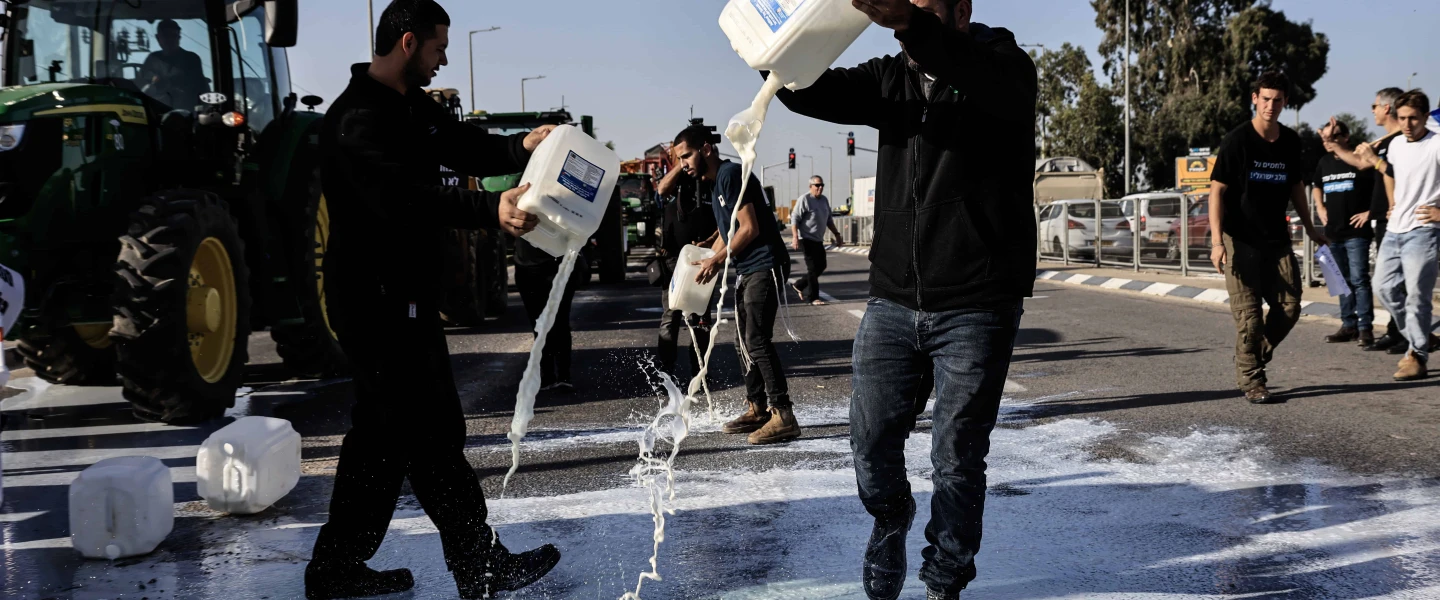
Israel’s dairy crisis exploded into open conflict in early February when farmers halted deliveries, dumped milk on highways and clashed with police in Jerusalem. Supermarket shelves emptied, and major chains imposed purchase limits as the standoff intensified.
The February strike cut roughly 20 percent of Israel’s milk production and cost an estimated 10 million shekels ($2.8 million) per day.
Hundreds of farmers converged on Jerusalem with tractors on Feb. 4, pouring milk onto Highway 1 outside the Finance Ministry before police moved in. Farmers had already resumed deliveries a day earlier after Agriculture Minister Avi Dichter appealed for calm, but protests continued.
At the center of the conflict is Finance Minister Bezalel Smotrich’s plan to dismantle the dairy regulation system that has governed the industry since Israel’s founding. Smotrich argues the system protects monopolies and keeps prices high. Farmers say it ensures food security during wartime.
Reform moves forward
Smotrich’s reform is no longer theoretical. It’s embedded in Israel’s 2026 state budget, which passed its first Knesset reading in late January and must pass by the end of March or the government faces new elections.
The proposed changes would eliminate protective tariffs of up to 40 percent on dairy imports, building on a temporary waiver Smotrich approved in August that was set to expire in February.
The reform would also cut national milk production from 1.5 billion liters to 1 billion liters annually—a one-third reduction—while farmers would see the prices they receive for raw milk drop by 15 percent.
The centralized planning system managed by the Israel Dairy Board would be dismantled, ending quota allocations and price controls that have existed since statehood.
Smotrich argues that three companies—Tnuva, Tara and Strauss—control 85 percent of the market and charge prices more than 50 percent higher than those abroad. Opening the market to imports and reducing domestic production, he says, will bring meaningful relief to consumers.
“Even after the reform, approximately 80 percent of the milk you drink and the cheeses you eat will continue to be produced right here in Israel,” he said as the protests intensified.
The Knesset’s legal adviser recommended separating the dairy reforms from the budget to allow proper debate, but the parliamentary House Committee voted 8-7 to keep them bundled together.
Shortages hit consumers
The February strike brought the policy debate directly to Israeli shoppers. Major chains including Carrefour and Mahsanei Hashuk imposed limits of two to three dairy items per customer as shortages spread.
Though the strike officially lasted two days, distribution bottlenecks meant regulated products like milk, butter and cottage cheese remained scarce even after farmers resumed deliveries.
Israel’s dairy industry operates under tight government control, with the Israel Dairy Board setting production quotas while the government determines both the minimum price farmers receive for raw milk and the maximum retail prices for regulated products.
The system has helped Israel achieve some of the world’s highest per-cow yields, but it struggles with seasonal demand spikes, particularly before holidays when consumption rises and dairy processing plants close for religious observances.
Smotrich and other critics say the regulations insulate major producers from competition and keep prices unnecessarily high. Israel ranks among the most expensive OECD countries, making even small reductions in staple food prices politically significant.
Farmers: Reform threatens food security
For farmers, this fight extends beyond economics. The Israeli Cattle Breeders’ Association says the reform threatens roughly 400 dairy farms, many along Israel’s borders in areas still dealing with fallout from the October 7 war.
“It has nothing to do with food security for Israelis or the challenges during the war period,” said Dagan Yarel, director of the ICBA, in November, criticizing the government’s rationale for the reform. “We proposed alternatives, but these were not even accepted. Instead, the government prefers to harm dairy farmers around Gaza … and reward dairy farmers in Poland.”
Amit Ifrach, secretary-general of the Moshav Movement and chairman of the Israel Farmers Federation, countered by framing the stakes in security terms: “Farmers and dairy farmers are the Iron Dome of the food security of the State of Israel. We will fight for our right to produce food security for the citizens of Israel and for the future of agriculture in the country.”
Farmers who sell their production quotas would receive compensation of 2 million to 3 million shekels, which critics say is insufficient to rebuild agricultural capacity if needed in the future.
Once domestic production drops, they argue, restoring it could prove prohibitively expensive or impossible. The dairy sector employs about 15,000 workers across farming, processing, and distribution.
Lawmakers from agricultural areas in the Negev, Galilee and Jordan Valley have voiced strong opposition to the reforms. Several Likud Knesset members have broken with Smotrich on the issue, creating tensions within the coalition as the budget deadline approaches.
Lab-grown dairy gains ground
The dairy crisis has given precision-fermented dairy products an unexpected boost. These lab-made proteins are molecularly identical to cow milk but contain no animal ingredients, and two Israeli companies have recently launched consumer products that are selling out quickly, particularly during the shortages.
Remilk partnered with Gad Dairies to introduce “New Milk” in cafes in November, expanding to retail in January. ImaginDairy, working with Strauss Group, launched its “CowFree” line of cream cheese and dairy drinks around the same time.
The products carry kosher-pareve certification, meaning they contain neither meat nor dairy under Jewish dietary law and can be consumed with either. For observant consumers, this allows using dairy-like products with meat meals, something traditional dairy prohibits.
Precision-fermented dairy remains a small fraction of the overall market, but the timing of these launches—amid supply disruptions and political uncertainty around traditional dairy—has given these products an opening that might have taken years to achieve otherwise.
What’s next?
The immediate crisis has eased, with farmers back to work and supermarket shelves slowly restocking, but the underlying conflict remains unresolved.
The budget vote, expected by the end of March, will determine whether Smotrich’s reforms become law or whether the government collapses and Israel holds new elections. Even if the reforms pass, implementation could take months, and it remains unclear how quickly the market might adjust or whether the promised price reductions will materialize.
For farmers, the question is whether Israel will maintain domestic dairy production as a strategic policy or allow market forces to reshape an industry that has operated under state planning since 1948.
For consumers, it’s whether opening the market delivers the price relief Smotrich promises—or simply shifts dependence from domestic producers to foreign suppliers, with the risks that brings during regional instability.
The coming weeks will show whether Israel can reform its dairy sector without sacrificing food security and undermining rural economies that have kept the current system in place for more than seven decades.