When Paul Bernstein joined Prizmah: Center for Jewish Day Schools as CEO in May 2016, some feared that non-Orthodox U.S. Jewish education was in crisis.
Prizmah began as what Bernstein calls an “unprecedented experiment” merging five groups: Progressive Association of Reform Day Schools (PARDES), Partnership for Excellence in Jewish Education (PEJE), Jewish Community Day School Network (RAVSAK), Schechter Day School Network and Yeshiva University School Partnership.
Data at the time from a census of U.S. school enrollment by the Avi Chai Foundation, which ceased grant-making on Dec. 31, 2019, suggested that there was growth in Haredi and Chassidic schools and some in Modern Orthodox schools, according to Bernstein.
“But the non-Orthodox day school world was shrinking, and there were people that I remember when we were starting this up who really questioned whether non-Orthodox day schools had a future,” he told JNS. “It was a very difficult time.”
At the time, many parents thought that they had to choose between “good” schools or Jewish day schools. “That was the bifurcation of how people perceived schools to be,” Bernstein said. “So we had a perception, a quality problem or perhaps a perception of a quality problem. Jewish day schools did not have a reputation for being excellent.”
“On top of that, the Avi Chai Foundation, which was the dominant funder of national Jewish education initiatives at the time, was sunsetting,” he said. “What I saw was a complicated merger, a very interesting startup, a shrinking market and an opportunity to make a difference in something that was deep in my heart.”
“That was the passion that drove me to Prizmah,” he said.
A London native, Bernstein spoke at length with JNS recently about his 10 years at Prizmah, his career and his broader thoughts on challenges in Jewish education today.
“What keeps me up at night is the reality that we do not have enough high-quality teachers in our system,” he said. “The teachers we have, we don’t respect and support in the way that they deserve. And if we’re successful and we grow enrollment, that problem only gets bigger.”
When Prizmah created its first strategic plan, it emphasized the three areas of leadership, educational excellence and school advancement, including enrollment and fundraising. Excellence wasn’t about curriculum but areas like Judaic studies and mental health, Bernstein told JNS.
Over time, the nonprofit expanded its areas of data and research.
“The reason we focused on the leadership component was not because we in any way underestimated the importance of teachers,” Bernstein told JNS. “It was a matter of we couldn’t do everything, and if we could influence the strength of leadership, those leaders would ultimately be in a better position to support and nurture teachers in a better way.”
Affordability of schools, particularly in the Orthodox world, where there “is less of that question of ‘will I’ or ‘won’t I,’” was a central question too.
“Another thing, I would say, keeping me up at night is that terrible anecdote that says that Jewish day school is the best form of birth control,” he told JNS. “Addressing excellence and affordability are really the central features, and the biggest driver of excellence, as we know, is teachers and leaders.”
“How we make a massive shift in our approach to teachers in the next decade-plus is central to the success of schools,” he said. “It hits on not just Jewish community issues but societal issues—the lack of respect and support for teachers in society in general.”
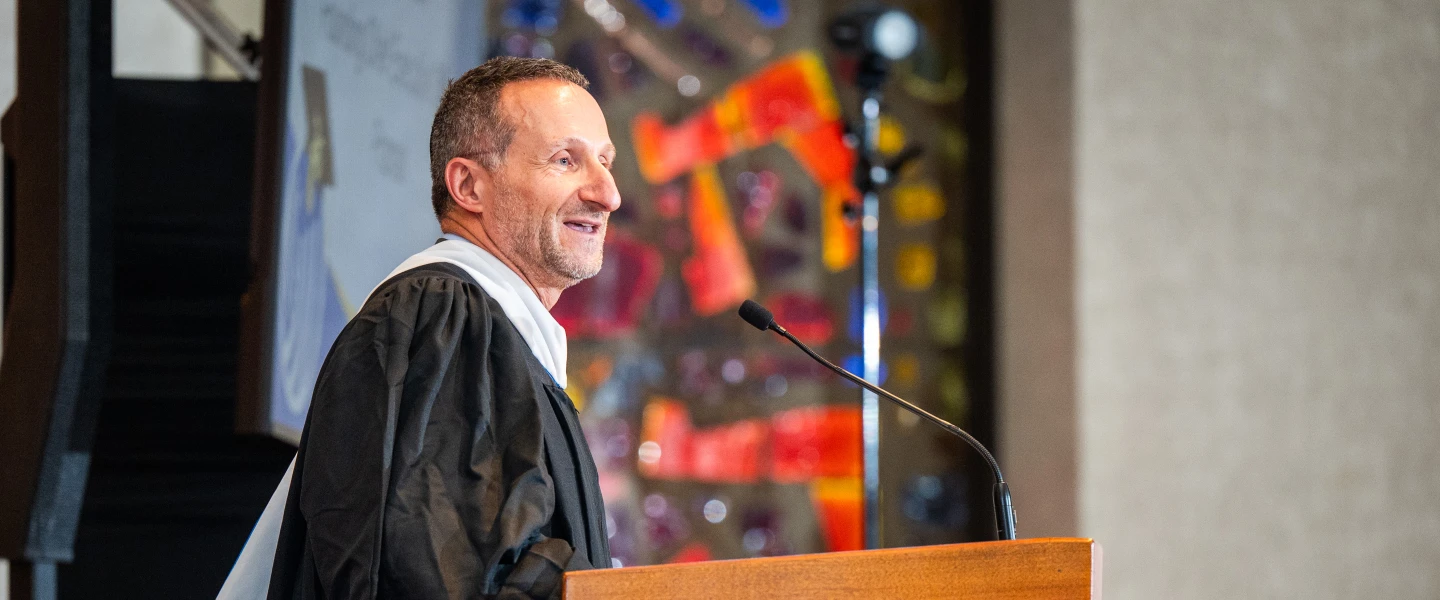
Bernstein had spoken recently at the high school graduation of the Jack M. Barrack Hebrew Academy in Bryn Mawr, Pa.
He spoke about his own teachers growing up. “When I think about the possibilities of what our graduates might go on to do, it’s incredible. They will give back,” he said. “If you’re at the Jack M. Barrack school in Philadelphia, you can joke at them, maybe one of you one day will become a governor, given the governor is both an alum and parent of that school.”
“But if you want to be the ultimate influencer of lives, for all the reasons we’ve been saying, and if you want to be a hero—think about being a teacher,” he told JNS.

‘Always on the agenda’
Before Bernstein met Lisa Capelouto, a consultant who works with Jewish groups, his future wife taught Hebrew at the elementary school in London that he attended as a kid.
“When we met, she knew my teachers, which was a little bit freaky,” he told JNS.
Going up to the Jewish day school was “the formative experience of my life in very profound ways,” he said. “When I met my future wife, there was never a question in our relationship would we send our kids to day schools. It was always on the agenda.”
Their two children went to a “variety of Jewish day schools” where they lived, in Cape Town, South Africa, and then in New York, where they moved 15 years ago.
Bernstein told JNS that he has a “mixed” background, including working in government in the United Kingdom and in new media and telecommunications in the commercial world before transitioning to nonprofits some 20 years ago.
His entry point to nonprofits was as global managing director of ARK, or Absolute Return for Kids, which he called a “sort of collective philanthropy of the hedge fund community coming together in the U.K., very much equivalent to what the Robin Hood Foundation is in New York.”
“In fact, it was modeled on Robin Hood in the early days,” he told JNS. “The entire philosophy, and you can see this in Robin Hood’s materials, is to apply business thinking to nonprofit solutions.”
Bernstein has drawn upon that approach in his work, including by focusing on data to measure the return on investment from philanthropic dollars. “We talk about donors often as investors in Jewish education, Jewish day schools,” he told JNS.
Before coming to Prizmah, Bernstein worked for five years in New York at Pershing Square Holdings, Bill Ackman’s foundation, in areas like social entrepreneurship.
In 2010, then-Newark mayor Cory Booker, now a U.S. senator, announced a large partnership with Mark Zuckerberg to reform Newark schools. Bernstein saw efforts to change and reform an entire educational system. When he heard about Prizmah merging the five groups, he was drawn to the organization.
Jewish day schools, as a student pointed out to him recently, are places where young people spend more time than they do with their family. That “is not to suggest your school has more impact than your family,” he told JNS.
“But if you compare a day school immersive experience to almost anything else—perhaps camps in their short window when you go to camp in the summer have that sort of intensity as well—it just stands out for the impact it can have, because it is so deep and so long in your life,” he said.

Independent islands
American Jewish day schools differ from other schools worldwide in several major ways, according to Bernstein.
Scale is one of the most dramatic differences. “It’s probably true to say there are more day schools and yeshivas in the U.S. than the rest of the world outside Israel put together,” he told JNS.
In the United Kingdom, where there is no separation of church and state, Jewish communities fund Judaic studies at schools, which can be public and whose secular studies the government funds.
That means it costs “dramatically” less to send a child to Jewish day school in the United Kingdom, or almost anywhere else, than it does in the United States, akin to college costs, according to Bernstein.
There is also more diversity among Jewish day schools stateside than overseas, where certain “streams,” often Modern Orthodoxy, represent the dominant structure of synagogues and Jewish organizations, according to Bernstein.
“There is much less of other streams, like Conservative or Reform,” he told JNS. “That’s reflected in the school denominationally, and we have schools that try to blend different hashkafah,” or religious philosophy, “into the way they operate in some form of pluralism. So that diversity is much greater than elsewhere.”
In places with dominant synagogue groups, such as United Synagogue in the UK, there tend to be centralized curricula, which are often Modern Orthodox. “When you have diverse schools, it’s much more independent,” Bernstein told JNS. “The vast majority of schools here are their own little island. They’re independently registered and self-governed. The diversity of learning is dramatic.”
Finally, other countries have more common graduation requirements, like the French baccalaureate, whereas the U.S. educational system is less likely to have that, according to Bernstein.
“The nearest we have to it is ACT or SAT or APs, but not everyone does that,” he said. “In the absence of that, there’s much more diversity in educational approach.”
Wherever one attends a Jewish day school, Bernstein thinks that students learn about things that get “deeply embedded.”
“One of the ways I think about it is, I can remember things I learned from certain teachers. I can’t remember what someone shared with me in a meeting last year,” he told JNS.
He still remembers parts of “Chapters of the Fathers,” a tractate of the Mishnah, that he learned in elementary school. “I can picture the classroom and the rav that was teaching me,” Bernstein told JNS.
His kindergarten teacher was Hazel Goldreich. Prior to moving to the United Kingdom, she and her husband, Arthur Goldreich, owned the farm in South Africa that served as a secret safe house for the African National Congress and was the site where Nelson Mandela was arrested before being imprisoned.
“Here was a teacher who had such a major role in a massive social cause and then chose to be a Jewish day school teacher,” he said. “It’s not that she ever taught me about South Africa, but the values that were driving her were values that I learned from, and when I learned more about her story later in life, it really stuck with me.”
Those values “helped shape some of the other work I’ve done in my life around social causes,” Bernstein told JNS.
The third thing he remembers from day school growing up took place when he was in the third grade, in July 1976.
His teacher, whose name escapes him, walked into the classroom and said, of Operation Entebbe, where all the hostages except Dora Bloch, who was hospitalized in Uganda, were rescued, “You know that incredible thing everyone’s talking about?”
“She walked in that morning and said, ‘Dora Bloch is my aunt,’” Bernstein recalled. “That connection to Jewish peoplehood that comes from knowing you are just that one degree of separation from a profound moment in Jewish history.”
Since Oct. 7, “everyone has had hundreds of tragic stories of their personal connections to what’s been going on,” he said. “As a kid, that really stuck with me.”
Coming together
The underlying idea of Prizmah is that none of the Jewish denominations involved has to embrace the views of the others.
“This is not about pluralism in the sense that we all have to right come together, but we recognize that we have much more in common than divides us, and we are respectful of each other and able to be in the room together,” Bernstein told JNS.
“That was an experiment, and we had no idea, and certainly there were people who were very against it,” he said of a decade ago, when Prizmah began.
“Not surprisingly, it was and for some still is uncomfortable in the Orthodox world,” he said. “We’re open to working with everyone. The reality is that the Haredi world is not going to choose to participate normally in those kinds of environments, but our door is always open to everyone.”
Chabad schools participate sometimes, Bernstein told JNS.
Prizmah has succeeded, and it brings together 305 schools in the United States and Canada, he said. That’s an increase in the number of participating schools in the “high two hundreds” when he started, Bernstein told JNS.
There is “very active” participation, “close to 100%,” although some schools participate more than others, and that too has grown over time, he said.
Prizmah doesn’t tell schools what to do from a religious perspective, but it developed a program specifically for Orthodox women in leadership, for example. “It’s not about trying to tell people how it should be,” Bernstein told JNS. “It’s enabling it for those that can.”
In recent years, he has seen more Modern Orthodox schools elevate women to be heads of school that had never done so before, and Bernstein has seen more women take on leadership roles at Jewish day schools, he said.
One of the sessions that Bernstein held early on in his tenure was about admissions and enrollment. An administrator at a small school in the Midwest told the group about the impact that admitting non-Jewish students to the school was having on its culture.
“That’s a choice they had made, and it was obviously affecting, as they described it, the culture of the school,” he told JNS. “While they were presenting, I was sitting next to an Orthodox school, I think from Florida, and I remember thinking, ‘What are they thinking right now?’ They’re going to be thinking, ‘Why are we here?’”
“Obviously that would be quite an alien question to them,” Bernstein said. “They were next to present. They stood up and said, ‘Our challenge is what does it mean for the hashkafah of our school with the growth and the inflow of families from Latin America into our school?’”
Whether culture or religious philosophy, both were “expressing it differently, but fundamentally, they were dealing with a common question about what do you do when your demographics change,” Bernstein said. “They were able to have a respectful and constructive conversation about what they can learn from each other in that situation.”
“It was a beautiful moment that reminded me of what’s possible when you’re listening in the most positive ways,” he said.
In the beginning, Bernstein would have defined success after 10 years at Prizmah as reversing the trend of Jewish day schools merging and shuttering. “Now we’re focused on growth,” he told JNS.
A focus going forward is on helping parents make the best Jewish early-childhood education choices for their families.
The federal tax credit scholarship program, into which governors must opt, as New York Gov. Kathy Hochul has said that she will, has the “potential to be a game changer,” according to Bernstein.
“The real question on this is, can we mobilize the entire Jewish community and friends of the Jewish community to want to support this program, in which case you are extending funding for Jewish day schools and yeshivas well beyond the people who are currently involved and currently fund a much larger number,” he said. “This could have a massive impact.”
“We are now looking at how to work as a whole community to really maximize the opportunity from the tax credit, in terms of how we structure the scholarship-granting organizations, how we actually work together to get the message out to the wider Jewish community that this actually is an opportunity to support Jewish day schools,” he told JNS.
Hillel Broder, a rabbi and head of school at Berman Hebrew Academy, a Modern Orthodox school in Rockville, Md., told JNS that “Prizmah is an umbrella network of experts, collectives and sub-organizations supporting the work of leadership, teaching and learning in the Jewish day school world.”
“Through its various programs, networks, institutes and conferences, it brings schools together to share practice, learn from one another and grow the field,” he said. “Through its strategic work, it is raising and supporting the most important questions about the present and future of Jewish education, especially around the teacher pipeline and affordability.”
Broder has benefited personally from several Prizmah programs and networks, including the organization’s newly merged Jewish New Teacher Project, its support through interview processes, and, recently, its two-year Day School Leadership Training Institute.
“As a teacher and now school leader, I have benefited greatly from the supportive networks, convenings and public conversations Prizmah continues to offer the greater Jewish day school world—and by extension, the greater Jewish community,” he told JNS.