I must admit that while reading the first several chapters of Living Dangerously: My Struggle to Get Rich Without Losing My Soul (Beverly House Press, June 2025) by Irwin Gabriel Katsof, I didn’t like it or the author at all. I was even sorry that I agreed to review it.
But to say it got better is an understatement. In the end, I loved both the book and the author; there is so much to learn from it. So if, like me, you have no patience with people who only seem to care about status and material wealth, don’t give up. Keep reading. It’s worth it.
Katsof is an ordained rabbi who worked for many years as a fundraiser for Aish HaTorah, a nonprofit Jewish educational institution that has inspired hundreds of thousands of people worldwide, before he decided to get rich. Rather than asking donors for money, he preferred to become a philanthropist himself with the ability to give a million dollars to charity.
He is also a profound believer in the Almighty. His first business “partner” was the saintly Rabbi Yehoshua Zilberman of Jerusalem, at the latter’s initiative. According to the agreement, Katsof would “work physically,” while Zilberman would “pray daily for the success of the deals,” after which Katsof would donate a large amount of money to support Torah learning.
Katsof has an obsessive personality, as he readily admits. When he decides on a path, he goes all the way. He aimed to be among the top one percent of wealthy individuals.
In addition, he “always liked living on the edge”—and he has chutzpah. His adventures with world leaders and countless others among the world’s rich and famous are highly entertaining.
However, his constant obsession with money almost ruined his life; that was his wake-up call to re-examine his priorities: his wife of 42 years, and their children and grandchildren. The way that he completely turned his life around, which he describes with raw honesty, is downright fascinating.

Katsof never did reach the top 1% of wealth, but he is undeniably successful. He is the president of Trademissions.org, which, in cooperation with the U.S. Department of Commerce, organizes trade missions to foreign countries for American alternative asset fund managers to help them seek out new sources of capital and, at the same time, do global good.
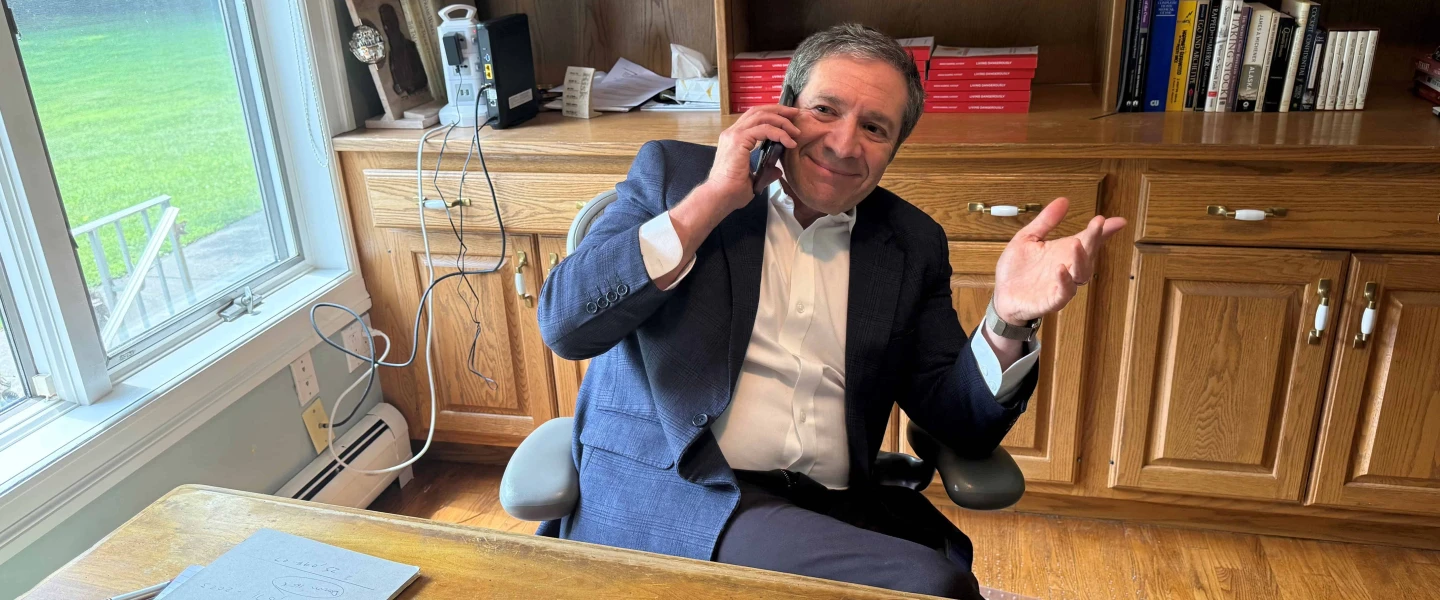
He splits his time between New York and Jerusalem with his wife, Judy. They have eight children and 25 grandchildren. Living Dangerously is his fourth book.
Following is an interview he gave to JNS, slightly edited for clarity.
Q: Reflecting on your decision years ago to leave fundraising, you wrote, “I wasn’t completely satisfied with my share, but I wasn’t greedy. I wanted to give. I wanted to share. I wanted to be a blessing to others—to be blessed with abundance.” In hindsight, do you believe that was completely true?
A: At the time, I believed it was true. That desire to give and to be a blessing, it came from a real place in me. But it wasn’t the whole story. One of the things I’ve learned through writing and through the inner work I’ve done since is that we’re not just driven by one motivation. We’re made up of parts. There was a sincere part of me that truly wanted to serve, to build, to support others. But there were other parts too—parts that craved recognition, that wanted to be seen and loved, that were trying to prove I was worthy. So no, I wasn’t greedy in the material sense. But I was hungry—hungry for meaning, for identity, for approval. And I chased that hunger into business, thinking I’d find the answer there. That’s really what Living Dangerously is about: the shift from being driven unconsciously to choosing consciously. When you recognize that your “noble goals” might be entangled with wounded places inside you, you stop pretending your ambition is pure, and you start asking deeper questions. That’s where real change begins.
Q: Several times, you wrote “I was angry with God” and “If God is my Father in Heaven, then why would He allow this to happen?” It was surprising to read that, considering there is so much intense suffering in the world. That was the kind of question asked by Holocaust survivors and children of survivors. Did you think about that when asking such questions?
A: Yes, absolutely. Those moments of feeling angry with God came from a very raw and real place. And I believe that’s an authentic part of the Jewish spiritual path. I wasn’t questioning God’s existence; I was questioning His presence. There’s a difference. When you cry out in pain and say, “Where are You?”—it’s because deep down, you believe He’s actually there. You just don’t understand His silence. The late Rabbi Jonathan Sacks wrote that faith is not certainty—it’s the courage to live with uncertainty. That resonates with me deeply. The relationship with God is not transactional. It’s not, “I do my part, and You owe me.” It’s far more mysterious and often more painful. I’ve learned that God’s love doesn’t always look like comfort. Sometimes, it looks like challenge. Like disappointment. Like silence. But in hindsight, it’s always a kind of medicine. You may not like the taste, but it heals what you didn’t even know was broken. There were moments in my life, especially in the darkest valleys, when I couldn’t see the good at all. But looking back now, I realize that those were the very moments that forced me to grow. To go deeper. To become more honest. And ultimately, more whole.
Q: On that note, you seemed to believe that if you prayed with all your heart and studied Torah, God would reward you in your quest for wealth. How did you think in such simplistic terms?
A: Yes, I did think that way. Not consciously as a formula, but there was a strong part of me that believed: if I do the spiritual work—prayer, Torah, charity—then God will bless my efforts in kind. It was sincere, but it was also limited. Over time, life taught me that the world doesn’t operate on a straight line between effort and reward. I began to see that success and suffering don’t always reflect divine favor or disfavor. There’s a teaching from the late Rabbi Abraham Isaac Kook that suffering doesn’t negate holiness—it often reveals it. I came to realize that blessings sometimes come dressed in breakdown. Unanswered prayers might be answered in ways we don’t expect. What helped me was understanding that God doesn’t owe us outcomes. He offers us a relationship. And in that relationship, some of the greatest gifts come disguised as loss, delay, or redirection. From a psychological perspective, especially inspired by Jung, I began to see that my desire for wealth was partly about doing good and partly about proving something. It wasn’t evil. It was just human. But it needed to be brought into consciousness so I could stop serving it blindly. Now, I try to pray not to get something, but to connect. I try to work not to achieve status, but to live in alignment. I don’t always succeed. But that’s the journey.
Q: What inspired you to write this book?
A: To be honest, I never set out to write a book. [It] started as my private journal—just pages I wrote over a decade to process my experiences. Ten years later, I reread those pages and felt something stirring. There was pain in them, yes—but also clarity. Wisdom. A roadmap through chaos. And I thought: maybe this could help someone else. I shared it with the editor of my previous book, and she said, “Irwin, this isn’t just a journal. This is a story that needs to be told.” I decided to write the book because I believe we learn best from stories. And not just the polished ones, but the real ones. I wanted to show people the behind-the-scenes of ambition. The struggles no one talks about. The spiritual cost of chasing success—and the surprising redemption that comes when you stop pretending you’ve got it all figured out. There’s a quieter moment in the book that still stays with me. It was Super Bowl Sunday, and I was in Sarasota. My mother-in-law asked if I would visit a man with ALS—Lou Gehrig’s disease—who was nearing the end of his life. He could barely speak, barely move. But he was fully present. He wanted me to know that he was a good man. That visit shook me. Because I realized—this could be me. This could be any of us. Life can change in a moment. And I had been living like I had forever. That encounter helped me realize that life is now. That the time to change isn’t someday—it’s today. That moment planted the seed for this book. And I hope the book plants seeds for others.
Q: I’m curious about Rabbi Zilberman’s partnership? Did he expect you to succeed in becoming mega-wealthy? Do you think he realized what was driving your ambition?
A: That moment with Rabbi Zilberman was unforgettable. I came to him full of passion and told him I wanted to become wealthy so I could support Torah. He looked at me and simply said, “Fine. I’m your partner.” That was it. Looking back, I don’t think he agreed to a business plan. I think he was blessing a journey. He knew I had a sincere desire to do good, but I also think he sensed that I was being driven by more than just generosity. There was hunger in me. And he didn’t try to talk me out of it. He just held the space for me to find out for myself. Years later, a major deal fell through—something I had worked on for months. I remember sitting alone in my office, devastated. I had prayed, given charity, done everything “right.” And yet, it all unraveled. I remember thinking: “What happened to the contract with God? With Rabbi Zilberman?” In that silence, something else arose: the realization that maybe Rabbi Zilberman’s partnership wasn’t about money. Maybe it was about soul. Maybe he saw not just who I was, but who I was capable of becoming. That moment—when everything fell apart—wasn’t the end of the contract. It was the beginning of a deeper one, based not on success, but on surrender. Not on transactions, but on transformation. And I think, in his wisdom, Rabbi Zilberman knew that all along.