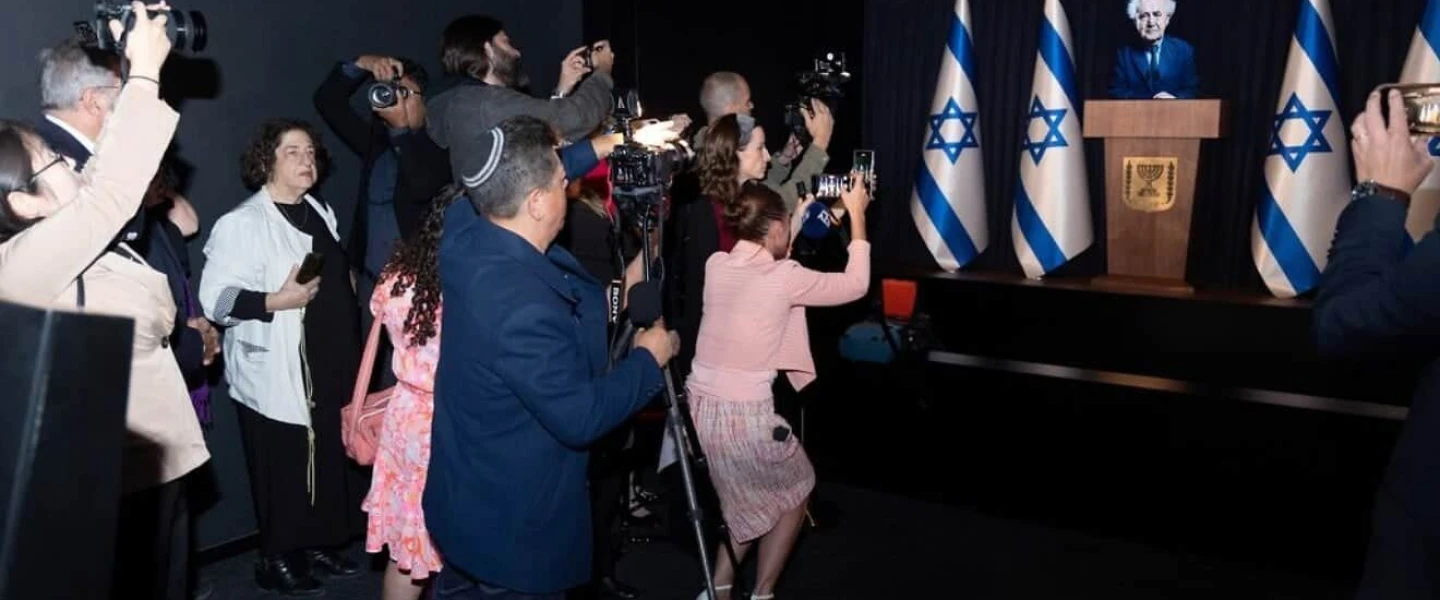
I interviewed the legendary Israeli prime minister, Golda Meir, in downtown Jerusalem today. The fact that she died more than 40 years ago didn’t bother either of us. Much like a regular press conference, I asked her questions and she answered.
“You were the third woman in the world and the first in Israel to head a government. What message do you have for the young female audience?” I asked her.
And she responded, “The fact that I’m a woman has never hindered me in anything. It never caused me embarrassment and never gave me an inferiority complex. It is not really important to decide at a very young age what a person wants to do; it is much more important that you decide on a way in which you want to live.”
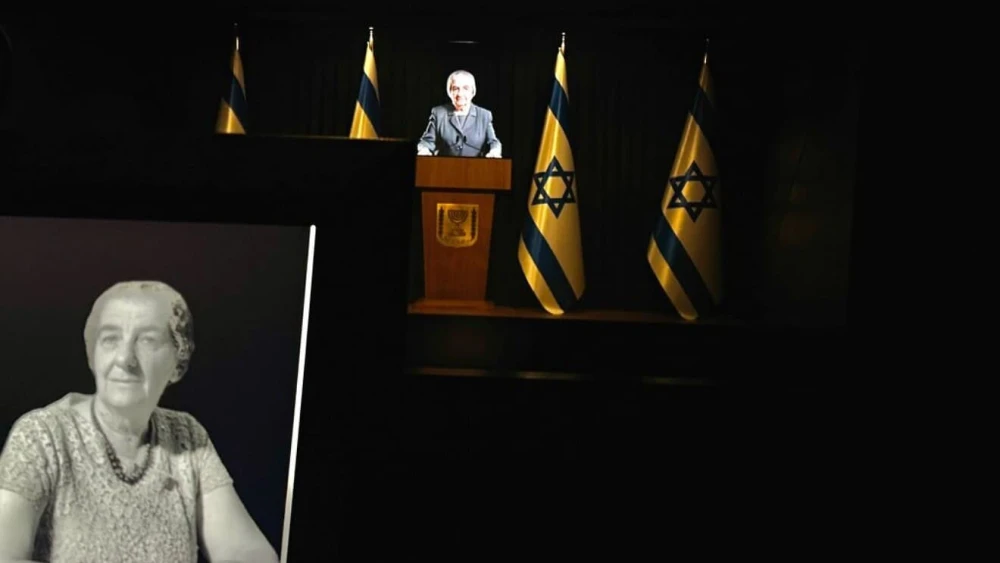
Of course, it wasn’t really Golda but a convincing hologram that took actual quotations from her and used AI to create lifelike images.
The new exhibition, which marks the 10th anniversary of the Friends of Zion Museum (FOZ) in downtown Jerusalem, has high-quality holograms of most of the 14 prime ministers who have led Israel from the establishment of the state in 1948, beginning with David Ben-Gurion and ending with Benjamin Netanyahu.
The prime ministers deliver official statements and respond to questions from the audience using their original recorded voices. “This extraordinary interactive installation offers a one-of-a-kind experience that has never before been presented in Israel,” the museum said in a press release.
“The biggest obstacle of museums is to speak in a language that will also be interesting for the younger generation,” the CEO of the Friends of Zion Museum Daniel Voiczek, told JNS. “Here, it looks real and they are excited and it is something that speaks to them.”
The exhibition, which opened on Wednesday, is set up like a press conference with the holograms of the prime ministers standing behind a podium. The holograms are remarkably lifelike, and each opens with a famous quotation.
“In Israel, to be realistic, you must believe in miracles,” Ben-Gurion’s hologram states.
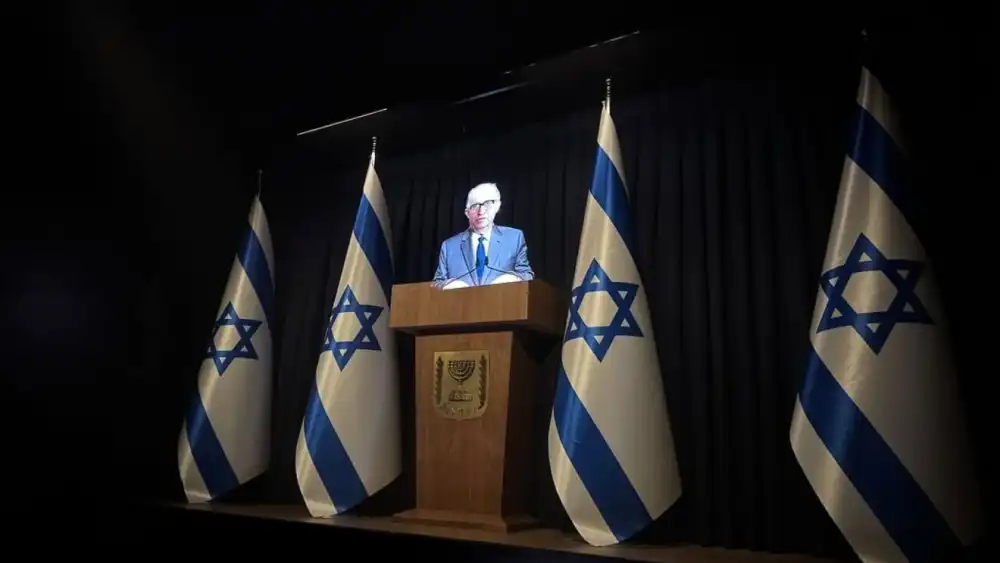
Then there is Menachem Begin, who speaks in his Polish-accented English, with a quote from his Nobel Peace Prize acceptance ceremony, along with Egyptian President Anwar Sadat, in 1978.
“Peace is the beauty of life,” he says. “It is sunshine. It is the smile of a child, the love of a mother, the joy of a brother, the togetherness of a family. It is the advancement of man, the victory of a just cause, the triumph of truth.”
The hologram of Yitzhak Rabin, who won the Nobel Peace Prize along with Shimon Peres and Yasser Arafat in 1994 and was assassinated 11 years later by Yigal Amir, who wanted to stop a peace agreement with the Palestinians, says in his trademark gravelly voice, “You don’t make peace with friends; you make it with very unsavory enemies.”

Interviewing the prime minister
Visitors can also ask individual prime ministers scripted questions, which the holograms then answer. Here, for example, is a question for Netanyahu and his answer.
“Mr. Prime Minister, how would you describe your relationship with U.S. President Donald Trump?”
“President Trump is the greatest friend that Israel has ever had in the White House,” Netanyahu answers. “He cuts to the chase. He sees things others refuse to see and says things that others refuse to say. He recognized Jerusalem as Israel’s capital, moved the American Embassy there, and recognized Israel’s sovereignty over the Golan Heights. He brokered the groundbreaking Abraham Accords in which Israel made peace with four Arab states, he helped bring our hostages home, confronted antisemitism and renewed maximum pressure against Iran. With his leadership and our partnership, I believe we will forge a brilliant future for our region and bring our great alliance to even greater heights.”
Voiczek said that over the past 10 years, more than 500,000 people have visited the museum, about half of them tourists and half Israelis, including many school groups and soldiers. He says that many tourists and even some Israelis are not familiar with all of Israel’s Prime Ministers.
The interactive exhibits throughout the Friends of Zion Museum highlight non-Jewish supporters of Zionism and the establishment of Israel. In its words, it is “an immersive historical center that introduces visitors to the heroes and stories of non-Jewish supporters who devoted themselves to assisting in the establishment of the State of Israel.”
While most of the exhibits in the museum are offered in 16 different languages, the new exhibition on the prime ministers has just Hebrew and English, because of the AI challenges, according to FOZ. The exhibition is open during regular museum hours and entry is free.