It is painful to write about my friend Richard Stanger in the past tense. Unfortunately, he completed his God-given mission on earth and left us suddenly after Tisha B’Av this year.
I regret that I didn’t review his book in print while he was still alive. Richard, if this review makes its way to the heavenly throne and you are reading this there, please accept my apology.
Stanger didn’t leave us without leaving behind a valuable piece of work that he had been laboring over for years. A Path to Jewish Survival (Bennett Press, 2024), which he began writing before he made aliyah from New York during the COVID-19 epidemic, is indeed something to hold onto—and perhaps, its declared objective is one thing that actually has the power to change this crazy world in which we find ourselves.
A Path to Jewish Survival’s stated purpose is “to convince Jews of all persuasions everywhere to reconsider how they perceive other Jews and inspire them to change their approach. The book presents a novel framework for thinking about the different streams of Judaism and proposes a way for members of each stream to consider ‘the other’ in positive terms.”
Stanger wrote that, even those who observe all the laws of Torah will not usher in the Messianic age without avoiding sinat chinam (baseless hate). Of course, in this day and age of instant communication and the tendency to jump to immediate judgment, this is not an easy task. How do you even discuss and encourage the concept of Messiah with Jews whose religious stream denies that concept?

Stanger’s personal journey took him through many different streams of Judaism.
He personally embraced, at different times of his life, Reform, Conservative and Modern Orthodox, before he found himself a happy life with his wonderful wife Jane, living in Jerusalem and learning Torah every day for hours on end.
He was known in America as “the man who invented the 401K,” an innovative lawyer and later in life, a business consultant. His approach to bringing the Messiah by abolishing hatred of other Jews is as methodical as his approach was to the tax code—systematic and logical.
In his brilliant and humble way, he asks all Jews from all streams, as well as the secular and unaffiliated to consider one another in positive terms. Breaking down Orthodox, Conservative, Reform, Reconstructionist and Sephardic Jews in Part One of his book, Stanger writes, without judgment, from the perspective of people within each group.
The book presents a comprehensive viewpoint of the practices, belief system, history and rationale behind each style of Judaism. Without attempting to convince you that one stream is right and others are wrong, it educates and informs.
In Part Two of the book, Stanger gives a “Framework for Achdut” (unity), discussing some of the challenges to each stream of Judaism and making suggestions for overall Jewish continuity in every manner of being Jewish.
Part Three—"Thinking Differently"—challenges each stream to change their perspective of “the other” and applauds the strengths and lessons to be gleaned from each.
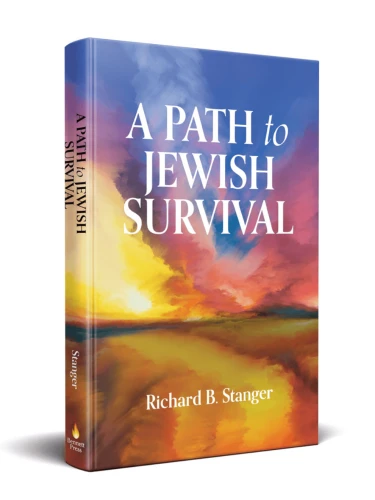
Part Four is a “Call to Action.” Speaking to each Jew individually, Richard calls on them to act now, because, as he points out in his introduction, “History has shown that if we don’t change, we will all suffer. As long as we continue our current (divisive) behavior, we are at severe risk of being driven from the Land of Israel and facing increased persecution in the diaspora.”
This well-researched, carefully footnoted book is full of explanations for those who may not be familiar with other practices of Judaism. Richard brings the Jewish world closer and there is something for everyone of every stream to learn about the other. He points out that no matter what his readers believe in, the baseless hatred within the people of Israel has put Jewish survival at risk, not just in Israel, but all over the world. And his call—now sadly posthumously, is for everyone—from every stream of Judaism to grown and change.
A Path to Jewish Survival is available online on Amazon and at Jerusalem’s Pomeranz bookstore. It’s the perfect pre-Rosh Hashanah read for people from every stream of Jewish life. Richard Stanger was a beautiful soul and his words may well be prophetic. May his spirit live on and ignite the flame of Jewish continuity forever.