


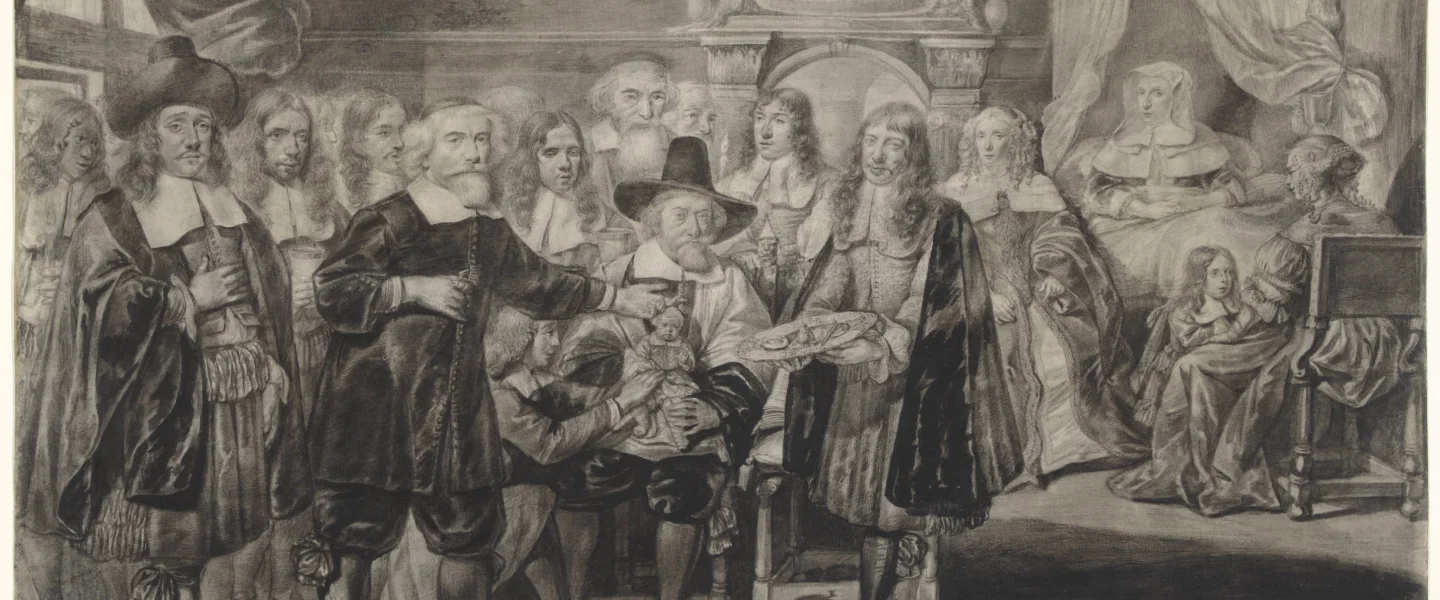
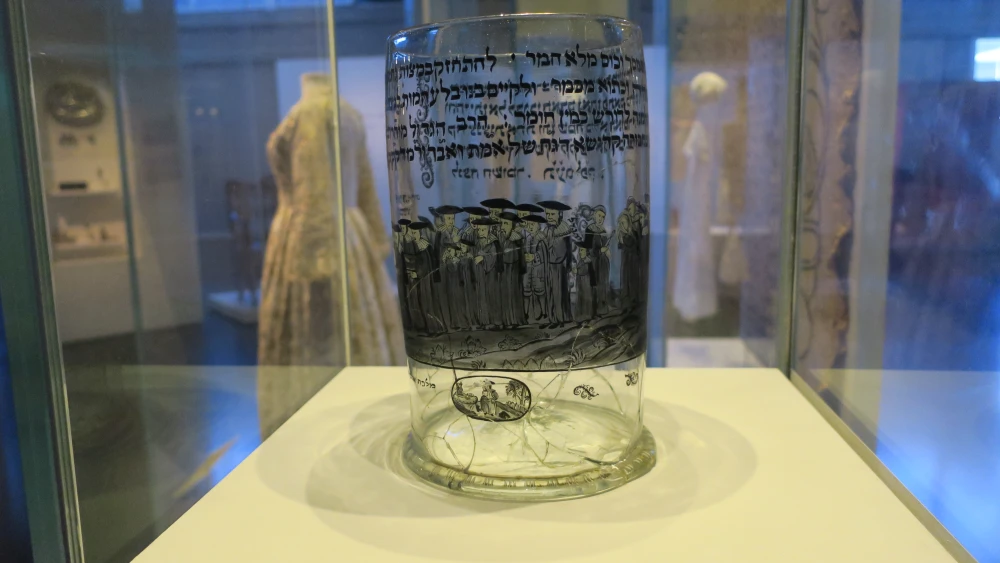
A 1786-87 glass tumbler associated with the Prague burial society offers a very different view to the drinker and those seeing the beaker from the outside. Clad in long black coats with white pleated collars and flat black hats, male members of the society can be seen on the outside. Those who hold the tumbler see a very different illustration—10 women with black-and-white dresses and white headcoverings.
The glass “illustrates the argument of this book,” Debra Kaplan, chair of German Jewish history at Bar-Ilan University, and Elisheva Carlebach, professor of Jewish history, culture and society at Columbia University, write in their new volume A Woman Is Responsible for Everything: Jewish Women in Early Modern Europe.
“Women’s work in the hevrah, and by extension in the community at large, was an integral part of the life in the kehillah,” they write, of the burial society and the Jewish community respectively. “When facing outward, the tumbler shows only the men in the hevrah. The women remain hidden unless one seeks them out.”
The proliferation of published material, which became cheaper with the printing press, and the emergence of formal Jewish communities, often ghettos, in Europe in the early modern period, from around 1500 to 1800, led to more records of women, and although those traces tend to be bare compared to those recording men, much may be gleaned from them about the everyday lives of Jewish women, the duo writes.
In a recent video interview with JNS from New York and Israel, respectively, Carlebach and Kaplan told JNS that, like many scholars, they studied archival materials in broader ways than just the intentions of those who created the records.
“Reading against the grain is something historians often do when they take a source that’s written for one purpose and read it for a different purpose to extract different information than what the authors intended,” Kaplan told JNS. “In our case, we were able to read certain sources against the grain to extract women’s voices or women’s experiences.”
The book, which Princeton University Press published in October, addresses a wide range of experiences of Jewish women, from wives of rabbis and communal leaders to those who sewed shrouds for burial societies to criminals and adulterers. Women show up in records that the scholars study when they write or translate books and when they lead both successful and failing business ventures. When they sue others or face allegations as defendants and when they acquire property in marriage, or when their husbands and fathers fight over their belongings after they die.
There are witches and a woman, Kresle bat David, whom the Altona, Germany, community (kahal) found guilty of “provoking her husband’s violence” in 1693. “First, Kresle insolently challenged a decision of the kahal by raising her voice and interrupting the prayers in the synagogue,” the scholars write. “The kahal accused her of ‘causing her husband to lie in wait when people were exiting the synagogue, and he stabbed ... lay leader R. Moshe ... with a knife.’”
“As punishment for the public insult to the authority of the kahal and for causing her husband to commit violence against one of its members, Kresle would be relegated forever to a distant bench in the back of the synagogue,” per the book.
In Prague, the scholars write, the men’s burial society grew “increasingly perturbed” by what it saw as the women’s burial society’s “growing autonomy.” In 1692, the men said there was “disorder” in the latter, and by 1739 or 1740, the men took over the women’s society in the city.
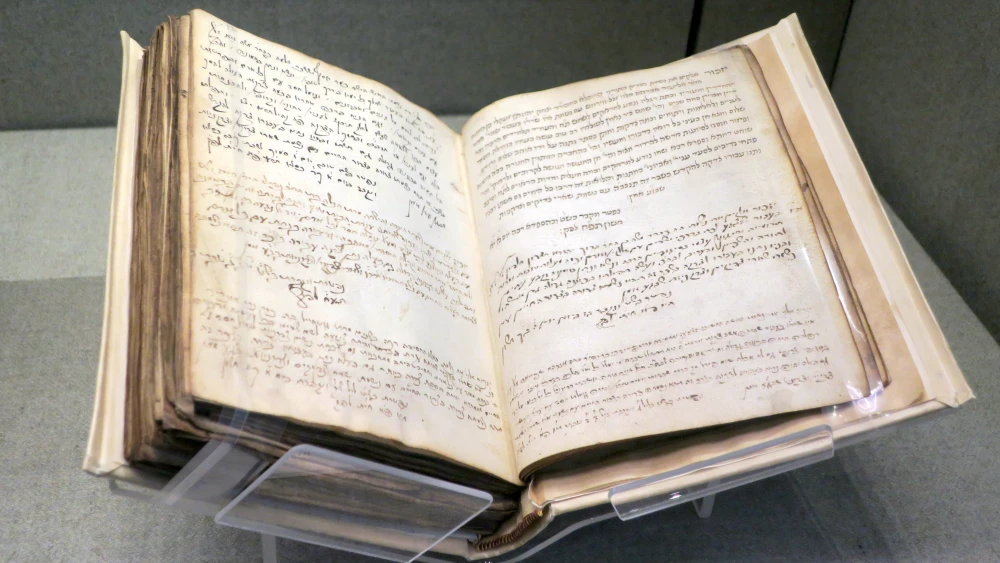
At issue, according to the book, were glasses and linen fabrics that the women sold. “Showing industry and entrepreneurial spirit, the women began to stock extra shrouds to be used in the event of need,” they write. “Extras could be sold, and the proceeds could further the charitable aims of the society.”
But the men thought that the women weren’t sufficiently discerning about whom they appointed to the society, “the debased alongside the dignified.”
The men’s burial society seized the extra shrouds and barred the women from selling them in the future, per the book.
“They’re trying to replace the slate of the female leaders, and they’re unhappy with the women, and they say, ‘They collect too much charity, and they stand all day asking for money, and they’re so successful,’” Kaplan told JNS. “So we read that as how entrepreneurial and successful the women were, so much so that they attracted the ire of the men.”
The scholars, when reading a rabbinic responsum about Jewish law, perhaps related to women’s menstrual status, are “reading not to understand the Jewish legal perspective but to really think about what’s going on with women and their bodies, or whatever other issue is being addressed in the responsum,” Kaplan said.
Ironically, the scholars record in the book, when the Prague men’s burial society struggled with “an undeniably immense and difficult task” 12 years after its gripe with the women’s burial society, it used the phrase from Genesis of appointing a “helpmate, to lighten his accounting burden” when, in January 1752, it named R. Moshe Weibler to assist R. Yissakhar Maldstein.
In so doing, the scholars write, it was “ironically using the biblical phrase referring to Eve as Adam’s partner despite the fact that the men retained sole control over the finances.”
Around the same time, in 1745, in Berlin, there are records of a formal women’s burial society, for which women, or gabbetes, kept the books and administered finances. The women worked with the men, who often paid for their labor.
“The constant coordination between the men and women was undoubtedly facilitated by the familial relations between them,” the scholars write, noting that gabbetes were wives and widows of communal leaders.
One, Sarah, was married to the head of the men’s burial society, and another, Gela, was married to the head of the men’s society that administered to the sick, according to the book. “That society’s elites were the leaders and members of both the men’s and women’s hevrot is a reminder of the great dignity that was associated with caring for the sick and the dead in Jewish communities,” the scholars write.
The period and geographic span that the scholars study vary widely. Unlike in Prague, where there was gendered professional jealousy, in 18th century Amsterdam, the scholars record, communal leaders added the work of women sewing shrouds—which became too costly—to the list of things to which those called up to the Torah could donate weekly, “thereby actively encouraging and supporting the women’s work in a public communal forum.”
‘Against the grain’
When Carlebach speaks to Jewish groups, often women’s groups, she asks them if they have records of what might be a monthly lecture series that has run for decades.
“Do you keep a list of who came and who lectured?” she asks the groups. “It doesn’t even occur to them.”
At a lecture in Queens, N.Y., which was the last of a monthly, 20-year series, she saw posters pasted on the walls of various prominent women who had lectured in the program.
“I said, ‘I assume you have a collection like this somewhere in the synagogue’s archive, right?’” Carlebach said. “She said, ‘Oh, no. I’m using it as wallpaper for our last session, and I was going to throw it out.’”
“I said, ‘No. Didn’t you learn anything from what we taught you?’” she said. “This in itself is just a small example of something that I had read once in a New York Times review. It isn’t the victors who win history. It’s the writers. It’s the people who keep the records. Those are the ones who have immortality in history, and unfortunately, women’s voices have been so long discounted.”
The two are pushing against the grain both in the “common assumptions in the Jewish world that there’s nothing there to write about or discover about the way women experienced life in the community so long ago,” and also “even professional historians like our own mentors, who told us, ‘There’s no material.’ ‘It can’t be done.’ ‘There’s nothing there,’” Carlebach said. “We are pushing against that larger grain as well.”

‘Expected to be included’
A wide range of women’s voices and experiences—often anonymously—emerge in the book. JNS asked the scholars what they thought the women would make of having their stories told centuries later.
“There were women who wrote to have their voices preserved for posterity. We had a woman by the name of Bella Perlhefter, who wrote with her husband. She was the author of the introduction and several sections that are clearly hers. A 1,000-page Yiddish encyclopedia of Jewish thought that she intended to have published,” Carlebach said.
“We have the title page, which looks like a printed title page, almost. In her lifetime, it was copied several times. It was clear that she wanted it to be as well-known as possible as a memorial for her children who passed away. There’s a woman who wanted her voice to be preserved,” she said. “She writes about herself as a writer, and people who mock women writers, and they don’t know how to put a sentence together.”
“This is in the 17th century. It’s mind-blowing,” Carlebach told JNS. “We have women who wrote wills—more like ethical wills, and actually say, ‘This will should be preserved in my family and read every year on my yahrzeit.’ So they wanted their voices and their lives to be preserved.” (Rebecca, daughter of Abraham Halfon, of Manheim, whose will was preserved in March 1720, was one such woman.)
The book discusses Devorah Traub, who was executed by sword in the public Hamburg square on Feb. 4, 1793, for poisoning and killing her sister and mother-in-law. The Jewish community secured permission from the judge to not only visit Traub in her cell and study Torah with her, go through the viduy confession with her and to purify her—something generally done after death—but also to later exhume her body and move it to a Jewish cemetery.
The latter took place in the place where “Jews deemed dishonorable or marginal by the community were buried,” the scholars write.
“We believe that she was mad and could have probably pleaded insanity had she lived even a short time later,” Carlebach told JNS. At the time, there was no treatment for the woman’s mental illness.
“Although she may not have wanted to be remembered for it, we are trying to show that the people in the community cared about her and took care of her even after her death,” she said. “They unearthed her body from the place of execution in the middle of the night” and gave her a Jewish burial, “because they believed that she wasn’t an evil person but rather mentally unable to make good judgments.”
Illiterate women also appear in the sources that the scholars studied, Kaplan told JNS.
“I think part of what facilitated us writing this book was the fact that we’re in an age of recordkeeping, and the early modern period was so much about documenting and writing,” she said.
The scholars found a logbook from an Amsterdam charitable society for orphan girls, meaning, at the time, those who lost their fathers.
“Sometimes when the terms of an agreement were reached between the confraternity and the family, the girl or the mother would sign,” Kaplan said. “You can see sometimes in the signature a woman, who really probably only knew how to write her name, but in some instances a woman, who didn’t even know how to write her name and has a little circle. The scribe writes, ‘This was where she signed,’ because she didn’t know how to write her name.”
“Even women who were illiterate expected to be included in communal records, which is not the same as our book, but I think we’re thinking very much about being included,” she said.
There were also, of course, literate women who didn’t pen books. “You have women keeping their own personal logbooks of what’s going on in their households,” Kaplan said. “We found a court case where a woman—they weren’t sure if a maid servant was owed money, so they looked at the woman’s book to see if she had paid the salary, was she up to date on her payments.”
“It was expected that people would keep records, appear in records,” Kaplan added. “So I think they would have rather liked it.”
‘Exciting finds’
Given the wealth of detail in the 450-page book, JNS asked Kaplan and Carlebach if there were things that surprised them in the course of their research.
“I don’t know if I want to say ‘surprises.’ There were surprises. There were treasures. There were so many exciting finds that it’s really hard to capture that, and it’s not just in terms of let’s say a category, but just a story, a person’s life that we could not have imagined, a voice we couldn’t have imagined capturing,” Kaplan said.
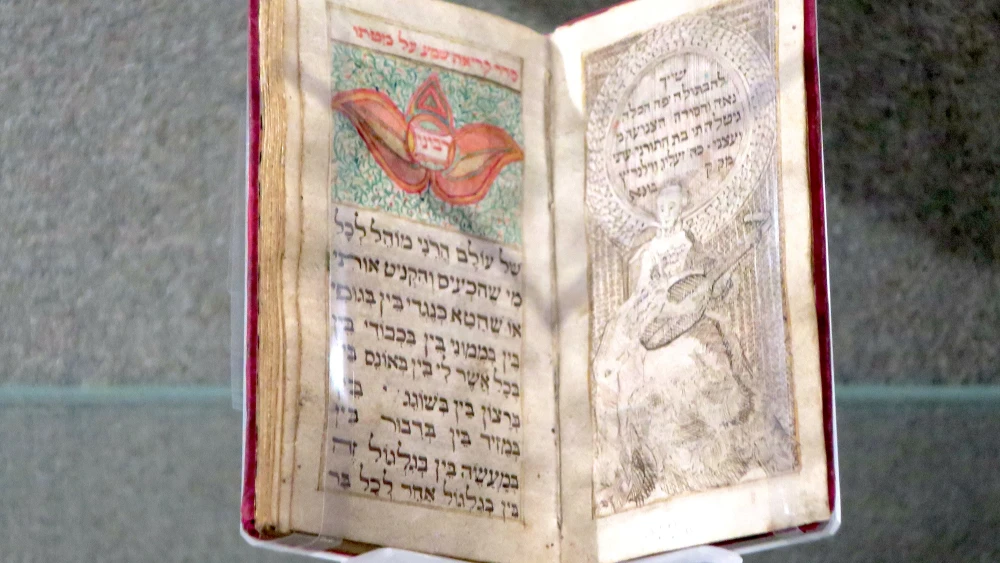
“A love letter or the voice of an abused wife, which we found in a rabbinic responsum,” she said. “I think some of the images that we found were unbelievable. We didn’t expect to find—or at least I didn’t expect to find as many images as we did, and that was exciting.”
The scholars knew about communal ovens, but when they found pots with women’s names on them, that was “really exciting,” she added.
Carlebach told JNS that she learned about something that was instituted in the days of Rabbeinu Tam, the rabbi Jacob ben Meir, who lived from 1100-1171, and was “very much practiced in our own period” in the book.
The “years of return,” or shenot ha’chazarah, “which I had never heard of before doing this research,” was a rabbinic decree, takanah, “that if a woman died in the first and possibly second year of marriage, which was very very common in those days for women to die in childbirth after giving birth to the first child,” Carlebach said. “What happened is that women get married and carry a dowry with them and many different objects of value into their marriage, and very often that represents a very significant portion of a family’s wealth.”
If the woman dies very soon after getting married, “is it fair for the husband to inherit that wealth when they were barely married?” Carlebach posed. “Rabbeinu Tam institutes this takanah, and they write this in advance” as a condition going into a marriage, “that if the woman dies in the first and in some regions also the second year, they have to give back a certain percentage.”
“The woman’s family gets back many of her possessions, and what we had found was an actual inventory in a case of a dispute between a father of a woman, who died, and the husband of the woman,” she said. “Interestingly, she is never named in the case. It’s only the two men, but her presence is there, and they list every single item—the little salt shakers that she brought into the home.”
“It’s an inventory of every item of value,” she added. “The furniture, the clothing that she had that she came into her marriage with, what her father expected to come back into the family coffers, so to speak, and what her husband claimed he had given her either as a gift and so forth.”
That inventory gave the scholars both a sense of the Jewish legal practice (halachah) that “was very widespread in early modern Europe that I don’t think most people know about today,” Carlebach told JNS. “It also gave us a glimpse into this life.”
‘We wrote it together’
Carlebach told JNS that she and Kaplan are pleased that readers seem to be learning so many new things from their book, “including people who say, ‘We never knew that it was possible to know so much about the lives of women in particular from such a period, a long time ago.’”
“Practically every paragraph and footnote could become a book on its own. There’s so much material in the kinds of sources that we looked at—community-produced sources, of all different types,” she said. “There’s just an abundance here, and we’re hoping that this book will really open a gateway for a flood of new work on the lives of people, who we didn’t know about in the Jewish past.”
The scholars, who met during Kaplan’s postdoctoral fellowship during 2004-05 at Queens College, where Carlebach was a professor, had been kicking around the idea of the book for more than 20 years. They decided to take the plunge before the pandemic, and found themselves talking much more frequently.
At Queens College, “we decided to do a course on the history of Jewish women in the medieval and early modern period,” Carlebach told JNS. “That really planted the seed for this project, because we realized that there was so little material from primary sources available to distribute to our students. There really was no adequate textbook.”
The two had to “pretty much invent everything from scratch from our own files, and that really became the roots of the project,” she said. “Over many years, as we both worked in archives in Israel, Europe and the United States on parallel, different projects, each one of us had our own scholarly trajectory, but we would overlap.”
“Eventually, we just said we have to put this all together and do something to put this material before a public that’s really curious and interested,” Carlebach said. “We worked through the pandemic. We worked through a war. We worked through personal crises on both sides, and we worked across an ocean.”
“This is a book that had a very strong idea in both of our minds, and we were both tremendously motivated once we got started, because otherwise there’s no way it could have come to fruition,” she said.
Kaplan told JNS that the two wrote the whole book together.
“We read the sources together, whether in libraries or on the phone or imagine in the pandemic using digitized sources and then reading them together,” she said. “We wrote it together, so there’s not a chapter that one of us wrote, but we really wrote it together, sent it back and forth.”
“I don’t know that we could pick out sentences that one of us wrote,” she said. “It was really a team effort.”
Carlebach told JNS it was the first time that she ever had a coauthor on a book, and it was “absolute mutual respect,” and there was “always a sense of joy and enthusiasm when either of us came up with a new reading idea.”
“The synergy is amazing,” Kaplan told JNS. “I don’t feel I could have written such a book without Elisheva. Our skills came together.”
“They say in Hebrew, tovim ha’shnayim min ha’echad, two are better than one,” she added. “This is that experience. It was just so wonderful when we would exclaim about a treasure we had found to be able to share it with somebody and just be thrilled.


