Newsletter
Newsletter Support JNS

First-ever delegation from Azerbaijan visits Israel during US embassy opening

Azerbaijan is a major customer for Israeli weapons, having purchased nearly $5 billion in arms, including radar systems and drones, which it uses in a protracted war with Armenia over control of territory.

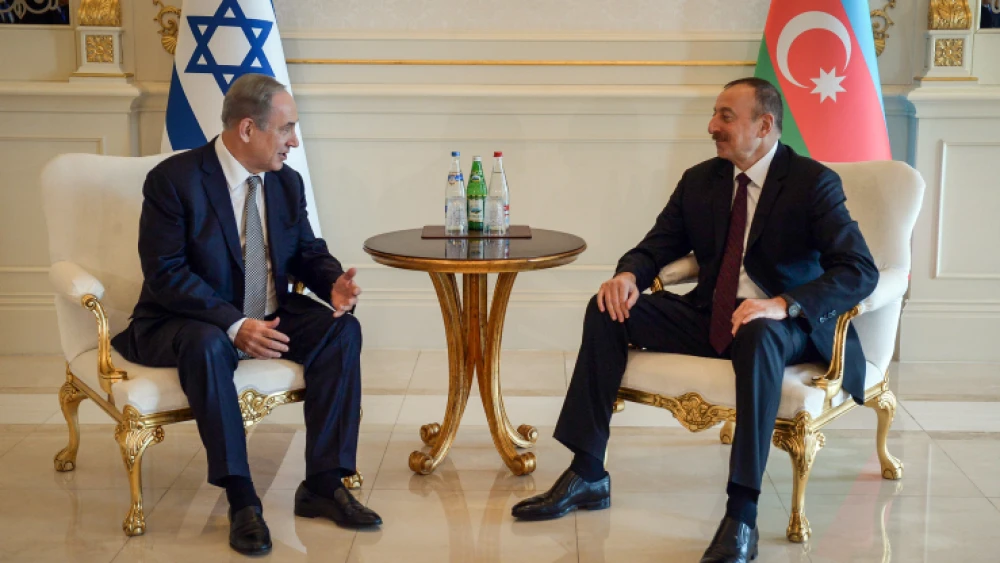
Israeli Prime Minister Benjamin Netanyahu meets with the Azerbaijan President Ilham Heydar Oghlu Aliyev in Baku on Dec. 13, 2016. Photo by Haim Zach/GPO.

On May 14, as the United States was inaugurating its new embassy in Jerusalem, senior officials from Azerbaijan visited Israel for a first-ever meeting meant to strengthen economic ties between Israel the two countries.

An Azeri delegation headed by the Azeri tax minister stayed for three days, meeting with Minister of Jerusalem Affairs and Minister of Environmental Protection Zeev Elkin on ways to promote economic, commercial and business ties.

Israeli Prime Minister Benjamin Netanyahu visited the country in December 2016 to strengthen relations between the countries.

Azerbaijan is a major customer for Israeli weapons, having purchased nearly $5 billion in arms from the Jewish state, including radar systems and drones, which it uses in a protracted war with Armenia over control of territory.

Reports also suggest that Israel uses Azer territory to surveil neighboring Iran. The Kuwaiti paper Al-Jarida quoted an Israeli source as saying that the massive cache of Iranian documents Netanyahu recently displayed in a televised presentation on the nuclear threat of Iran were smuggled by Mossad agents to Israel through Azerbaijan.

Azerbaijan provides Israel with energy, and receives high-tech, medical and agricultural supplies from Israel.

Though the country is 97 percent Muslim, it is home to approximately 12,000 Jews and to several Jewish schools, a Chabad center and a kosher restaurant in Baku, the nation’s capital and commercial hub.

The convoys will travel toward Prison 10 near Kfar Yona, where some yeshivah students are being held.
“I have Iran on the ‘ropes,’ ready to go down for the fall,” said the U.S. president.
Experts at JNS Summit examine claims of institutional bias against Israel at the United Nations.

The former IDF chief and defense minister told JNS that the Jewish state must remain strong against Iran and its proxies while building domestic consensus and new regional alliances.
“I didn’t serve this country to watch it get sold out by a career politician, who would rather protect his party than his constituents,” Cait Conley stated.
“I have to get even more involved because, apparently, the progressive movement is taking such a deep root in New York City, we have no choice,” Sid Winston, of Brooklyn, told JNS.
Benny Gantz, JNS editor-in-chief Jonathan S. Tobin, Gilad Erdan, Mosab Hassan Yousef, Nissim Black and leading voices in security, diplomacy, media, law and Jewish communal affairs headline the summit’s third day in Jerusalem.