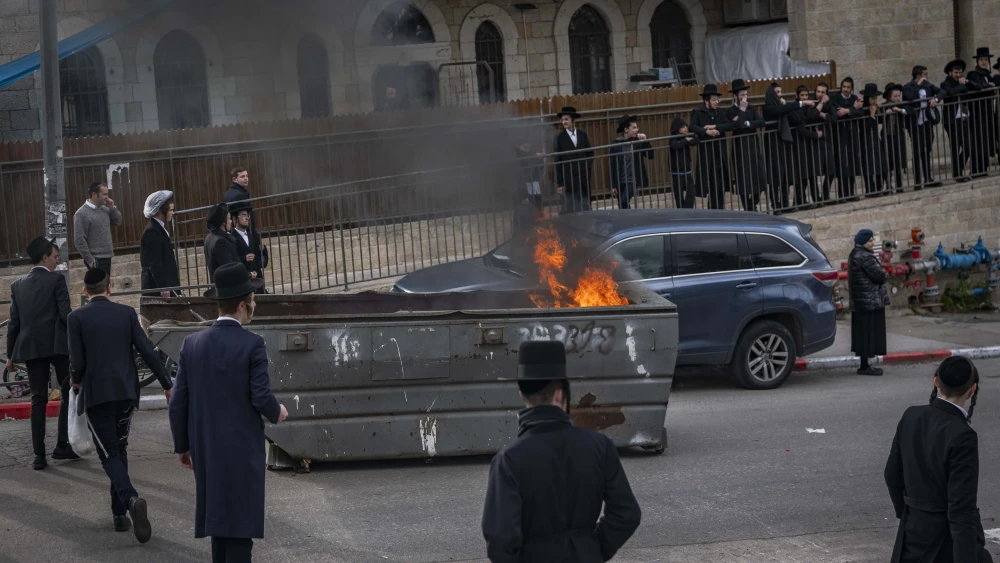
A Haredi protester was moderately injured on Tuesday after being struck by a car during a Jerusalem demonstration against autopsies on infants who had died under unclear circumstances at a daycare center the previous day.
The Magen David Adom emergency service said its paramedics “provided medical treatment and evacuated to Shaare Zedek Hospital a young man, about 18, in moderate condition with injuries to his limbs.”
The Israel Police’s Spokesperson’s Unit identified the victim as a protester and said he had blocked traffic before he was struck.
“The driver accelerated, struck the protester, and ran him over,” the statement said, adding that authorities had detained the driver for questioning. It emphasized “that blocking roads is life-threatening” and called on “all protesters and rioters” to follow official instructions.
Widespread ultra-Orthodox riots took place in Jerusalem, Beit Shemesh and Bnei Brak on Tuesday after the Jerusalem Magistrate’s Court on Monday evening authorized autopsies on the bodies of three-month-old Lia Tzipora Golovnetsitz and six-month-old Aharon Katz.
The Israeli Supreme Court on Tuesday accepted an appeal filed by the ultra-Orthodox ZAKA emergency service on behalf of the Golovnetsitz and Katz families against the autopsies. The decision was taken following consultations with Dr. Chen Kugel, director of the Israeli Health Ministry’s National Institute of Forensic Medicine (Abu Kabir) in Tel Aviv, the judges noted.
Golovnetsitz and Katz were among more than 50 infants and toddlers hospitalized in varying conditions after being evacuated from an unlicensed nursery operating inside a residential apartment in the Romema neighborhood.
Investigators believe the deaths of the two children may have been caused by dehydration and respiratory distress, reportedly linked to an air conditioner set to a high temperature in a poorly ventilated room.
The owner of the daycare center was arrested on Monday, along with another suspect identified in media reports as a caregiver.
A law enforcement representative told a remand hearing on Tuesday that after officers arrived at the scene, authorities initiated “special investigative actions” to determine the circumstances of the deaths.
Police said they found a children’s mattress hidden under a toilet in a bathroom stall, which “points to planning to bring a baby there and actually laying the baby there,” the official told the court.
He said one suspect told authorities that she had run the facility for 30 years without a license and that it was not registered with tax authorities.