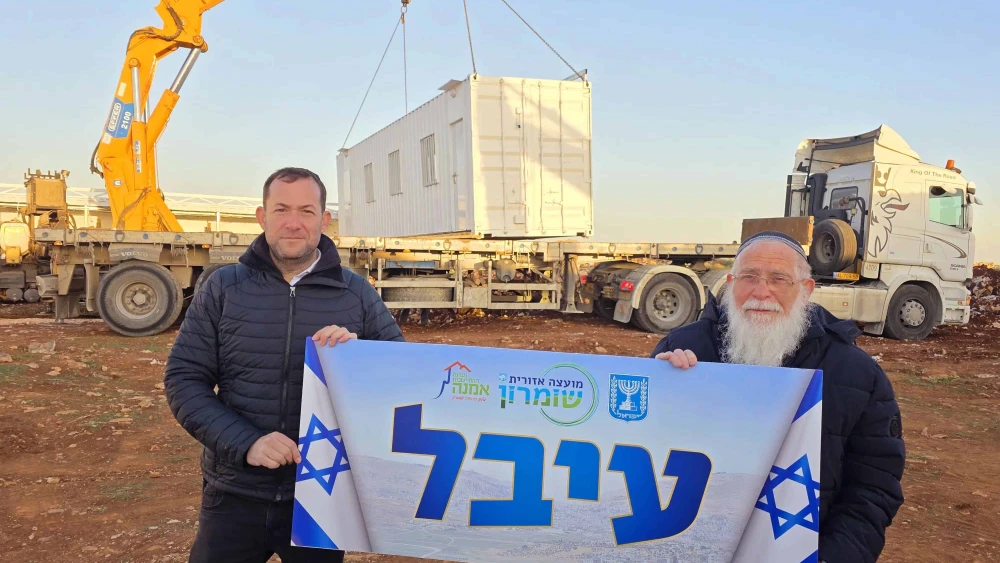
The Samaria Regional Council on Wednesday morning erected the first residential structures on Mount Ebal, around 10 months after Israel’s Cabinet approved the establishment of a new community at the site.
Samaria Regional Council head Yossi Dagan, together with the Amana settlement movement, worked overnight to establish the village after receiving formal Interior Ministry approval last month, Dagan said.
“This morning, we’re privileged to feel the wings of history beating,” he said. “To make history together here by establishing a new community this morning on the heights of Mount Ebal—next to the location where Joshua built an altar and where the people of Israel became a nation.”
“We are not standing here as private individuals,” Dagan continued. “We stand here in the name of the entire people throughout the generations: from the history of this generation to the people of Israel in the future.”
“This Land stood empty, waiting for its builders—for the people of Israel—for so many years,” the regional council head added.
The establishment of the village near the site identified with Joshua’s Altar comes in response to attempts by the Palestinian Authority to damage and destroy the Jewish heritage site, Dagan noted.
The first residents of Mount Ebal are expected to establish an agricultural yeshivah, as a branch of the Alon Moreh hesder yeshivah, after which additional families are expected to join as founders of the town.
Dagan and Samaria Rabbi Elyakim Levanon on Wednesday recited the blessing “Matziv Gvul Almanah” (“Who establishes the boundary of the widow”), which is traditionally used when settling the Land of Israel.
“Today is a great day for the people of Israel,” Levanon said. “Here we are, continuing the path of our forefather Abraham ... Thousands of years have passed since then, and thank God, we continue his path.”
“With God’s help, just as he was the foundation of the people of Israel, so too this place will become a foundation for many more communities—a great revival of the people of Israel, a great salvation, and may we soon see complete redemption in our days,” the Samaria chief rabbi added.
The Israeli Security Cabinet in May 2025 signed off on 22 new Jewish communities throughout Judea and Samaria, including Mount Ebal.
Some of the legalized communities were existing outposts that had thus far been unauthorized under Israeli law, while others were new towns.