


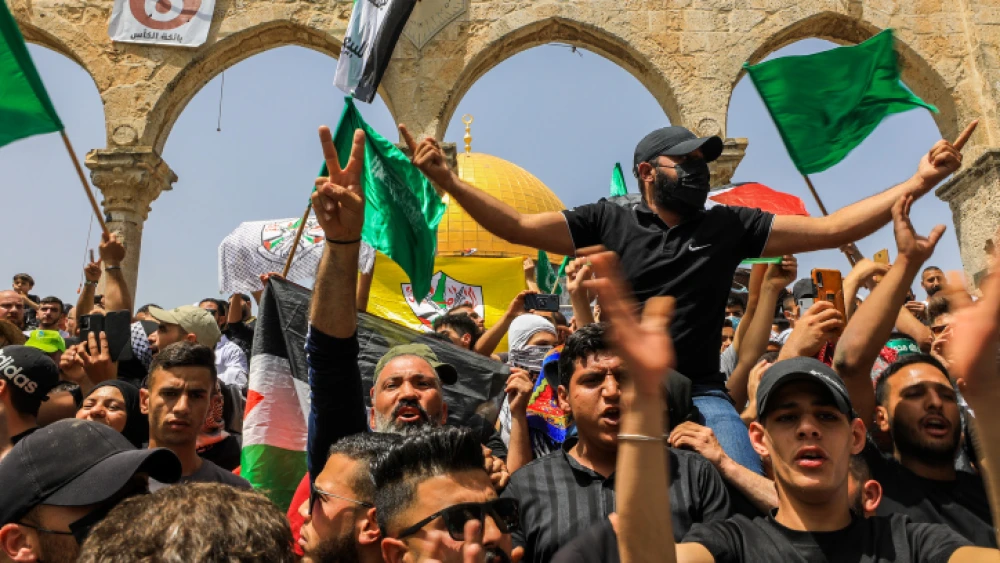
With Ramadan set to begin at sundown on Friday, Hamas is aiming to spark a wave of terrorist attacks in Jerusalem, including on the Temple Mount.
On Thursday, Harun Nasser al-Din, the head of Hamas’s Jerusalem Office, who is currently abroad, declared that there must be “full confrontation against the occupation’s incursions, an uprising against its projects, and no surrender to attempts at Judaization and expulsion.”
Another senior Hamas official urged an escalation of “resistance in all its forms in Jerusalem,” a clear incitement to terrorist attacks.
Al-Din also referenced the demolition of illegally built structures in Jerusalem, accusing Israel of implementing “malicious plans for expulsion and Judaization projects.” He further emphasized that “all plans and schemes will be shattered by the escalation of the resistance in all its forms.”
Throughout the week, Hamas seized on Israeli police recommendations to limit the number of Muslim worshippers allowed on the Temple Mount during Ramadan, proposing a cap of 10,000 people at a time.
In response, the terrorist organization declared that restricting the number of worshippers constitutes “a dangerous escalation and precedent aimed at undermining freedom of worship at Al-Aqsa mosque.”
Hamas further warned Israel about “the consequences of implementing these recommendations,” stating that it would bear full responsibility for any resulting escalation.
At the same time, Hamas is not ruling out an extension of the first phase of the hostage deal and ceasefire in Gaza. If additional phases proceed, they will coincide with the volatile period of Ramadan, which has seen terrorist attacks in the past.
Overnight on Wednesday, 642 terrorists were released as part of the deal, including individuals who were freed from prison and sent to eastern Jerusalem. This marks the last hostage release of the first phase of the ceasefire agreement, during which 33 captives were returned, including eight who were dead.
Hamas spokesman Abd al-Latif al-Qanoua told the Al-Araby channel on Thursday morning that “the organization is ready to extend the first phase of the hostage deal or merge the two phases according to red lines.”
He further claimed that the first phase of the agreement has been completed and the terrorist organization upheld all its commitments despite Israel’s “ongoing stalling.” Hamas has set several conditions for the second phase, including a “permanent” end to the war in Gaza and a full withdrawal of Israeli forces from the Strip.
This is an edited version of a story originally published by Israel Hayom.



