


Israel’s governing coalition faces renewed uncertainty as Haredi parties continue to withhold support for a must-pass budget this week, without the accompanying passage of a law to exempt military-age yeshivah students from mandatory conscription in the Israel Defense Forces.
The issue of fuller Haredi conscription has seemingly been politically unsolvable for decades. At this month’s Israeli-American Council Summit, a panel discussion tackled the issue—arguably the most divisive in Israel—head-on.
“It’s a tough conversation to have. It’s a conversation I’ve had many, many times, whether with others or in my own head,” Miami-born Rabbi Karni Gross, head of Derech Chaim Yeshiva in Gan Yavne, told JNS. “All the issues brought up here bother—and should bother—every single Jew, certainly in Israel.”
Gross sat down with Yohanan Plesner, a former Knesset member and current president of the Israel Democracy Institute. While in office in 2012, Plesner headed a committee to develop revisions to the Haredi conscription policy, but the committee was dissolved by Israeli Prime Minister Benjamin Netanyahu due to intercoalition disagreements.
Plesner went on to publish the recommendations anyway, which included criminal charges, fines and loss of benefits for draft dodgers.
Of the IAC panel, Plesner told JNS that “it was a discussion with fabulous social entrepreneurs that are instigating change, each in their realm within Haredi society, in wonderful projects and proofs of concept.”
But, he said, “we ought to be in the phase of moving from proof of concept to scaling. This is the big challenge. And you cannot scale without proper legislation, strong economic incentives and government policy. This is the void.”
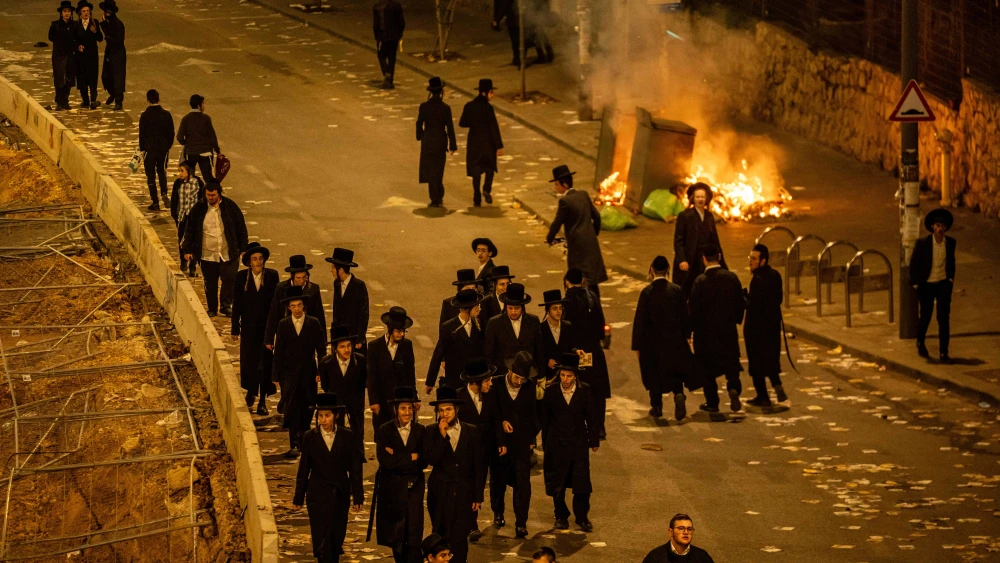
‘We literally check every box’
Haredi men studying in yeshivahs have historically received exemptions from conscription, along with financial subsidies, often citing their religious studies as their service to the Jewish people.
The agreement with the leadership, Israeli founding father and first prime minister David Ben-Gurion included, of the early Jewish state was intended to restore rabbinical scholarship after the devastating effects on Jewish scholarship wrought by the Holocaust.
But critics contend that the pact has long outlived its usefulness. And with the Haredi population steadily composing a greater and greater percentage of Israeli society, it is unsustainable from both a security and an economic perspective.
Years of rulings in Israeli courts to direct the government to pass a more equitable solution have never taken hold, with Haredi members of Knesset often using their critical leverage to prevent changes.
Approximately 3,000 Haredi men enlisted in the IDF during the 2024-25 recruitment cycle, out of roughly 80,000 eligible. More than 530 enlisted in a single day this month, marking a record.
That led up to the IAC discussion, called “While Your Brothers Go to War, Would You Remain Behind?”
Gross founded Derech Chaim more than a decade ago. There, students combine intensive religious study, along with technology classes in the evening. After two years, they go into the IDF for another two years, putting their tech education to work in a specialized role that allows them to come home to their families each evening rather than staying on the base.
His program has grown from eight students to more than 1,000 over the past 10 years.
“It is probably the most effective tool to take Haredim and integrate them into the army, into Israeli society, into the workforce. We literally check every box,” Gross told JNS.
“When the Knesset and the committees think about how to create a draft law, you would think they would have picked up the phone and asked me, ‘Rabbi Gross, how do you do this? What’s your plan, and can we replicate it?”

‘They should get engaged’
But Gross said that call has never come, and he believes it’s because there is intentionally no search for a solution.
“One of the biggest faults of politics is that it’s run by politicians. They just go around and around, there’s no new thinking, and everyone has their interest and their special group, which, by the nature of things, makes perfect sense.”
He said he understands the reality of politicians looking out for their constituency. But it’s a killer of progress at the same time. He claimed that even as some Haredi leaders will tell young men in their community that going into the army is a good thing, they will take a different stance publicly. And Gross hinted that the situation may have to hit rock bottom for that to change.
“It has to come from a place where the leadership sees that their constituency cannot sustain and then they can begin to be forced, compelled in a way, to look bigger,” he told JNS.
Plesner views it differently. He told JNS there’s no substitute for the political system.
“They shouldn’t get out of the way,” Plesner said of political officials. “They should get engaged. The political system, as much as it’s flawed, is the most important arena where decisions are made. Therefore, I hope that they’ll be able—at least on this critical, existential issue—to come together and legislate the only thing that makes any sense.”
But change can also come from the ground up, Gross insists, as difficult as that may seem to contemplate.
“The Haredi world today, as insulated as they try to make it, it’s not really insulated anymore. It doesn’t work. You can see right through, and the changes that are taking place in the Haredi world are happening despite the leadership and people who think that you always have to go through the leadership,” Gross told JNS.
“The people want change, and they don’t need the leaders to agree to it,” he added. If you offer them, and you support and you fund various other possibilities … you build it, they will come.”



