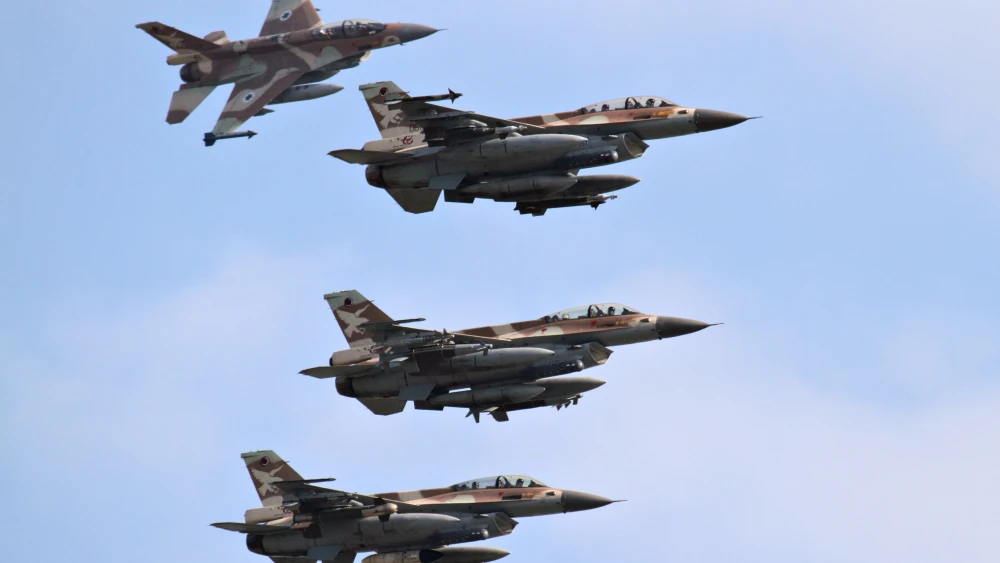
The Israel Defense Forces on Monday struck several Hezbollah targets in Lebanon’s Beqaa Valley, the military said.
The strikes targeted military compounds belonging to Hezbollah’s Radwan Force, where terrorists were identified, according to the IDF. The sites hosted live-fire exercises and weapons training for Hezbollah fighters.
“The storage of weapons and military training conducted by Hezbollah terrorists against the State of Israel constitute a blatant violation of the understandings between Israel and Lebanon and pose a threat to the State of Israel,” the military said.
Also on Monday, the IDF eliminated Hasan Ali Jamil Atwi, a senior operative in Hezbollah’s Aerial Defense Unit, in the Nabatieh area of Lebanon.
Atwi played a key role in rebuilding and rearming the unit and served as a major source of operational expertise, according to the military. He also maintained contact with the unit’s leaders in Iran and was involved in procuring equipment for Hezbollah.
Atwi’s death “further degrades Hezbollah’s military reestablishment efforts,” the IDF said.
The Israel Defense Forces on Friday struck a site used to coordinate Hezbollah’s fire and defense network in the Beaufort Ridge area of Southern Lebanon. The military said the attack targeted weapons and underground infrastructure.
A day earlier, the IDF eliminated two Hezbollah terrorists in the southern Lebanese town of Kfar Reman. According to a military statement, the men served as engineering operatives and were involved in rebuilding the Iranian-backed terror group’s assets in the residential areas of Mount Dov and Khiam.
On Wednesday, the IDF killed senior Hezbollah terrorist Ali Muhammad Qara’uni in the Kafra area of Southern Lebanon. Qara’uni was the group’s local representative in the village, responsible for financial and military ties with residents, the army said. He was also accused of commandeering private property for operational purposes, including renting homes to store weapons and carry out surveillance.
“The terrorists’ activities constituted a violation of the understandings between Israel and Lebanon,” said the IDF, referring to the Nov. 27, 2024, ceasefire deal that ended more than a year of war.
The situation in Lebanon remains volatile following the end of the truce on Feb. 18. Hezbollah began launching missiles and drones at the Jewish state a day after the Hamas-led massacre on Oct. 7, 2023.
Although Jerusalem has withdrawn most of its ground forces since the war ended, it still controls five strategic sites in Southern Lebanon. Israeli officials have stated that the IDF will retain these positions until the Lebanese army demonstrates it can maintain security.
Lebanese Foreign Minister Youssef Raggi said on Sept. 9 that the country’s armed forces will have fully disarmed Hezbollah in Southern Lebanon within three months.
Last month, Naim Qassem, the secretary-general of the Iranian proxy, said that Hezbollah will not lay down its arms, in a public show of defiance against the Lebanese army’s plan.
In response, U.S. President Donald Trump has approved $230 million in funding for Lebanon’s security forces, Reuters reported on Friday, citing sources in Washington and Beirut. The package reportedly includes $190 million for the Lebanese Armed Forces and $40 million for the Internal Security Forces.
In an email, a State Department spokesperson said the assistance would support the effort “to assert Lebanese sovereignty across the country and fully implement U.N. Security Council Resolution 1701, the only viable framework for a durable security arrangement for both Lebanese and Israelis.”
The U.N. resolution, adopted in the aftermath of the 2006 war between Israel and Hezbollah, calls for the terror proxy to disarm and withdraw from Southern Lebanon, with the Lebanese army and the U.N. Interim Force in Lebanon (UNIFIL) tasked with securing the area.