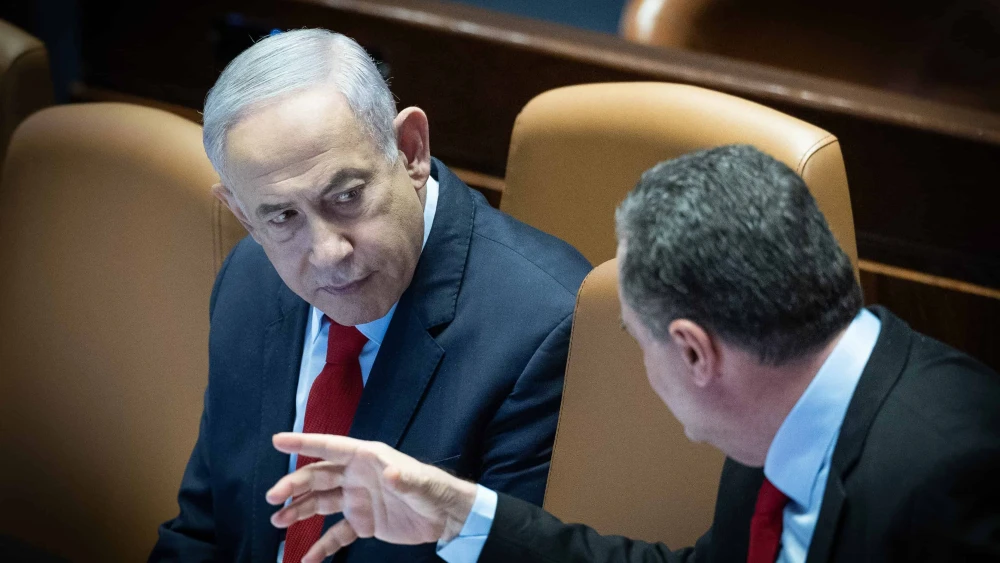
The Hamas terror organization only has “a few days” to agree to a U.S.-proposed ceasefire extension, an Israeli government spokesman confirmed on Tuesday.
“If they don’t, the Cabinet will convene and decide on the next steps,” Omer Dostri, Israeli Prime Minister Benjamin Netanyahu’s spokesman, told Israel’s Army Radio.
The Security Cabinet, which is responsible for defense-related decisions and composed of senior ministers, is scheduled to meet on Sunday at 4 p.m., the Ynet outlet reported on Tuesday, noting that the forum would convene only after Maj. Gen. (res.) Eyal Zamir was sworn in as the 24th chief of staff of the Israel Defense Forces.
Jerusalem is developing a plan to resume the war in the Strip in four to six weeks in a decisive campaign to wipe out Hamas, The Washington Free Beacon reported on Friday, citing several current and former Israeli officials.
Netanyahu and Israeli Defense Minister Israel Katz instructed Zamir to develop the plan, which is projected for completion when he enters office on Thursday, according to the report.
The plan is to conquer the entire Gaza Strip in one fell swoop with more than 50,000 soldiers, relocating the civilian population to humanitarian zones and waging a “ruthless ground campaign” in terrorist-heavy areas that will receive no humanitarian aid, according to the Beacon.
The campaign is to commence with a heavy aerial assault, followed by a reduction of aid entering the Strip. IDF divisions would simultaneously enter the Strip in the north, center and south, carving it into three parts.
The campaign could be paused if the Hamas leadership agrees to free captives, or if it disarms and goes into exile, the report added.
Israeli assessments indicate that Palestinian terrorist groups in the Strip are still holding 59 hostages. Of these, 24 are believed to be alive—all men—while 35, including three women, are believed to be deceased. Two of the living hostages and three of the deceased are foreign nationals.
Phase 1 of the ceasefire, which went into effect on Jan. 19, formally expired at midnight on Saturday.
Jerusalem subsequently announced it had suspended all humanitarian aid after Hamas rejected U.S. Mideast envoy Witkoff’s plan to extend the temporary ceasefire deal during the Ramadan and Passover period.
“Saturday was the last day of the first phase of the framework for the release of our hostages. Israel has fully implemented its part, including the part of humanitarian aid, fully and down to the last day,” Israeli Foreign Minister Gideon Sa’ar told international media on Tuesday.
He noted that Israel had agreed to the U.S. bridging proposal, but that “unfortunately, Hamas rejected the offer. Accordingly, Israel stopped enabling the entry of aid into Gaza.”
Any aid that ends up in the hands of Hamas “is not humanitarian,” charged the foreign minister. “Unfortunately, Hamas’s takeover of goods turned it into an economic engine for them. It became the number one budget income for Hamas in Gaza. They use that money for terror, to restore terror capabilities and get more young terrorists to join their organization.”
Not content with appropriating the aid, “They are shooting the civilians who try to get access to the aid. They use it as an engine in their war against Israel,” Jerusalem’s top diplomat added, declaring: “This can not continue and will not continue.”
Likud lawmaker Moshe Passal told JNS on Monday that it had been a mistake to let aid into Gaza in the first place.
“It wasn’t humanitarian aid, it was actually money for Hamas that helped perpetuate the war,” he said. “Anyone who is truly concerned about the poor, uninvolved residents of Gaza should give them the opportunity to emigrate from Gaza and no longer be pressured by this terrorist organization, Hamas,” he added.
“It is clear that a full blockade of Gaza should be contained and that uninvolved civilians should be allowed to leave the war zone. If we do not implement a blockade, we are leaving Hamas in power,” he said.
Tally Gotliv, another Likud lawmaker, said that that Hamas’s rejection of Wiktoff’s bridging proposal granted Israel legitimacy to impose a “heavy siege” on Gaza.
“A siege will lead Hamas to return all of our hostages in exchange for water and electricity. This is the way to do it,” she continued, adding however that “food is a different story.”