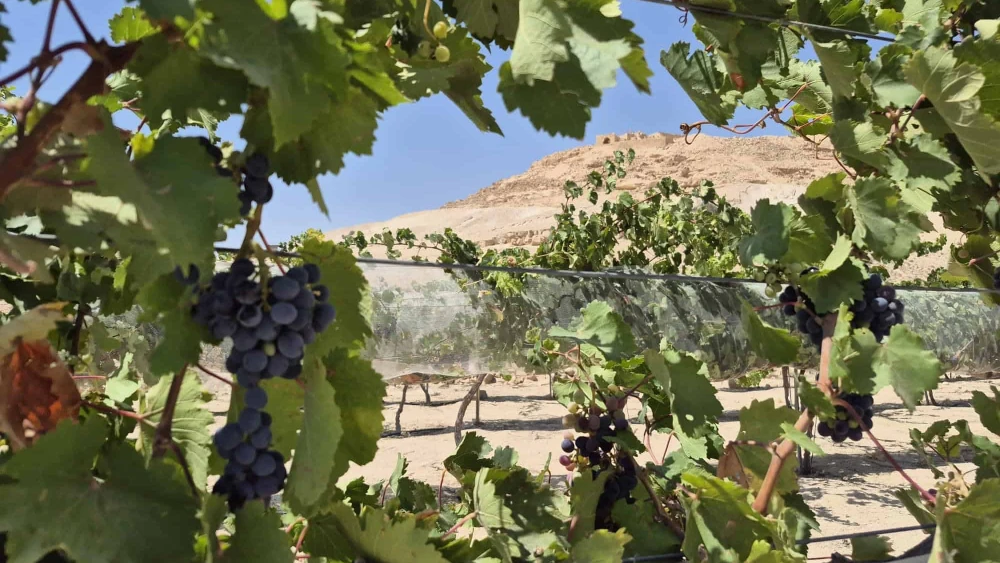
Israeli researchers have harvested 1,500-year-old Byzantine-era grape varieties from a restored vineyard in the Negev Desert, part of an effort to recreate a renowned ancient wine that was once exported throughout Europe, the Israel Nature and Parks Authority announced.
The first harvest took place last weekend at Avdat National Park, marking a major milestone two years after ancient grape seeds were planted in the site’s desert vineyards as part of a groundbreaking effort to revive a centuries-old winemaking tradition.
The grape seeds were discovered years ago by Haifa University researchers in an archaeological cave at the site.
“The Byzantines in the Negev were a powerhouse,” Lior Schwimmer, the Israel Nature and Parks Authority’s southern district heritage officer who led the harvest, told Ynet on Monday. “While wine was commonly produced in the lowlands and coastal plains, achieving that in the Negev was extraordinary. Yet they managed to produce wine on a massive scale—millions of liters—and export it to Europe.”
The project builds on research showing that ancient grape varieties once thrived in the region between the fourth and seventh centuries, a period when the Negev was renowned globally for its high-quality wine.
Around 20 kilograms (44 pounds) of grapes were harvested—enough to produce approximately 12 bottles of wine.