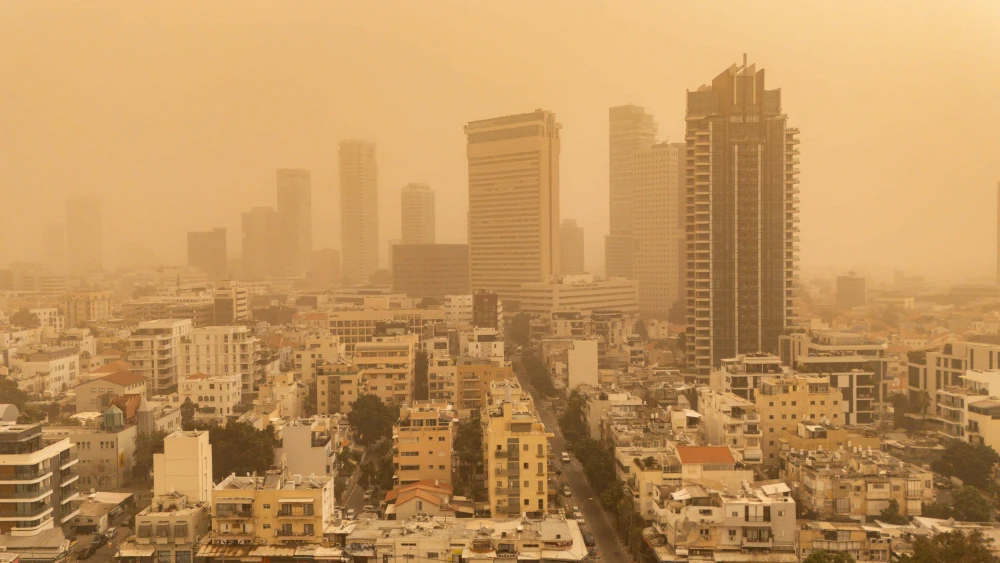
Haze descended throughout Israel on Saturday, brought by strong southwesterly winds from Egypt.
“The dust reached us via the Mediterranean Sea, and therefore the highest concentrations of particles were measured in the coastal cities and the central lowlands,” the Israel Meteorological Service said.
The concentration of haze and dust led Tel Aviv and Jerusalem to top the list of cities with the worst air pollution in the world on Feb. 14.
Amir Givati, director of the Meteorological Service, explained that “the haze originates from the contrast between the wintry weather affecting Europe and unseasonably warm weather in our region, accompanied by relatively dry southern winds. This combination causes the strong winds that bring dust from the deserts of Egypt and Libya. Such haze is very unusual for this season and is almost undocumented in mid-February,” Ynet reported.
אובך כבד ברחבי הארץ, האבק צפוי להתפזר בשעות אחר הצהריים@WexlerSharon pic.twitter.com/bIWNKW2LIq
— כאן חדשות (@kann_news) February 14, 2026
Toward the evening, however, the air quality gradually improved as eastward winds carried the dust toward Jordan.
The unusual weather is expected to continue throughout the next week, with high temperatures forecast to hit Israel due to a heatwave expected on Monday.

Monday’s high temperatures are forecast to be 33 degrees C (91-93 degrees F) in the western Negev, 31-32 degrees C (88-90 degrees F) in the coastal region, and 25-26 degrees C (77-79 degrees F) in the mountainous areas, according to Ynet.
The following day, temperatures are expected to drop by 10 degrees Celsius (18 degrees Fahrenheit) and return to seasonal norms.