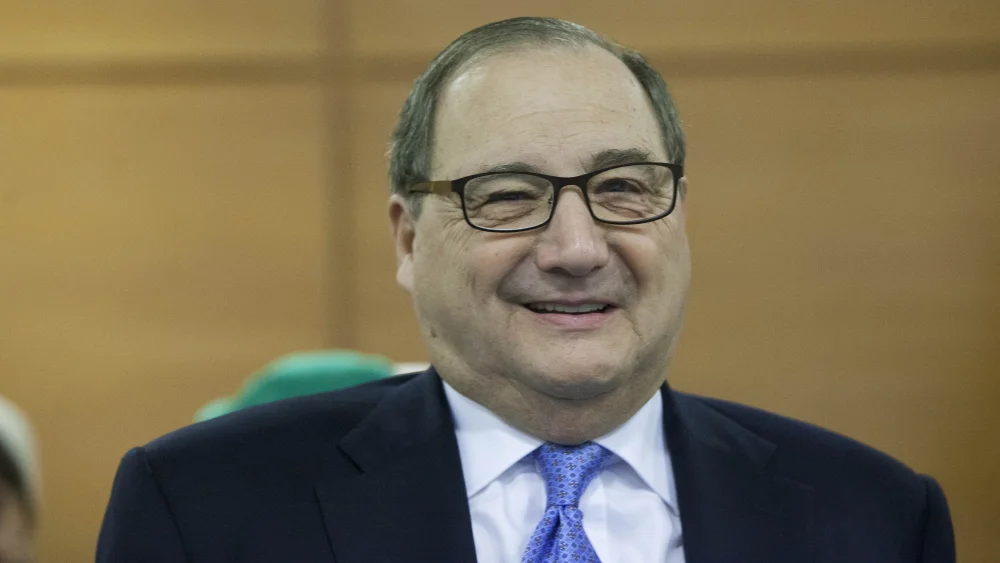

This transcript of the eulogy given for Abraham Foxman at Park Avenue Synagogue in New York City on May 12, 2026, was provided exclusively to JNS. It has been lightly edited for style.
In considering the life and legacy of Abe Foxman, I find myself drawn to a beautiful, enigmatic, and much-debated rabbinic midrash—a parable told about Abe’s namesake, the biblical Abraham, and the moment Abraham becomes “Abraham.” The rabbis imagine Abraham as a man who comes upon a birah doleket—“a house either filled with fire or light.” Startled by what he sees, Abraham asks: “Is it possible that this house has no owner?” In response, the owner peers out and declares: “I am the owner of the house.”
What Abraham saw—and what the parable means—has been the subject of debate across the generations. Most understand the house to be burning. Our patriarch looked out at a world on the brink of ruin, violence and moral collapse, and his greatness lay in refusing to stand idly by. He ran into the flames. He took responsibility for God’s world.
Others, most famously Rabbi Abraham Joshua Heschel, understood the image differently. The house was not aflame but illuminated. Abraham was thunderstruck by the radiance and wonder of creation itself. Abraham’s greatness lay in recognizing what others could not see, the beauty and mystery of existence, the presence of a Creator and the possibility of hope, and human partnership with the Divine.
To capture the life of Abraham Foxman through a single piece of Torah is an impossible task. But if I had to choose one text through which to understand Abe, it would be this one—because Abe’s life embodied both readings at once.
Abe Foxman ran into the fire. He confronted hatred, antisemitism, tyranny and indifference with unmatched courage and moral clarity. And Abe was also a man animated by light—by the dignity of every human being, by the promise of America, by the beauty of Jewish life, friendship, family and hope itself. His greatness was not that he chose between the fire and the light. It was that he spent his life carrying both.
Golda, Michelle, Ariel—when we sat together and spoke about Abe’s life, I asked how his personal biography shaped his public moral vision. Almost in unison, you spoke about the woman into whose care Abe was entrusted as a baby during the Shoah—the Polish Catholic nanny who sheltered him, baptized him and saved his life while the world around was aflame in hatred.
For Abe, the significance was not just the story itself, but what Abe chose to take away from it. He was never particularly interested in the transactional details—whether the nanny was paid, the logistics of how he was returned to his family, the mechanics of survival. Abe’s focus was always on the singular moral act itself: that in a world consumed by fire, one human being chose courage. One person chose decency. One person chose light.
As is well known, Abe developed a close and meaningful relationship with Pope John Paul II. In their meetings, the pope would invariably ask Abe what he could do for him. Abe’s recurring request was that the pope bless the memory of the woman who saved him. Abe knew the darkness intimately. But he insisted on blessing the light.
A case can be made that few people in modern Jewish history devoted more of their lives to studying and confronting the pathology of hatred than Abraham Foxman. An equal case must be made that few people believed more deeply in the possibility of human transformation, forgiveness and redemption.
Public figures who had stumbled into hatred or ignorance turned to Abe seeking another chance. Why? Because Abe believed that hearts could change. He never understood cancel culture, the idea that people can be irretrievably reduced to their worst moments. He believed that if hatred hardens your own heart beyond repair, then the hatred has already won.
Abe saw the fire. But he never stopped believing in the light.
This was Abe—never defined by optimism or pessimism alone, but by the difficult discipline of holding both at once. Ever cautious of the dangers of too much hate or too much love.As he would say: “I don’t have the luxury of being a pessimist.”
It was a balancing act that was Abe’s moral posture toward the world: vigilance joined with hope; idealism tempered by hard-earned realism; fierce particularism alongside expansive human concern. A statesman and a mensch. Someone equally comfortable standing with presidents and prime ministers, yet utterly without pretension—living out Rudyard Kipling’s charge “to walk with Kings—nor lose the common touch.”
And his common touch was extraordinary. Abe’s love language was helping people. Picking up the phone on someone’s behalf. Making the introduction. Taking in a young colleague. Offering encouragement, counsel, protection, opportunity. Abe carried his enormous moral authority lightly, always understanding that influence mattered only insofar as it could be used in the service of others.

These last years since Oct. 7 were so hard for him. Israel was always in his heart, and the eruption of hatred against the Jewish people shook him deeply. But even so, Abe believed in the joy of Jewish life. It was, and always would be, a privilege to be a Jew—a people living not just by the watchword: “If I am not for myself, who will be for me?” or “If I am only for myself, then what am I”—but both or more precisely the breath we take between. The universal and the particular. The fear and the hope. The fire and the light. The moral breath held between those poles—that was the breath that animated Abraham Foxman’s life.
And at the very center of that life, his greatest blessing and deepest joy: his family. Golda, you were his partner in every sense of the word: the ballast and the fuel, the protector and the protector’s protector. You paced him, steadied him, sustained him, and together, you built not only a marriage of nearly six decades, but a home filled with devotion, resilience, laughter and abiding love.
Michelle and Ariel: Your father’s reach was global. He traversed continents, crises and causes—all before Zoom, FaceTime or texting. And yet somehow, you always felt his presence. He gave you one of the greatest gifts a parent can give: he taught you how to think. And because of that, even now, in his absence, the cadence of his voice, the clarity of his values and the gentleness of his guidance will continue to accompany you.
And to the grandchildren—how deeply he loved each of you. To his very last breath, he never stopped showing up: birthdays, milestones, conversations, encouragements, small gestures of connection that became sacred rituals of family life. The way you care for one another, stay connected, reach out with a “Shabbat shalom,” “Gut voch,” as he did—that is not incidental to his legacy. That is his legacy. To keep the family together. To carry the light forward. That is how you honor him.
At the end of Mishnah Sotah, the rabbis teach that when certain great leaders died, something essential departed from the world. “Wisdom ceased. Humility faded. Reverence diminished.” The rabbis understood that there are rare human beings who do not merely inhabit virtues, but carry them for an entire generation.
It is tempting, with Abe’s passing, to feel that something irreplaceable has gone out of the world: a certain moral clarity, a certain courage, a certain refusal to surrender either to hatred or despair. But Judaism does not permit us to end there. When the leader dies, the work does not disappear. The mantle descends upon the living. What once rested on one extraordinary pair of shoulders must now be carried, however imperfectly, by the rest of us.
“It is not,” as Rabbi Tarfon taught, “incumbent on you to complete the work, but neither are you free to desist from it.”
God’s house is still aflame. God’s house is filled with light. Abe carried the work farther than most people could ever dream. May we honor him by carrying it forward.
May the soul of Abraham Foxman, Abraham Hanoch Henach ben Yosef Moshe v’Haya Rivka, be bound up in the bond of life eternal. Amen.