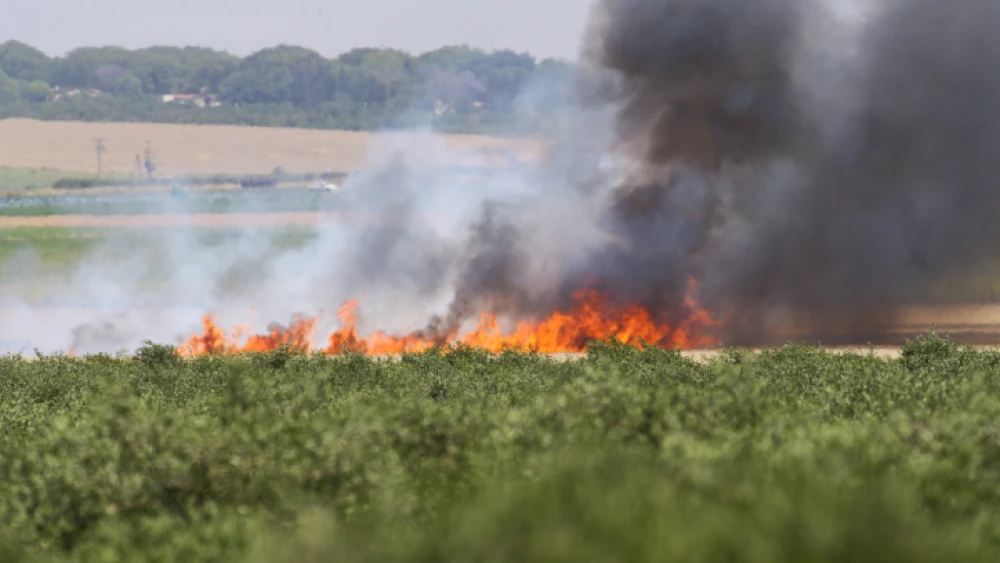
Palestinian kite terrorism continued to rage over the weekend as 30 fires erupted in Israeli communities near the Israel-Gaza border after dozens of airborne incendiary devices, launched from Gaza, crashed in Israeli territory.
Hundreds of firefighters and volunteers, assisted by firefighting aircraft, battled the blazes, which were fueled by the heavy heat and strong wind conditions. Several roads in the area were temporarily blocked as fires threatened them as well.
On Sunday, an Israeli aircraft struck the vehicle of one of the ringleaders of the kite-terrorism campaign. No one was wounded in the strike in the Shujaiyya neighborhood in Gaza, but it marked an escalation in Israel’s response to such weaponry.
One of the balloons launched over the border on Saturday was found to be carrying explosives. Police sappers neutralized the device safely.
In response, the Israel Defense Forces struck a terrorist cell gearing up to launch additional explosive kites over the border, as well as a Hamas observation post in northern Gaza.
On Friday, the military fired warning shots at terrorist cells trying to send incendiary kites and balloons over the Israeli border.
The Palestinians reported that two men were wounded in an IDF strike on a kite cell in the al-Bureij refugee camp in central Gaza.
“The IDF is determined to counter the Palestinians’ acts of terror,” the IDF Spokesperson’s Unit said in a statement, adding that regardless of which terrorist organization instigates the attacks, “Hamas will be held accountable for anything that transpires in the Gaza Strip.”
Military officials warned last week that if the Palestinian kite terrorism continues, the IDF will launch surgical strikes to eliminate these terrorist cells, which is a policy currently used against cells that fire rockets at Israel.
However, senior IDF officers expressed concern that surgical strikes against kite terrorist cells could set off a rapid security escalation that could lead to another round of fighting in Gaza.
The IDF is mostly employing drone technology to combat kite terrorism, but local residents say the drones are ineffective in alleviating the damage caused by the fires.
Authorities say that more than 7,500 acres of forest and agricultural land on the Israeli side of the border have been reduced to ash since the Palestinians launched the “kite campaign” in late April, causing tens of millions of shekels in damage and affecting every community in the area.
The Israel Nature and Parks Authority says the impact on local flora and fauna has been devastating, as local habitats have lost more than 3,500 acres to fires, including one-third of the Carmia Nature Reserve, a part of the Be’eri Forest and all of the Nir Am Nature Reserve.
INPA official Uri Naveh said the environmental damage caused to the area was nothing short of catastrophic.
“The Western Negev area is the natural habitat for rare species of plants and many species of reptiles, which have sustained catastrophic damage that will take decades to repair,” said Naveh. “Moreover, if the fires are a recurring event, the habitat may change completely. Nature knows how to deal with a large fire every 10 years or so, but if it happens every year or in short intervals, without the habitat having time to recover, it changes so dramatically that it becomes something else.”