


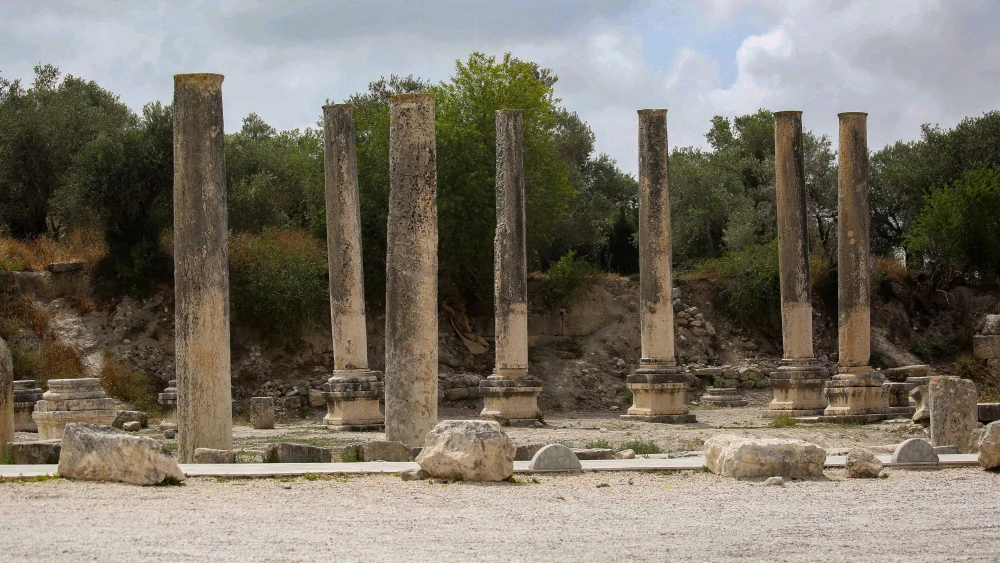
The Israeli Defense Ministry’s Civil Administration announced on Thursday that it had begun the process of designating 1,800 dunams (445 acres) for the preservation and development of the Sebastia archeological site in Samaria.
“The expropriation will be carried out in areas of the archaeological site located in Area C” of Judea and Samaria, which is under Israeli control per the Oslo Accords signed with the Palestinians in the 1990s, it said.
The statement noted that the decision to expropriate was made due to “intentional neglect” by the landowners and the Palestinian Authority.
Israeli officials notified landowners of the start of the process and the transfer of the lands around Sebastia to the management of the Civil Administration’s Archaeology Unit, the Defense Ministry body said.
The move is carried out “in accordance with the law, as part of a broader project led by the Ministry of Heritage, which includes an investment of roughly 32 million shekels [$9.8 million] to upgrade the site, improve visitor access and develop the archaeological area,” it continued.
The Civil Administration said the land seizure is expected to help enable the site’s “infrastructural development, the expansion of archaeological excavations and the uncovering of additional historical findings.”
Israeli authorities began archaeological work in May to restore and develop Sebastia, a major archaeological site that served as the capital of the Kingdom of Israel three millennia ago.
In 2023, the Israeli Cabinet allocated nearly $10 million for the restoration and development of Sebastia. The funds were disbursed to establish a new visitors’ center, pave access roads and increase law enforcement to stop Palestinian vandalism.
Shomron (Samaria in English) was the capital of the Kingdom of Israel in the 9th and 8th centuries BCE. It was named Sebastia by Herod the Great in honor of Emperor Augustus, using the Greek word sebastos, meaning “venerable,” a translation of the latter’s official Latin title.
The site has significance in modern Israeli history as well. In the 1970s, Jewish resettlement activists moved into Sebastia’s abandoned train station, marking the first Jewish return to Samaria in 2,000 years.
Since the Oslo Accords in the 1990s, the archaeological site has been located in Area C of Judea and Samaria, under full Israel Defense Forces control, while the adjacent present-day Arab village of Sebastia has been in Area B, under joint Israeli security control and P.A. civilian jurisdiction.



