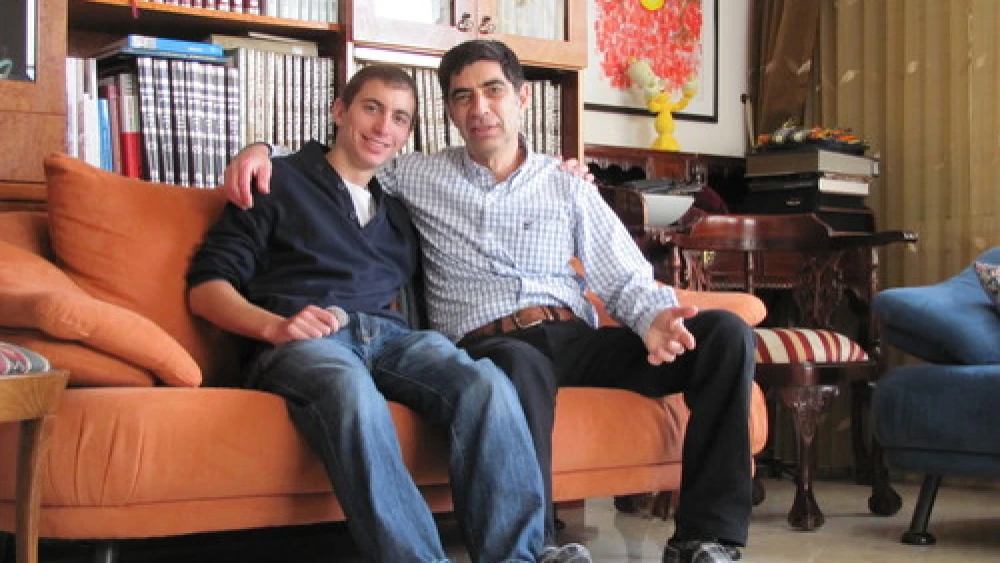
More than 11 years after his son, Lt. Hadar Goldin, 20, was killed and abducted by Hamas in the Gaza Strip during Operation Protective Edge, Professor Simcha Goldin says the State of Israel still has a moral and national duty to bring him home.
“Hadar is the first hostage,” Goldin told the Hebrew national religious weekly Shvi’i in an interview due to be published on Friday. “My son has been held in Gaza for 4,116 days—11 years and three months. We won’t stop until he returns.”
Goldin, a historian at Tel Aviv University, has been a central figure in the struggle to bring back the bodies of Hadar and Staff Sgt. Oron Shaul, 20, held by the terrorist group since 2014. Shaul’s body was retrieved by the IDF from Gaza on Jan. 19 and returned to Israel for burial.
Goldin’s remarks followed reports that the terror group had provided information on the burial sites of some of the eight remaining hostages’ bodies—seven civilians and his son, the last hostage taken during active IDF service. On Tuesday, Israel identified the returned remains of Israeli-American Itay Chen, a staff sergeant in the IDF, whom Hamas terrorists killed in battle at Kibbutz Nir Oz on Oct. 7, 2023.
IDF Chief of Staff Lt. Gen Eyal Zamir urged the political echelon on Tuesday to consider releasing 200 Hamas terrorists trapped in IDF-controlled parts of Gaza in exchange for Goldin’s body.
His father called on Israeli Prime Minister Benjamin Netanyahu to make sure that his son’s remains are returned to Israel for burial, especially after the government had agreed to free “every terrorist involved in his death” as part of the hostage deal that ended the war.
“When Hamas kidnapped Hadar, the state failed to act decisively. We said then: whoever doesn’t bring back the fallen will abandon the wounded, and later the living,” Goldin said. “The prime minister sends soldiers into battle; his duty is to bring them all back—alive or fallen. He hasn’t brought back Hadar, even after releasing every terrorist involved in his death.”
Recalling the immediate aftermath of the Oct. 7 massacre, Goldin said his family had helped to establish a crisis center for newly bereaved and abducted families. “We knew the state wouldn’t be ready,” he said. “We had to act.”
Despite his pain, Goldin expressed faith in Israel’s younger generation. “Change always comes from the bottom up,” he said. “The soldiers—regulars and reservists—are the future leadership. In the future, no soldier, alive, wounded or fallen, will be left in enemy hands.”
He added, “Victory will mean that, as a society, we understand that no one is ever abandoned again.”