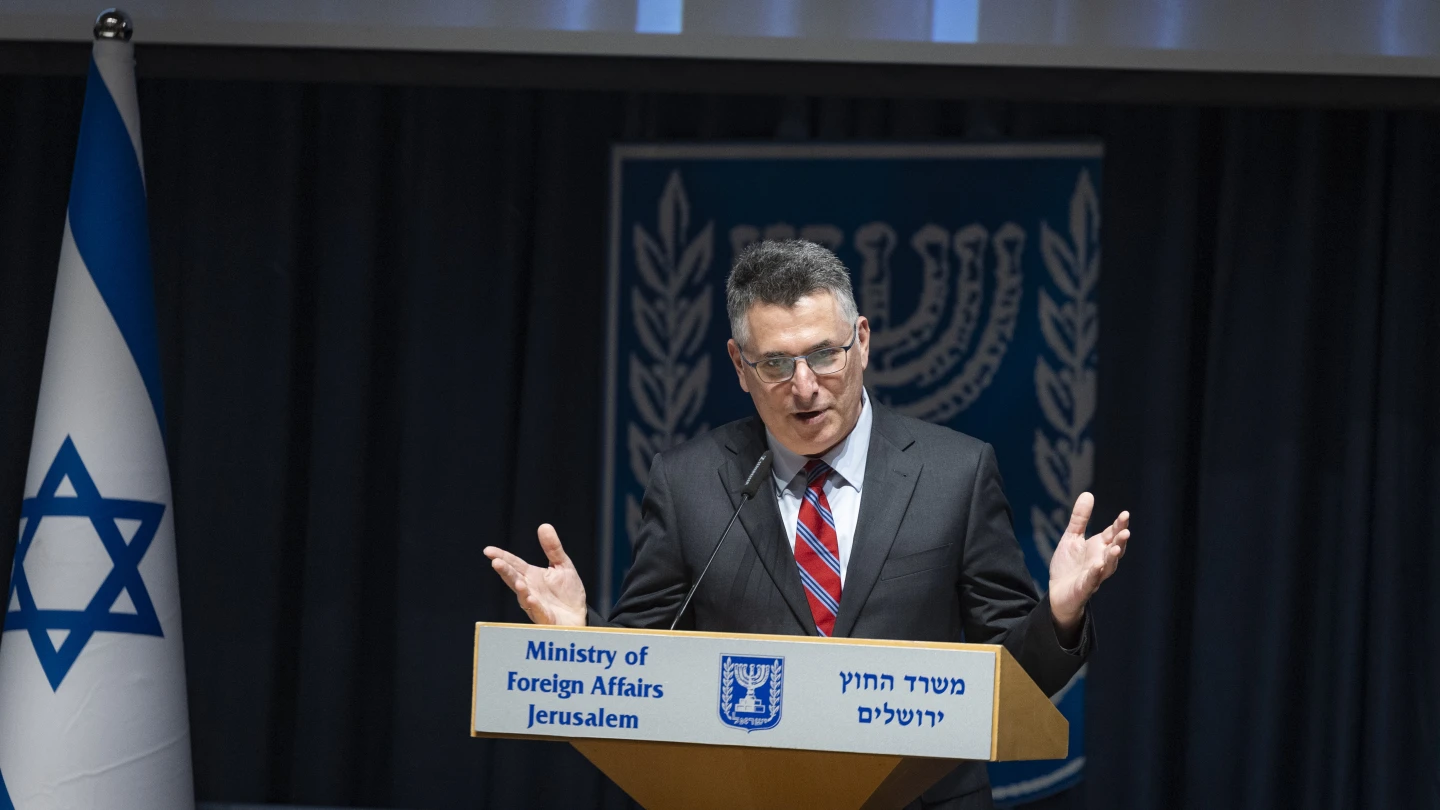
Israeli Prime Minister Benjamin Netanyahu and Mossad Director David Barnea attended a ceremony on Wednesday night marking 60 years since the execution of Eli Cohen, the Jewish state’s legendary spy operative in Damascus.
“Eli Cohen is a national hero in every sense of the word,” Netanyahu said during the event at the Herzliya Cinematheque, recalling the Mossad agent’s “supreme willpower” during his detention and interrogations.
“When the curtain fell on his life that dark day in the heart of Damascus, the entire nation felt the weight of the blow,” the premier continued. “What anguish and gloom descended upon us. On the other hand, it was also the day on which many swore to follow in his footsteps.”
Referring to the Jewish state’s moves in the wake of the Hamas-led Oct. 7, 2023, massacre, Netanyahu said: “We have already proven to the entire nation that there is no safe place for those responsible for the horrific slaughter of October 7.” He added, “The message was clear: you have no refuge.”
Barnea also linked Cohen’s legacy to the ongoing work of Israel’s intelligence services. “Even at this very moment, heroic Mossad operatives risk their lives for Israel’s security,” Barnea said.
The Mossad head highlighted Cohen’s ethos of secrecy and daring in his remarks, noting: “In his death, he gave meaning to the values of love of Israel and strength of spirit. These values remain a guiding light for us.”
Barnea also paid tribute to Cohen’s widow, Nadia, recognizing her role in raising their three children and supporting her husband’s operations: “You gave the strength, resilience and stability Eli needed to carry out his mission. Our appreciation is immense.”
Cohen was tried and hanged for espionage by the Syrians in 1965 after he infiltrated top levels of government. The information the legendary Mossad spy obtained is seen as having played a key role in Jerusalem’s conquest of the Golan Heights from Syria during the 1967 Six-Day War.
In May, the Mossad, in coordination with an allied foreign intelligence service, retrieved the official Syrian archives on Cohen. The covert and complex operation resulted in the transfer of thousands of artifacts that had been held for decades by Syrian security services, Jerusalem said.
The recovered archive includes approximately 2,500 documents, photographs and personal effects—most of which are being revealed to the public for the first time.
Collected by Syrian intelligence following Cohen’s capture in January 1965, the materials include interrogation files, audio recordings, correspondence between Cohen and his contacts, handwritten letters to his family in Israel, photographs documenting his covert operations in Syria and personal belongings seized from his home after his arrest.
Among the items was Cohen’s original handwritten will, penned hours before his execution in Damascus in May 1965. Until now, only a copy of the document had been publicly known.
In late 2024, Israel reached out to Russian mediators for assistance in locating Cohen’s remains, without success. Syria has previously denied knowing where Cohen was buried.