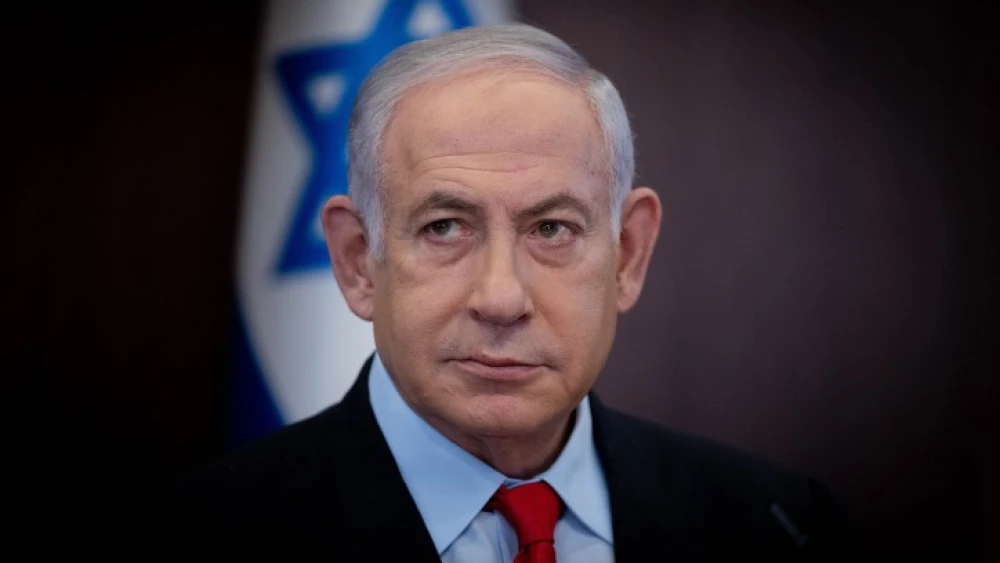
Israel’s victory over the Iranian-backed Hezbollah terrorist organization has opened up the “possibility of peace with our neighbors to the north,” Prime Minister Benjamin Netanyahu declared on Sunday.
“Our victories in Lebanon against Hezbollah have opened a window to a possibility that wasn’t even imagined before,” he told ministers during the last Cabinet meeting before Rosh Hashanah, which begins on Monday evening.
“In any case, these talks, as well as the contacts with Lebanon, would not have been possible without our crushing victories on the northern front and also on other fronts,” the prime minister said.
“We are on the eve of Rosh Hashanah,” Netanyahu continued. “In the past year, we achieved tremendous, historic accomplishments—first and foremost the historic achievement that guarantees the continued existence of the State of Israel, and thus of the Jewish people.”
Referencing the Israel Defense Forces’ “Operation Rising Lion” against Iran in June, he said that “for 12 days, we were physically in the deepest pit,” employing an Aramaic idiom from the Talmud that describes the reversal of the “evil decree” to murder all Jews under the Achaemenid Empire, aka the First Persian Empire, a deliverance that is celebrated during the Purim holiday.
However, the Jewish state “emerged through ‘Operation Rising Lion’ to its greatest achievement,” Netanyahu continued. “This is no exaggeration. Above all, we have removed from over our heads the threat of Iranian atomic bombs intended to destroy us, and the threat of tens of thousands of ballistic missiles that Iran had planned to produce within a few years.”
IDF soldiers continue to fight in Gaza “for the final defeat of Hamas and the return of all our hostages” held by the terrorist group, he added.
“I would like to wish you all Shanah Tovah, and that there will be fruitful work to ensure the eternity of Israel—nothing less,” he concluded.
Syrian President Ahmed al-Sharaa said on Aug. 24 that there had been progress in the talks for understandings with Israel based on the 1974 Disengagement of Forces Agreement that ended the Yom Kippur War.
While the president said that he does not view current circumstances as favorable for concluding a peace, he would “not hesitate” to do so if he becomes convinced that it would benefit Syria and the region.
For his part, Lebanese President Joseph Aoun on July 11 ruled out the prospect of normalizing relations with Israel, though he expressed a desire to end the longstanding conflict with the Jewish state.
“Peace is the lack of a state of war, and this is what matters to us in Lebanon at the moment. As for the issue of normalization, it is not currently part of Lebanese foreign policy,” Aoun stated, per AFP.
The comments came after Israeli Foreign Minister Gideon Sa’ar declared that Jerusalem was committed to expanding the Abraham Accords and remained “interested in adding countries such as Syria and Lebanon, our neighbors, to the circle of peace and normalization.”