Israeli mayors, Cabinet members, activists and concerned residents crowded Symphony Hall in the city of Rosh HaAyin on Jan. 1 to call attention to the problem of the illegal burning of waste in Judea and Samaria.
The half-day conference, titled, “Eradicating air pollution from pirate landfill fires,” was the first of its kind and an indication that the problem had reached a crisis point.
“Each year, approximately 422,000 tons of mixed waste are burned in Judea and Samaria. This contributes directly to 43% of carcinogenic emissions and to roughly 27% of premature deaths from air pollution in Israel,” according to an October 2025 report by Regavim, an Israeli NGO focusing on land issues.
The problem primarily affects cities nearest to the landfills, those that sit along the “seamline,” the boundary between Israel proper and Judea and Samaria. These include Rosh HaAyin, Shoham and Modi’in-Maccabim-Re’ut, among others.
The problem is so big that the government’s approach of trying to put out the fires isn’t effective, said Rosh HaAyin Mayor Raz Sagi.
“It won’t work to keep running around extinguishing individual fires all the way from the Jezreel Valley down to the Hebron Hills,” Sagi told JNS.
Another reason extinguishing fires doesn’t work is that the mounds of trash are so vast that fires burn inside them even after they’ve been covered with sand or water. “It really is like hell,” he said.
“There are two types of fires,” according to Sagi. “One is the burning of waste that originates from Palestinians who remove garbage from their homes or communities, and it is usually vacated to the west, near the [seamline] fence. The second is completely different: people who organize waste in the State of Israel and transfer it to Judea and Samaria.”

In a painful irony, Israelis looking for cheap ways to save on garbage disposal end up receiving the garbage back in the form of poisonous fumes. Haim Bibas, mayor of Modi’in-Maccabim-Re’ut, estimated that 50% of the garbage found in the pirate landfills originates in Israel. Some 3,500 garbage trucks a year travel from Israel to Judea and Samaria.
Illegal landfills are big business. “It costs the Rosh HaAyin Municipality 5,340 shekels [approx. $1,700] to remove ... 14 tons of garbage. In contrast to [sending it to] Judea and Samaria, where the cost is about 700 shekels [$222]. Do the math. It’s a gap of thousands of shekels,” Sagi explained.
Organized crime has entered the picture, he said, turning the garbage business into a racket. (Rosh HaAyin and the other cities represented at the conference do not participate in the illegal dumping.)
Israeli Finance Minister Bezalel Smotrich, who spoke at the conference, and has taken an active interest in the issue, told JNS he considered illegal landfills a national security threat. He said he will deduct funds from the Palestinian Authority’s tax revenues, which Israel collects, and earmark them toward combating pollution.
“We are going to remove the waste of the Arabs in Judea and Samaria at their expense,” he said.
Barak Werker, CEO of Green Now, an environmental watchdog group and one of the co-sponsors of the conference, said that Israel is completely justified in deducting costs that Israel will incur to properly treat P.A. waste.
“One of the most basic principles in environmental regulation is ‘the polluter pays.’ They pollute and don’t pay,” he said, telling JNS that the P.A. has “done nothing” to improve its waste-disposal infrastructure.
The result is a wild west of landfills. Werker illustrated this with an anecdote, describing standing near a landfill in Judea and Samaria with VIPs to explain the extent of the problem. An Arab drove by, rolled down his window, and asked: “Is there a problem? This is my landfill.”
Several speakers expressed concern over where authority lay to cope with the crisis. There are so many addresses, from the army to the civil administration to the Environmental Protection Ministry, that in the end no one is in charge, they said.
Shoham Mayor Dafna Rabinowitz said the lack of a single address is the main reason the mayors have stepped in to lead the effort, “because we can’t allow our residents to be tossed from one office to another.” She constantly monitors air quality and sends warning messages to residents on WhatsApp. Dealing with the pollution issue is all she does as mayor now, she said.
Sharon Alfasi, head of the Beit Aryeh-Ofarim Regional Council, located near Modi’in, told JNS the goal of the conference was to make the problem a national issue, as only the government can solve it. Several speakers argued that the prime minister needed to step in and take the reins.
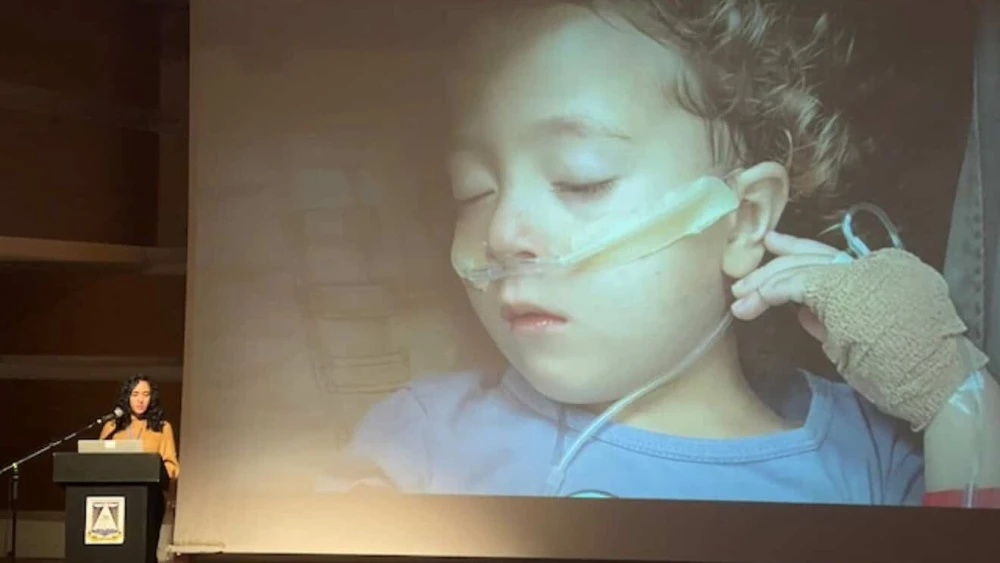
The most emotionally charged presentation came from Nataly Whitmarsh, 35, a resident of Rosh HaAyin. She revealed that her four-year-old daughter, Adele, has for the last three years suffered from debilitating health problems due to the polluted air. Adele has spent 45 days in the hospital over a dozen emergency visits. (Most recently, she spent all of Chanukah in the hospital.)
Heavy silence fell over the audience as Whitmarsh showed pictures of Adele, first as a healthy little girl, then as an invalid attached to breathing tubes.

Whitmarsh also showed the medical contents of her daughter’s knapsack, including steroids and an inhaler meant for adults. She needs three puffs, twice a day. “And those are on the good days,” she said.
“The symptoms are always the same. A slight cough that turns into rapid breathing and the need for an oxygen mask. The doctors’ answer [initially] was, ‘These are winter viruses,’” she said.
So when Adele had an attack in July, Whitmarsh was surprised. It was just as the family was about to depart for a Dead Sea holiday. They decided to continue with their vacation, ready to head to the hospital if necessary. But Adele’s health immediately improved in the cleaner Dead Sea air. “That was the day that I [understood] that Adele’s attacks were influenced by the air that she breathed,” she said.
Whitmarsh described a routine of constant vigilance. She regularly checks her daughter’s blood oxygen levels. Each morning, she visits the Environmental Protection Ministry’s website for measures of particulate matter density. It was these tiny particulates that triggered her daughter’s illness, she said.
Whitmarsh, who immigrated to Israel from California 17 years ago, told JNS that moving would seem the easy solution, but it’s not so simple. She and her husband bought their house in Rosh HaAyin, where they both work. One of her six children just started junior high. And the pollution problem exists across much of the country.
She concluded her presentation on a patriotic note: “I don’t accept running away, because we’re going to win. We will not allow terror to drive us out of our homes. When it was suggested to me to attend this conference, I was asked what message I wanted to convey. The message is very simple. Fight. For our children, for our country, for our air. Do whatever it takes.”
Rosh HaAyin Mayor Sagi expressed optimism. He noted a meeting two weeks ago with Smotrich, who in addition to serving as foreign minister holds a portfolio in the Defense Ministry giving him authority over civilian affairs in Judea and Samaria.
At that meeting, Smotrich presented a multi-layered plan that includes establishing a new unit that would pull together elements from the army, National Fire & Rescue Authority, Israel Police and Nature and Parks Authority. The new unit would have authority to act on both sides of the seamline.
Many of the speakers expressed the wish that this would be the first and last conference of its kind.