Two Israelis sustained light wounds on Thursday when rocket shrapnel fell in Katzrin, the largest Israeli community in the Golan Heights.
The victims, who were both said to be in their 20s, were treated by Magen David Adom medics and paramedics before being evacuated to Ziv Medical Center in the nearby city of Safed, the medical emergency response group tweeted.
Hezbollah terrorists in Southern Lebanon fired more than 100 rockets in the latest barrage, with direct hits and major damage reported across the Golan and Galilee.
Air-raid sirens blared incessantly in northern Israel on Thursday, warning of incoming rocket and missile fire, as well as suicide drones.
As of 3 p.m., seven “suspicious aerial targets” had attempted to penetrate the country’s skies, four of which were intercepted by air-defense systems, the IDF said.
Amid the escalation, schools in the Golan Heights and Safed were closed, with institutions in the latter city forced to stop matriculation exams as students rushed to shelter.
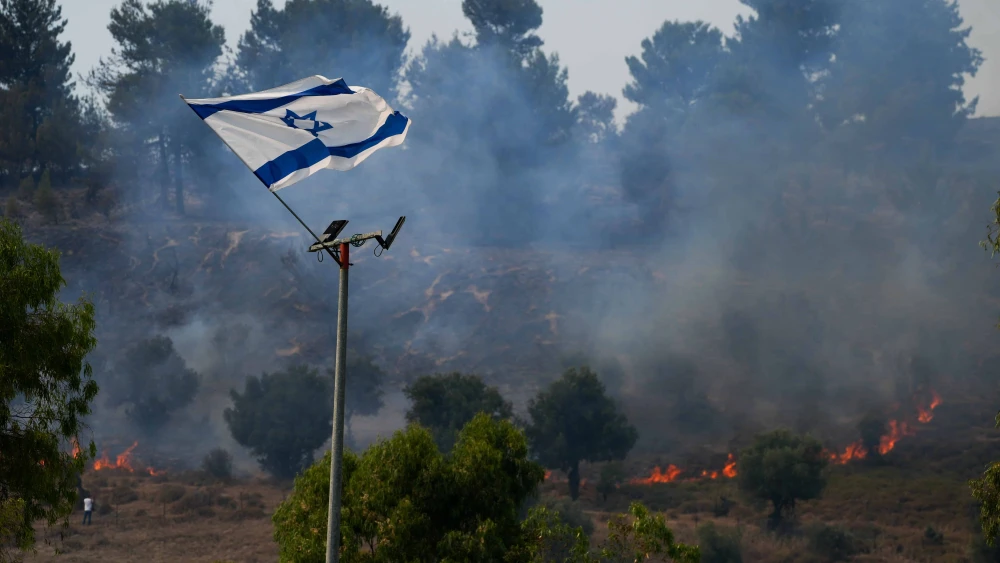
The rocket barrages sparked new fires throughout the northern region, including in Safed, with the Israel Fire and Rescue Services reporting blazes in at least 10 locations.
A large fire has erupted in the city of Safed following the massive barrage of rockets. pic.twitter.com/ofZUuEZPi5
— Hen Mazzig (@HenMazzig) June 13, 2024
The Iran-backed Hezbollah terrorist organization has attacked northern Israel nearly every day since joining the war in support of Hamas on Oct. 8, killing more than 20 people and causing widespread damage. Tens of thousands of Israelis remain internally displaced due to the violence.
A Hezbollah terrorist official told Qatar’s Al Jazeera channel that Thursday’s attack marked “the largest and most comprehensive attack” since Oct. 8, claiming the group launched 150 missiles and 30 drones.
On Wednesday, as Israeli families celebrated the festival of Shavuot (the “Feast of Weeks”), Hezbollah launched more than 200 rockets at the Jewish state in one of the heaviest attacks in recent months.
The attacks on civilian population centers came after the Israeli Air Force’s targeted killing of Hezbollah commander Sami Taleb Abdullah, who headed the Nasr Unit, or “Victory Force,” one of the terror group’s three divisions in Southern Lebanon, responsible for the eastern sector.
The United States is very concerned about the situation on the Israel-Lebanon border escalating further into full-out war, a senior Biden administration official told the Reuters press agency on Thursday.
“We have had consistent and urgent conversations at different times with Israel and Lebanon over the eight months, from the very beginning of this crisis, ... to keep this from developing into a full-out war that could have implications to beyond elsewhere in the region,” said the official.
Jerusalem’s powerful War Cabinet—which currently consists of Prime Minister Benjamin Netanyahu and Defense Minister Yoav Gallant, in addition to two observers—was set to meet on Thursday night to discuss the situation in the north.
The broader Security Cabinet is scheduled to meet in Jerusalem at 9 p.m. on Sunday.
“Lebanon and Hezbollah, under the guidance of Iran, bear full responsibility for the deterioration of the security situation in the north,” Israeli government spokesperson David Mencer said on Thursday.
“Whether through diplomatic efforts or otherwise—Israel will restore security on our northern border,” added the spokesperson.
The IDF Home Front Command is prepared for a full-out war with Hezbollah, commander Maj. Gen. Rafi Milo reiterated on Sunday.
“If the IDF needs to go to war in the north, we are ready. We have made great efforts to achieve this in recent months,” the Home Front Command head stated at the MuniWorld Conference in Tel Aviv.