Newsletter
Newsletter Support JNS

Israel packs up Ukraine field hospital

Some 6,000 patients were treated in the Kochav Meir hospital since it opened its doors on March 21; Israeli humanitarian assistance to Ukraine to continue.

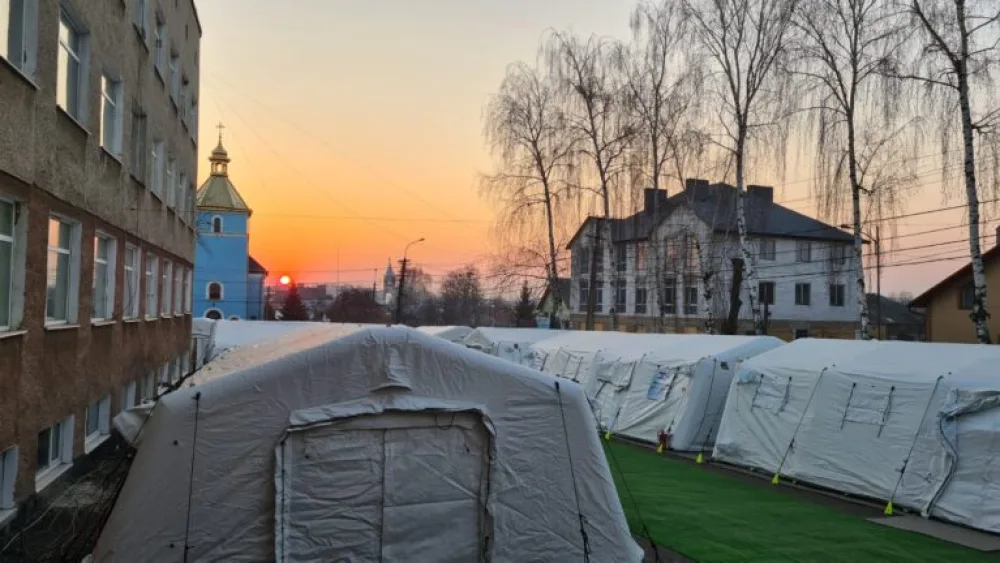
The Israeli field hospital in Mostyska, Ukraine. Photo by Naama Frank Azriel.

After six weeks of operation and 6,000 patients treated, Israel has shut down its field hospital in Western Ukraine and returned its medical team to Israel, Israel News Network reported on Friday.

The Kochav Meir (Shining Star) hospital was set up jointly by the Israeli health and foreign ministries, in collaboration with Sheba Tel Hashomer Medical Center, the Rambam Healthcare Campus and HMO Clalit Health Services.

Situated in the city of Mostyska, the 66-bed hospital was open 24/7 after opening its doors on March 21 and was staffed by more than 60 personnel.

The hospital included an internal-medicine ward for adults and children, an emergency room, delivery room and primary-care clinic, according to the ministry. It also employed advanced telemedicine technologies spearheaded by Sheba.

In the Israeli Health Ministry’s March 6 announcement of the mission to Ukraine, Health Minister Nitzan Horowitz called it “the least we can do to help the Ukrainian people in the face of a brutal Russian invasion.”

Despite shutting down the medical center, Israel will continue to provide humanitarian assistance to Ukraine, the report said.

More than 700 injured as a state of emergency is declared and international aid is rushed to the South American country.
Basil Sweid, 32, a driver in the military’s 75th Battalion, was “a virtuous man of good character,” his city council said.
Banning brit milah would prevent Jewish life from flourishing in Europe, said Katharina von Schnurbein.
“If this is false information, negotiations would end, immediately!” he said.
The Jerusalem-based India x Israel Nexus seeks to strengthen business, cultural and policy cooperation between the two countries.
Panelists at JNS Summit say educational reforms, new media voices and opposition to extremism are laying the groundwork for broader Middle East normalization with Israel.
Benny Gantz, JNS editor-in-chief Jonathan S. Tobin, Gilad Erdan, Mosab Hassan Yousef, Nissim Black and leading voices in security, diplomacy, media, law and Jewish communal affairs headline the summit’s third day in Jerusalem.