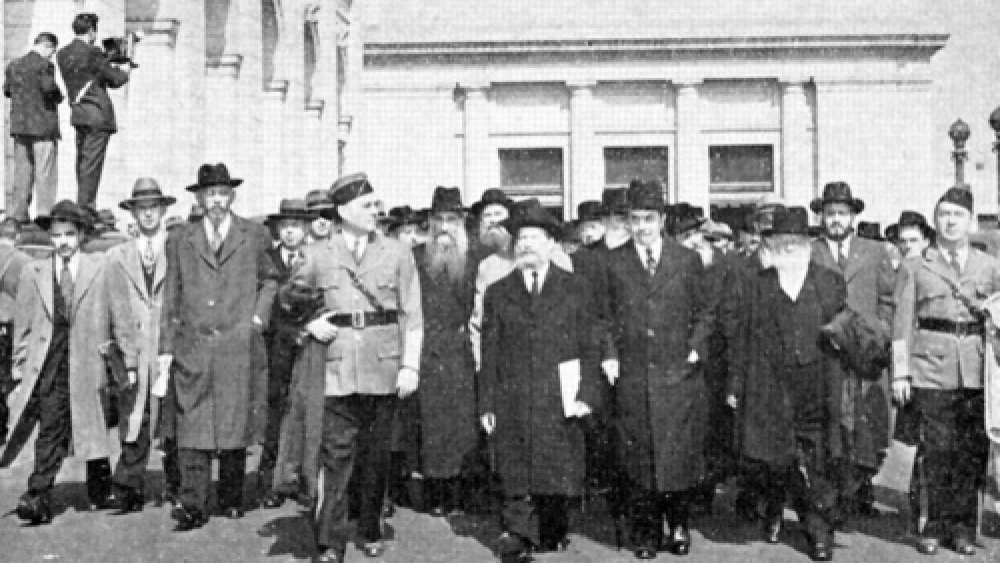
During the Holocaust years, there was only one march in Washington, D.C., to plead with President Franklin Delano Roosevelt to rescue Europe’s Jews. As the 70th anniversary of that remarkable demonstration approaches, the protest is finally gaining mainstream recognition in the Jewish community.
In the autumn of 1943, the Jewish activists known as the Bergson Group teamed up with an Orthodox rescue group, the Va’ad Ha-Hatzala, to bring more than 400 rabbis to Washington three days before Yom Kippur.
On the steps of the Capitol, the marchers were met by Vice President Henry Wallace and prominent Members of Congress. Two of the rabbis read aloud the group’s petition to the president, in Hebrew and English:
“Children, infants, and elderly men and women, are crying to us, ‘Help!’ Millions have already fallen dead, sentenced to fire and sword, and tens of thousands have died of starvation… And we, how can we stand up to pray on the holy day of Yom Kippur, knowing that we haven’t fulfilled our responsibility? So we have come, brokenhearted, on the eve of our holiest day, to ask you, our honorable President Franklin Roosevelt... to form a special agency to rescue the remainder of the Jewish nation in Europe.”
They marched to the gates of the White House, expecting a small delegation would be granted a brief meeting with President Roosevelt. Instead, to their surprise and disappointment, they were met by presidential secretary Marvin McIntyre, who told them the president was unavailable “because of the pressure of other business.”
In fact, the president’s daily schedule reveals that after lunch, he had no further meetings until the evening. The rabbis reached the White House at 2 p.m. But the president had no interest in giving the protesters the legitimacy and attention that a White House meeting confers. And it did not help that his Jewish advisers, embarrassed by the marchers, urged FDR to snub them.
If FDR thought he could avoid the rescue issue by avoiding the rabbis, he was mistaken. A headline in the next day’s Washington Times-Herald declared: “Rabbis Report ‘Cold Welcome’ at the White House.” A columnist for one Jewish newspaper angrily asked, “Would a similar delegation of 500 Catholic priests have been thus treated?” The editors of another Jewish newspaper, Forverts (Forward), reported signs of a new mood in the Jewish community: “In open comment it is voiced that Roosevelt has betrayed the Jews.”
In my interviews over the years with rabbis who took part in the march, they invariably expressed the feeling that they had failed. Since they had not been able to secure the president’s attention even for a few minutes, the rabbis felt the march had accomplished nothing. They were mistaken.
The march—combined with the Bergson Group’s campaign of newspaper ads and lobbying in Congress—helped attract much-needed attention to the rescue issue. It helped galvanize a crucial groundswell of public support necessary to move ahead with a congressional resolution calling for the creation of a U.S. government agency to rescue refugees.
That resolution, in turn, set off a battle between rescue advocates and the State Department that concluded with FDR being forced to create a rescue agency, the War Refugee Board. During the final 15 months of World War II, the Board helped rescue some 200,000 Jews in Europe. (Among other things, the Board financed the work of rescue hero Raoul Wallenberg.)
For many years, however, there was no mention of the march, either in Jewish history books or Holocaust museums. Whether because of bias against the activists, affection for FDR, or simply lack of awareness about the march, historians and museum curators routinely omitted the only demonstration in Washington against the Holocaust.
But in recent years, that has begun to change. After a campaign of protests and petitions, the U.S. Holocaust Memorial Museum added an exhibit about the Bergson Group, including a photo of the marching rabbis. The Encyclopedia Judaica and the Encyclopedia of the Holocaust now mention the march. Major new reference works, such as Jonathan Sarna’s American Judaism and Marc Lee Raphael’s Columbia History of Jews and Judaism in America, include the march. Even a recent book defending FDR’s response to the Holocaust included a page and a half
about the march.
It may have taken 70 years, but the march of the rabbis has finally been written back into history.
Dr. Rafael Medoff is director of The David S. Wyman Institute for Holocaust Studies. His latest book is “FDR and the Holocaust: A Breach of Faith.”