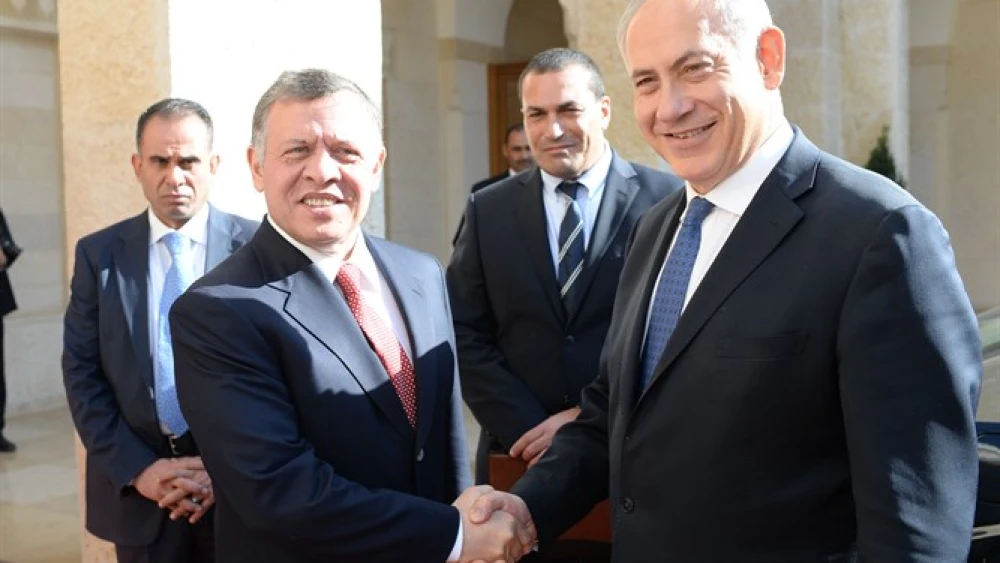
“The Jordanian-Israeli relationship is at an all-time low,” Jordan’s King Abdullah said on Thursday at an event in New York City hosted by the Washington Institute for Near East Policy.
The two countries recently marked the 25-year anniversary of their historic peace agreement, although their relations have recently become strained.
“Part of it is because of the Israeli domestic matters,” said Abdullah, in an apparent reference to the political gridlock in Israel which could see the country hold its third election in less than a year.
“The problems that we have had with Israel [are] bilateral. ... Now I hope, whatever happens in Israel over the next two or three months, we can get back to talking to each other on simple issues that we haven’t been able to talk about for the past two years,” said Abdullah.
In his remarks, Abdullah also discarded the notion that peace could be achieved between Israel and the Palestinians without the backing of the United States.
“Anybody who is in the international community who says that we can have peace between Israelis and Palestinians without the support of America doesn’t know our region and the role that America plays,” he said. “We all need America to bring both sides together.”
https://www.youtube.com/watch?time_continue=2&v=9AQSgidHi60&feature=emb_logo
Jordan has long supported a two-state solution to the Israeli-Palestinian conflict, which would include the establishment of a Palestinian state in Judea and Samaria, Gaza Strip and eastern Jerusalem.
In September, Abdullah said that if Israel goes ahead with the idea of annexing all the settlements in Judea and Samaria it would be a “disaster” for attempts to find any two-state solution.
Speaking after talks with German Chancellor Angela Merkel at the time, Abdullah said he was “extremely concerned” about Israeli Prime Minister Benjamin Netanyahu’s vow to annex parts of Judea and Samaria.
Abdullah on Thursday added that the peace process was currently stalled, suggesting it could not be revived until after a new Israeli government is formed.
“Unfortunately, we are in pause mode. As you well know, Israelis have gone through a series of elections. We may be seeing another three months of elections,” he said. “So as a result, we are all in pause mode and we haven’t been able to get people back around the table, talking to each other.”
The Jordanian king stressed that Israel’s full integration into the Middle East requires a solution to the Israeli-Palestinian conflict.
“Israel’s future is being a part of the Middle East, but the problem is that is never going to happen 100% unless we solve the Palestinian problem. There is a lot of people in our part of the world who can say behind closed doors: ‘Do whatever you want.’ But in reality it is a sensitive or an emotional issue. Unless we can solve the Israeli-Palestinian issue, we will never have the full integration that all of us deserve,” he remarked.
This article first appeared in Israel Hayom.