Newsletter
Newsletter Support JNS

Netanyahu’s security measures tightened following drone attack

The prime minister has been conducting most of his work from a secured location underneath the Prime Minister’s Office in Jerusalem.

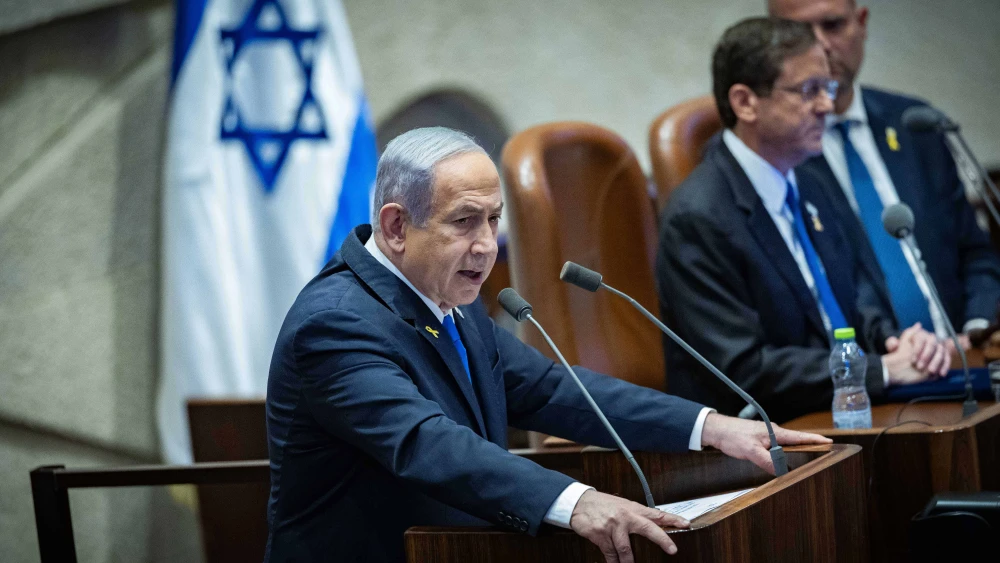
Israeli Prime Minister Benjamin Netanyahu speaks during a plenary session of the opening day of the winter session at the Knesset, the Israeli parliament, in Jerusalem, Oct. 28, 2024. Photo by Yonatan Sindel/Flash90.

For the past three weeks, Israeli Prime Minister Benjamin Netanyahu has worked mostly from a safe room in the basement level of the Prime Minister’s Office in Jerusalem, Israel’s Channel 12 News reported on Sunday.

Netanyahu has been conducting most of his routine schedule and meetings from this secure location since a Hezbollah drone hit his private residence in Caesarea on Oct. 19.

In the wake of the attack, security officials cited in the report recommended that the Israeli premier avoid remaining in one location for too long, as well as postponing the wedding of his son Avner.

Hezbollah’s Oct. 19 drone attack included three drones, one of which scored a direct hit on a bedroom window at Netanyahu’s Caesarea residence. The premier and his wife were not home at the time.

Following the attempted assassination, security measures for government ministers and other officials were “significantly” reinforced, according to the report.

“The attempt by Iran’s proxy Hezbollah to assassinate me and my wife today was a grave mistake,” the prime minister said after the incident. “This will not deter me or the State of Israel from continuing our just war against our enemies in order to secure our future. I say to Iran and its proxies in its axis of evil: Anyone who tries to harm Israel’s citizens will pay a heavy price,” he added.

Ilana Gritzewsky, a former Hamas captive, told the U.N. Human Rights Council she is “living proof” of sexual violence, challenging rapporteur Reem Alsalem.
“There is an understanding here that Israel has a problem with Hezbollah and that something needs to be done about it,” said the Dutch defense chief.
The terror group “must be eradicated,” said Israeli security expert Amir Avivi.
The convoys will travel toward Prison 10 near Kfar Yona, where some yeshivah students are being held.
“I have Iran on the ‘ropes,’ ready to go down for the fall,” said the U.S. president.
Experts at JNS Summit examine claims of institutional bias against Israel at the United Nations.

Benny Gantz, JNS editor-in-chief Jonathan S. Tobin, Gilad Erdan, Mosab Hassan Yousef, Nissim Black and leading voices in security, diplomacy, media, law and Jewish communal affairs headline the summit’s third day in Jerusalem.