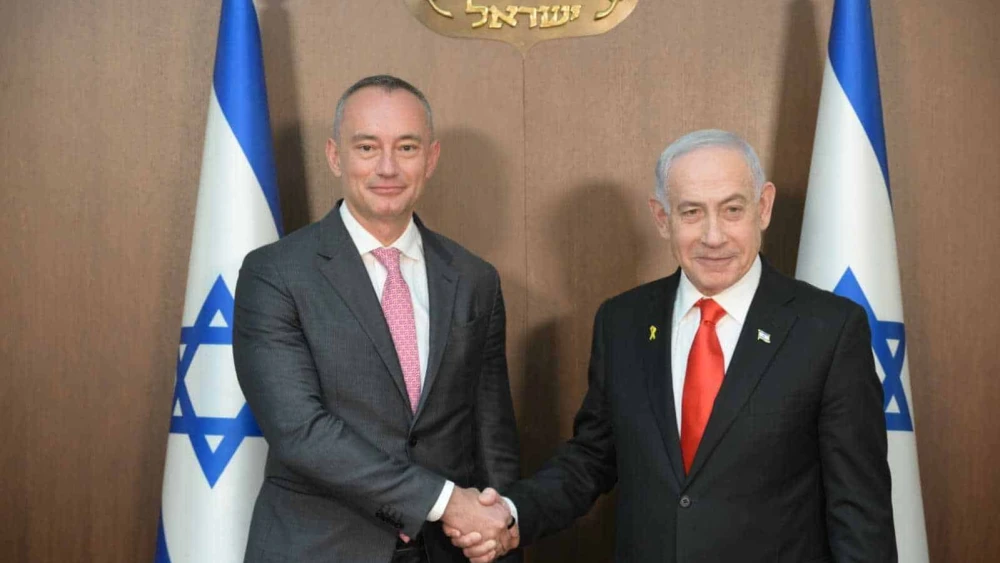
Nickolay Mladenov, the Board of Peace’s high representative for Gaza, said on Thursday that mediators had agreed on a framework for the Strip’s reconstruction and a “negotiated resolution of the Palestinian question.”
The proposal “is now on the table,” Mladenov tweeted, adding: “It requires one clear choice: full decommissioning by Hamas and every armed group, with no exceptions and no carve-outs.”
An unnamed senior U.S. official told NPR on Thursday that mediators presented Hamas with the proposal in Cairo last week. The terrorist group was reportedly asked to provide its formal response to the plans as early as this week.
However, a Hamas official told the U.S. public broadcaster that the Iranian-backed terror group was awaiting the outcome of the joint U.S.-Israeli campaign against the regime in Tehran before responding.
Under the terms of the proposal, Hamas would give up its heavy weapons, including rocket launchers, and share maps of its underground terror tunnel network, NPR reported. It remained unclear how or to whom Hamas would hand these over.
Palestinians who previously served in the Hamas-controlled administration would be allowed to become police officers as long as they successfully completed a vetting process, according to the report.
Implementing the Board of Peace’s proposals, including the disarmament process, could take up to eight months, officials involved in the efforts told The New York Times on Friday.
The U.S. State Department had not responded to a request for comment on the reported terms at time of publication.
Senior Board of Peace officials, including Mladenov, have repeatedly stressed that reconstruction can only commence after Gaza’s demilitarization, including Hamas’s full disarmament, so that the Strip no longer poses a threat to Israel.
Speaking during a panel at the Munich Security Conference last month, Mladenov said that “Gaza needs to be governed by a transitional authority, as authorized by the Security Council resolution, under which it needs to take on the full civilian and security control of Gaza,” in reference to U.S. President Donald Trump’s peace plan, which has received formal backing of the United Nations.
“That includes the disarmament of all factions in Gaza, not just Hamas,” he stated. “Hamas, Islamic Jihad, others—there are plenty of them who have weapons and tunnels and production facilities inside Gaza.”
According to Mladenov, “that is the condition under which we can see Israeli forces withdraw from the current Yellow Line in order to be able to begin any reconstruction for the Gaza Strip.”
Mladenov’s comments closely echoed comments by Israeli Prime Minister Benjamin Netanyahu on Jan. 26 following the start of Phase 2 of the U.S.-brokered ceasefire deal.
Jerusalem is “at the threshold of the next phase: Disarming Hamas and demilitarizing the Gaza Strip,” the premier told Knesset lawmakers at the time, emphasizing that “the next phase is not reconstruction.”
Netanyahu has repeatedly said that disarmament “will happen—as our friend Trump said—the easy way or the hard way, but it will happen.”
However, top Hamas leaders like Khaled Mashaal and Musa Abu Marzouk have rejected key parts of Trump’s plan in recent months, including disarmament, despite having agreed to the proposal in October.
“The resistance and its weapons are the ummah’s [Islamic nation] honor and pride,” Mashaal told an anti-Israel summit in Istanbul on Dec. 6. He added, “A thousand statements are not worth a single projectile of iron.”