


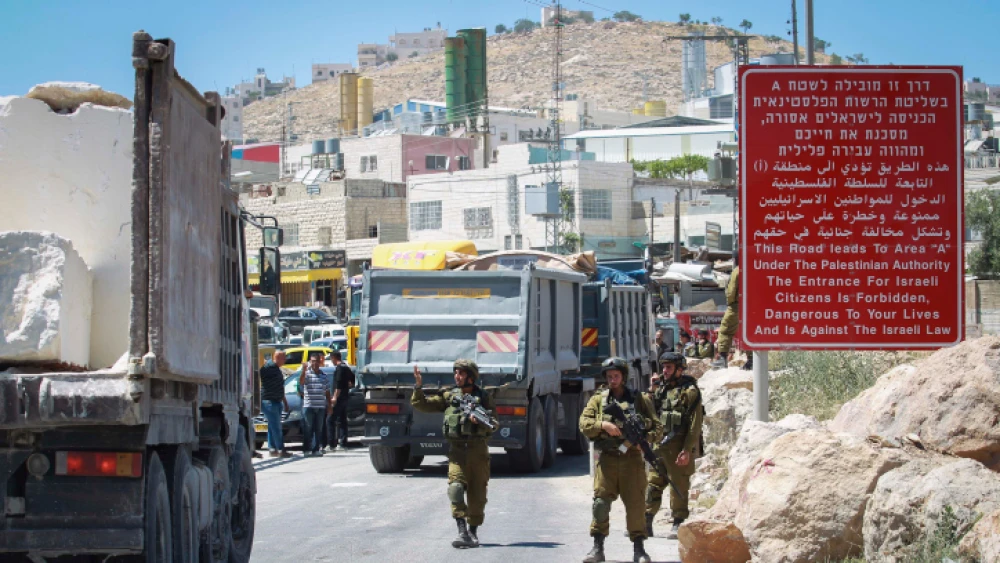
Israel Defense Forces soldiers withdrew from Hebron on Monday morning, ending a counterterrorism operation that began with the deadly Oct. 23 attack near the Judea city, a military official told JNS.
The Judea Brigade is now focusing on its defensive mission ahead of the weekend, when tens of thousands of Jews are expected to flock to Hebron for the Chayei Sarah Torah portion.
As part of the 10-day operation, IDF soldiers worked alongside Israeli Defense Ministry bodies to demolish illegal infrastructure near the Yehuda Junction, where Staff Sgt. Ron Yonatan Roytman and Sgt. Yuval Shai Svilem were killed on Oct. 23, according to the official.
They also carried out engineering work “to improve security conditions and strengthen defensive measures,” the official said.
A week after the attack, IDF soldiers demolished the homes of the two terrorists who carried out the attack.
In a targeted operation in a neighborhood belonging to a Hamas-affiliated clan, soldiers searched buildings and detained suspects for questioning. They seized four weapons, several vests and other military equipment. They also sealed an underground shaft next to one of the terrorists’ homes.
Soldiers and Israel Police also confiscated 25 illegal vehicles similar to the one the terrorists used in the attack.
“Counterterrorism activities throughout Judea and Samaria continue,” the official said.
Israeli Prime Minister Benjamin Netanyahu said on Oct. 24 that he had instructed the IDF and the Israeli Security Agency (Shin Bet) to draw up a “daring and comprehensive” plan unlike anything seen since the Six-Day War in 1967, aimed at uprooting terrorism in Judea and Samaria.
He spoke during an interview with broadcaster Channel 14, in which he was asked about the deadly shooting attack.
Explaining his directive to the IDF and the Israel Security Agency (Shin Bet), Netanyahu said that his government knows that “the Palestinian Authority is a body hostile to the State of Israel that seeks to eliminate us in various ways.”
Palestinian terrorists targeted Israeli Jews in Judea and Samaria at least 5,051 times in 2025, according to figures published by the Rescuers Without Borders (Hatzalah Judea and Samaria) NGO.
The figures do not include the hundreds of violent attacks on Israeli security personnel occurring during ongoing counter-terrorism operations in Arab towns under the control of the Palestinian Authority.
Twenty-four Israelis were murdered in Judea and Samaria in 2025, and more than 400 others were wounded, per the group’s annual report.
The findings, which were cross-checked against official data from Israeli security agencies, included 3,299 instances of rock-throwing, 458 firebomb attacks, 655 attempts to blind drivers with laser pointers, 286 attacks involving explosives and 19 shootings.


