
After three years of war, national trauma and relentless efforts to unseat Israeli Prime Minister Benjamin Netanyahu, Israeli voters appear to have delivered a remarkable verdict: They have returned the country to essentially the same political deadlock that characterized Israel before the Oct. 7, 2023, Hamas massacre.
Neither Netanyahu’s bloc nor the Zionist opposition has secured the 61 Knesset seats necessary to form a government. Despite new parties promising to reshape Israel’s political landscape, voters have largely returned to familiar political camps.
The effort to dislodge Netanyahu has, at least for now, failed.
Likud remains Israel’s largest party
With millions of votes counted as of Wednesday morning, preliminary projections placed Netanyahu’s bloc at approximately 54 seats, compared with 47 for the Zionist opposition and 19 for the Arab parties.
Likud emerged as the largest party with approximately 27 seats, followed by Gadi Eisenkot’s Yashar with 20. Naftali Bennett and Yair Lapid’s joint B’Yachad list was projected to receive 11 seats, Yair Golan’s Democrats eight and Avigdor Lieberman’s Yisrael Beiteinu eight.
On the right, United Torah Judaism was projected to receive seven seats, Shas seven, Otzma Yehudit seven and Religious Zionism six.
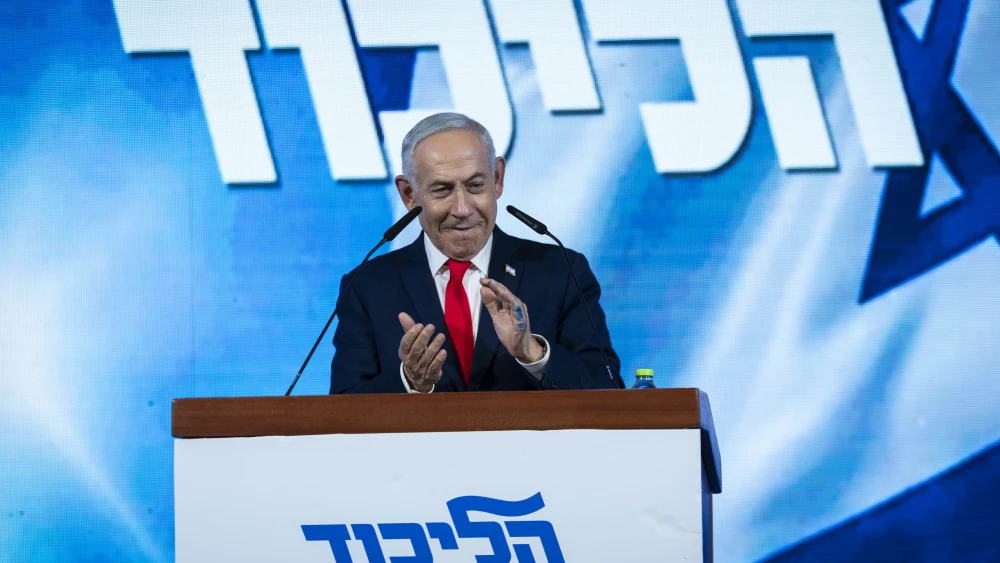
Netanyahu waited until after 3 a.m. Wednesday to address supporters at Likud’s election headquarters in Jerusalem.
“We are still waiting for the actual results,” he said, emphasizing that Likud would remain Israel’s largest party.
“The right-wing bloc has a clear, decisive majority among the Zionist public,” Netanyahu declared, calling for a strong national government and warning against a coalition dependent on Arab parties.
Although Netanyahu’s bloc has fallen short of the 64 seats it won in 2022, Likud’s continued dominance is significant. His opponents have yet to demonstrate that they can construct a viable alternative government.
Pollsters underestimated Likud
The early count exposed significant discrepancies between the final pre-election surveys and the actual vote.
Israeli television channels 11, 12 and 13 projected that Likud would win between 19 and 21 seats, while Eisenkot’s Yashar was expected to receive 22 to 23, potentially becoming Israel’s largest party.
Channel 14, which consistently projected a stronger Likud and right-wing bloc, forecast 30 seats for Likud and 20 for Eisenkot—considerably closer to the emerging results than the other major networks.
The discrepancies raise questions about how Israel’s polling organizations measured voter intentions, particularly among undecided voters.
Opposition leaders declared victory prematurely
Shortly after voting closed at 10 p.m., Eisenkot, Bennett and Lapid delivered speeches suggesting that Netanyahu’s political era had ended.
Eisenkot declared that Israelis had voted for change and called on Netanyahu to accept the public’s verdict.
“The people of Israel have stood up and spoken: Netanyahu has lost,” Bennett declared.
Lapid proclaimed: “The State of Israel has saved itself today.”
Yet even the initial exit polls did not give the Zionist opposition a governing majority.
And as actual votes were counted overnight, Netanyahu’s bloc pulled ahead.
The opposition leaders celebrated a victory they had not secured. Their central campaign objective was to remove Netanyahu, but the parliamentary arithmetic offers no clear path to that goal.
The Arab vote complicates coalition arithmetic
One of the election’s biggest surprises has been the unexpectedly strong performance of Israel’s Arab political parties, as of Wednesday morning projected to receive approximately 19 seats, compared with 10 in the outgoing Knesset.
The increase creates a dilemma for the opposition.
Together, the Zionist opposition and Arab parties may command more than 61 seats, but a parliamentary majority on paper does not automatically translate into a viable coalition.
Bennett, Lapid and Liberman have opposed forming a government dependent on Arab parties.
Ironically, the stronger Arab vote may have increased the numerical anti-Netanyahu majority while making it politically harder to establish an alternative government.
New names, familiar political parties
Perhaps the election’s most striking feature is how little Israel’s political landscape appears to have changed.
Numerous new parties entered the race hoping to capitalize on public dissatisfaction with the established leadership. Yet none of the smaller insurgent parties appears to have crossed the electoral threshold.
Even Eisenkot’s Yashar, technically a new party and one of the election’s largest lists, represents more of a political rebranding than a genuine breakthrough.
Eisenkot was previously the No. 2 figure in Benny Gantz’s Blue and White political alliance. He has effectively emerged at the head of a successor political formation, drawing on an established electoral constituency rather than creating an entirely new one.
Bennett and Lapid likewise joined forces under a new electoral banner, but both are familiar figures with longstanding political constituencies.
Meanwhile, Likud, Shas, United Torah Judaism, Religious Zionism and Otzma Yehudit remain the core of Netanyahu’s bloc.
Many of the lists entering the next Knesset bear a striking resemblance to those represented in the outgoing parliament.
The election has produced new party names and rearranged leadership positions, but little fundamental political realignment.
Back to political paralysis
Between April 2019 and November 2022, Israel held five national elections in less than four years, repeatedly failing to produce a durable governing majority.
That deadlock ended when Netanyahu assembled a 64-seat coalition following the November 2022 election.
Now, after the Oct. 7 massacre and a prolonged multifront war, Israel appears to be headed toward the same predicament.
For a government to emerge, either Bennett, Eisenkot or Liberman will have to reconsider joining Netanyahu, or the opposition will need an arrangement involving Arab parties.
Otherwise, Israel may face yet another election.
Trump, Iran and the 2020 precedent
One powerful factor in Netanyahu’s favor is the strong endorsement he has received from U.S. President Donald Trump.
Trump has made clear his preference for Netanyahu to remain prime minister during his remaining two years in office, with the confrontation against Iran at the top of their shared agenda.
“Vote for Bibi Netanyahu for Prime Minister; we have to finish the job that we started!” Trump declared on the eve of the election.
He doubled down following the election, crediting his endorsement with helping Netanyahu’s stronger-than-expected showing.
“When President Trump endorsed Bibi Netanyahu, the whole tide turned,” Trump posted on Truth Social, quoting a statement attributed to Irving C. Schwartz. The post said that instead of a “decisive defeat,” the result appeared to be a “big come-from-behind stalemate, or even a WIN for Netanyahu.”
“It all took place AFTER the Endorsement by President Trump,” the post added.
Netanyahu reinforced that message in his overnight election speech.
“Israel is facing a historic, one-time opportunity along with our friend President Trump,” he said, “to remove the Iranian threat once and for all.”
A prolonged coalition deadlock followed by another election could consume six critical months of Trump’s remaining presidency.
There is a precedent for national circumstances overcoming Israel’s political paralysis.
Following Israel’s third consecutive election in March 2020, the COVID-19 pandemic presented an unprecedented national emergency. Benny Gantz, Netanyahu’s principal challenger, recognized the broader implications of the crisis and agreed to establish a unity government with a rotating premiership.
Gantz, notably, has failed to return to the Knesset in the current election.
The unresolved confrontation with Iran now presents another potential catalyst for political compromise.
The opposition’s preferred outcome was to remove Netanyahu. But the emerging parliamentary arithmetic has not provided a clear path to doing so.
The question facing Israel’s political leaders is whether the opportunity to confront the Islamic Republic alongside a willing American president can overcome the divisions that have repeatedly paralyzed the country.
Trump has an interest in avoiding further delays. President Isaac Herzog, whose constitutional role includes consultations over government formation, would also have reason to seek a resolution without another election.
The precedent of 2020 demonstrates that bitter political rivals can find a formula for governing together when national circumstances demand it.
Israel’s indispensable man?
The paradox of Israel’s 2026 election is that the country has changed dramatically, while its electoral politics have changed remarkably little.
Israel’s security environment has been transformed. Its military has fought across multiple fronts. Its citizens have endured enormous sacrifices.
Yet voters have returned to essentially the same political divisions that existed before the war.
Netanyahu has not secured a governing majority. But neither has the opposition succeeded in removing him.
With Trump committed to confronting Iran and less than two years remaining in his presidency, the stakes of another election extend well beyond domestic politics.
Israel’s political leaders must now decide whether to seek a governing arrangement capable of addressing those challenges or return the country to another prolonged election campaign.
For all the efforts to end Netanyahu’s political career, he remains at the center of Israel’s coalition arithmetic—and its relationship with Washington.
Israel has changed. Its politics, remarkably, have not.