
Security, economy and societal issues are the key topics preoccupying Israeli voters. What this means specifically depends on whom one asks as “security” means different things to different Israelis. Observers told JNS that the specific issues include Iran and the current war, haredi enlistment, and the economy.
“For probably the last 60 years or so, the top issue defining right and left in Israel is security, especially during the past three years with a lot of conflicts still open and active,” Liron Lavi, assistant professor at the department of political studies at Bar-Ilan University in Ramat Gan, told JNS.
Voters across the political spectrum are concerned about security, but their priorities differ, she said. Right-wing voters tend to focus on the Iran threat and the need to prevent the Islamic Republic from obtaining nuclear weapons.
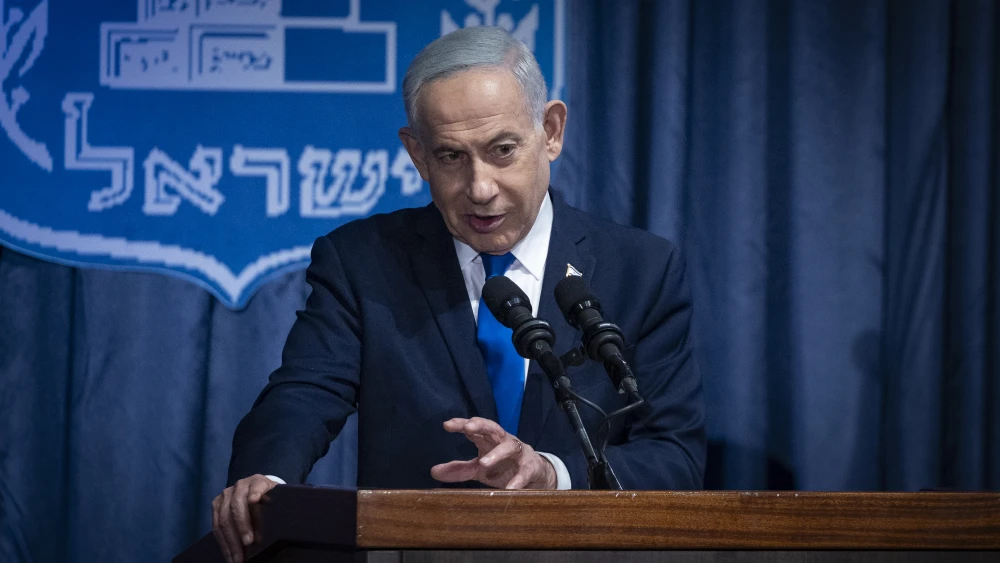
Israeli Prime Minister Benjamin Netanyahu has pushed the Iran issue front and center in the campaign’s final stretch, posting to his social media accounts an AI-generated image of Tel Aviv hit by a nuclear bomb. The image had been posted previously by Israeli high-tech entrepreneur Yuval Blumberg, together with a lengthy tweet (which Netanyahu also shared), making the case that the prime minister and U.S. President Donald Trump are best positioned to bring down the Islamic regime.
Trump has twice endorsed Netanyahu, posting to his Truth Social account on Sunday night: “Vote for Bibi Netanyahu for Prime Minister; we have to finish the job that we started!”
Underscoring the danger from the ayatollahs, Netanyahu warned on Sunday that Iran and its proxies might try to interfere with Israel’s election. Standing in front of an anti-missile battery, he warned Iran, “Don’t test us. You will suffer disproportionate blows.”
Appearing on Channel 14’s “The Patriots” (the opposition promises to shut down the politically conservative channel), Netanyahu dramatically stood up during an appearance on Sunday night to “speak from the heart” and warn that the opposition wouldn’t be able to stop Iran from rebuilding its nuclear weapons program.
There’s a question how much Netanyahu’s plea will appeal beyond his base. Left-wing voters view security matters through a different lens, Lavi said. “It’s not that left-wing voters don’t recognize the Iranian threat, but it tends to be a higher priority for right-wing voters.” Left-wing voters are more concerned with opening an official investigation into the government’s failure to prevent the Oct. 7, 2023, Hamas attack. They want a state commission of inquiry. (Netanyahu has resisted forming a commission, arguing it won’t be even-handed.)
Gadi Eisenkot, chairman of the Yashar party, criticized Netanyahu for his post, calling it “another scare video” and accusing the prime minister of hysteria.
Also of concern to the left are incidents of “settler violence” in Judea and Samaria. The right downplays these incidents as coming from only a “handful” of troublemakers, Lavi said.
The right wants the multi-front war fought to a successful conclusion. The left is more skeptical that continued military operations will bring victory, especially after three years of war. “So they’re more open to other types of solutions,” Lavi said, though “even center-left voters would be generally fine with continuing the war if it led to the desired results.”
Religion and state
Michael Milshtein, head of the Palestinian Studies Forum at Tel Aviv University’s Moshe Dayan Center for Middle Eastern and African Studies, told JNS that Netanyahu is in a somewhat precarious position on security. Despite major gains on multiple fronts, Netanyahu had hoped to enter the election with clear victories in Lebanon, Gaza and Iran, Milshtein said. However, all three fronts remain open. “And we’re hearing about how Hamas is recruiting 30,000 new members,” he said.
In Milshtein’s view, security is only the second-most important issue for Israeli voters. First is the haredi, or ultra-Orthodox, issue. This involves the effort to enlist the sector’s yeshivah students into the army. Haredim have received near-blanket exemptions from military service. The community views military service as a distraction from study and fears that those who are drafted will turn away from religion. The issue has become increasingly contentious since the start of the Gaza war, as IDF reservists have faced repeated call-ups and public pressure has mounted for the ultra-Orthodox community to share the burden.
Milshtein said the issue goes beyond “haredim,” which is a “code name” for a deeper cultural question regarding the relation between religion and state. “It’s a question of the identity of the state; what the vision of the state should be,” he said.
In previous elections, Milshtein said, haredi enlistment would rank as the fourth- or fifth-most important issue for Israelis.
Lavi agreed that the haredi issue, even though it involves military enlistment, and would seem to be a security issue, is better categorized as one of religion and state. “It involves their standing in society and the role of religion in public life,” she said. However, unlike Milshtein, she said it is No. 2 in importance for Israelis behind the more pressing security concerns.
The third-most important issue is the economy, Lavi said. It’s especially important for younger voters, who worry about the future and whether the economy will continue to grow and remain strong in the coming decades. Milshtein puts the economy at No. 4, ranking a defense-related issue at No. 3: Oct. 7 and the call for a state commission of inquiry. Eisenkot, whose Yashar party leads among opposition parties, made it the most important point of his campaign, Milshtein said.