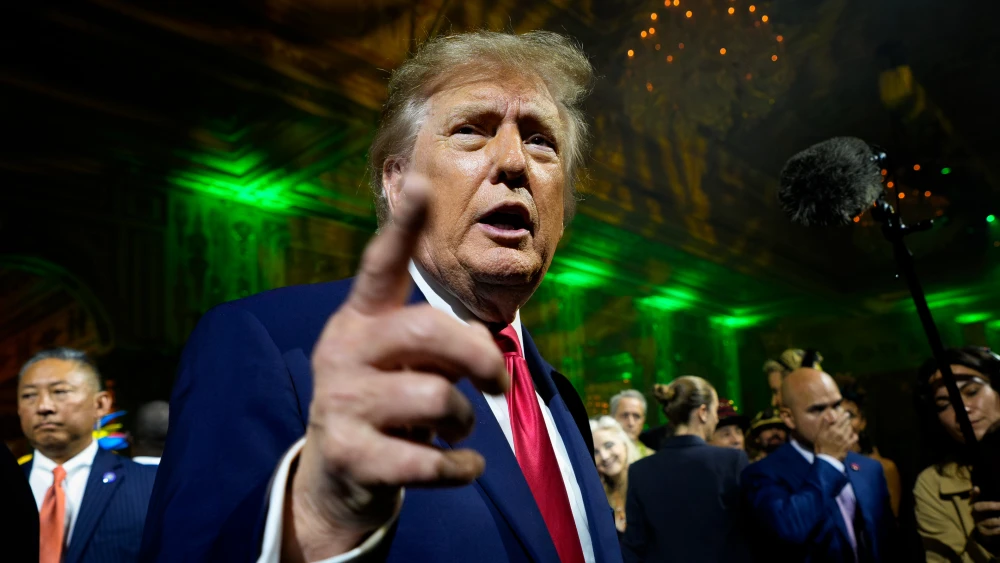
U.S. President Donald Trump said on Saturday that negotiations with Iran were “going fine,” despite describing Tehran as “not very reliable,” while suggesting that the United States could still strike one or two remaining Iranian sites.
“We still have to take care of, I would say, one or two sites, but we can do that in 10 minutes,” Trump told reporters at his Mar-a-Lago estate in Florida. He specifically mentioned Pickaxe Mountain, a suspected underground nuclear facility near Natanz, as a potential target.
🚨 NOW: President Trump announces he has MULTIPLE IRANIAN TARGETS in his sights that he could "take care of" in 10 minutes
— Eric Daugherty (@EricLDaugh) November 1, 2026
"You could look at Pickaxe Mountain. We can do that ALL very quickly."
"We can take care of, I'd say, 1-2 sites. We can do that in 10 minutes. We have that… pic.twitter.com/UqaoPrqpzP
Iranian Supreme Leader Mojtaba Khamenei on Saturday directed the country’s armed forces to prepare to respond to any attack “with an immediate, impactful, and geographically unrestricted response,” the state-affiliated Iranian Students’ News Agency and Reuters reported separately. He said Iranian forces were in high readiness along the Gulf coast, in and around the Strait of Hormuz and the Gulf of Oman, and on the country’s northwestern and southeastern borders.
Speaking at the White House on Friday, Trump said talks with Iran were continuing and asserted that Tehran was struggling to pay its security forces. “There are talks. They want to talk. They keep talking,” he said. “But look, they’re not paying their soldiers, they’re not paying their police. They’re in a lot of trouble. And we have time, frankly. It’s a war, but it’s not a typical war.”
Meanwhile, Mohsen Rezaei, secretary of Iran’s Supreme National Security Council, said on Saturday that Tehran had received a letter from U.S. Vice President JD Vance but had not formally replied, according to the state-run IRNA news agency. Rezaei claimed Washington’s tone toward the Islamic Republic had “completely changed, and this is a very good sign.”
Rezaei said Tehran had made no new decision on its nuclear doctrine, but warned of an internal debate over “whether, if another war breaks out, we want to maintain the same doctrine as before.” The regime has long claimed its nuclear program is peaceful. However, Iran has enriched uranium to 60% purity, for which the International Atomic Energy Agency has said there is no credible civilian use.
Trump on Wednesday said he had not directed Vance to send the letter, describing the initiative as an effort to help Iran obtain medical supplies. “He asked me what I thought and I said if you want to do that that’s okay,” Trump said. “Basically, it’s getting supplies in to help people that are not well.”
Iranian Foreign Minister Abbas Araghchi told Al Jazeera on Saturday that Iran’s leadership was examining Vance’s letter, calling it a “positive step,” but said there were no plans at that stage to meet with U.S. officials. He said an Iranian delegation had traveled to Doha to discuss Tehran’s proposal for reopening the Strait of Hormuz.
U.S. Secretary of State Marco Rubio said on Saturday that Trump “hasn’t made a decision” on whether to resume strikes on Iran and prefers a diplomatic resolution, Fox News reported.
Speaking at the G20 meeting in Atlanta, Rubio accused Tehran of fueling instability across the Middle East through its support for Hezbollah, the Houthis and Iranian-backed militias in Iraq.
“Anywhere you turn what you find is some Iranian proxy that’s undermining the peace and stability of the Middle East,” he said. “That is a fundamental threat that we have to confront, on top of the fact that they want nuclear weapons.”
“This is a regime that has massacred its own people,” Rubio added. “You could only imagine what it would do to others if it possessed weapons of mass destruction, which will never be allowed to happen as long as President Trump is in the White House.”
Meanwhile, the U.S. naval blockade, sanctions and obstruction of overland export routes have crippled Iran’s economy, according to a Treasury Department report obtained by Axios. The report said the rial had lost roughly a quarter of its value since the economic pressure campaign began in August, Iran’s annual inflation rate reached 90% in September and the country had not loaded any oil onto tankers since Aug. 25.
Treasury Secretary Scott Bessent is urging Trump to give the campaign, dubbed “Operation Economic Outcast,” more time rather than rush back into combat, Axios reported. U.S. officials said more time to destabilize the regime and potentially persuade Iranian leaders to make concessions in negotiations, according to the report. The Treasury report did not argue that the regime was close to collapse.
U.S. blockade, sanctions crippling Iran's economy, Treasury report sayshttps://t.co/1NvhZ0BZ6Y
— Rapid Response 47 (@RapidResponse47) October 30, 2026