


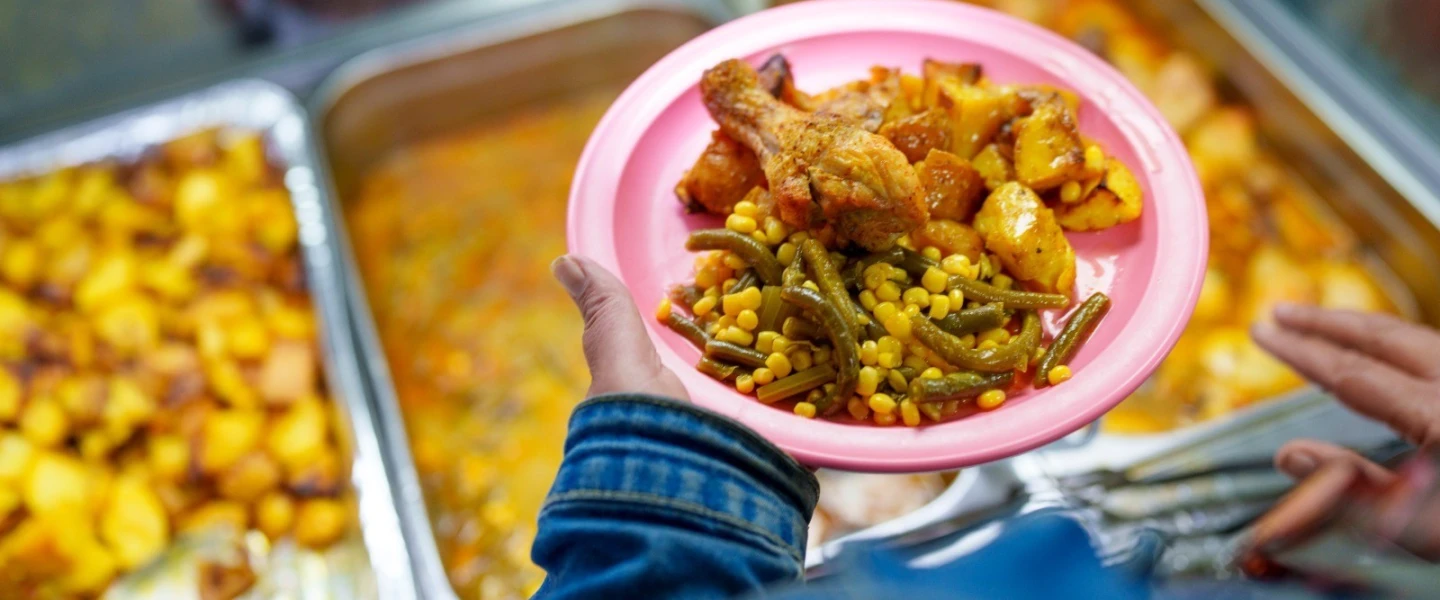
In recent weeks, Leket Israel, the National Food Bank, has been working to ensure that 700,000 nutritious meals reach Israelis in need throughout the country.
Leket founder Joseph Gitler could never have imagined how the one-person operation he started in 2003 as a new oleh, rescuing surplus food from catering halls and corporate cafeterias out of his Subaru, would grow into a well-coordinated national operation benefiting hundreds of thousands of Israelis.
While Gitler is proud that Leket is “a feeding operation all year round,” he notes that there is something particularly special about helping those in need celebrate the Jewish holidays with dignity and abundance.
The holiday season can be particularly difficult and stressful, he said.
“There is particular pressure on families around the holidays—the kids are home, there are more family meals, and you see how much your neighbors have.”
Leket strives “to allow those in need to feel more dignified and respected,” he said.
“There is a holiday spirit,” Gitler added. “People understand there is more need and do their best to keep the coffers full. Donors know that and tend to be even more magnanimous.”

A nationwide food-rescue network
Providing food for those in need around the holidays is a team effort.
Leket Israel rescues high-quality surplus prepared meals from hotels, institutional kitchens and IDF bases before they go to waste. The meals are transported quickly to ensure that they arrive fresh and ready to eat.
Through an extensive nationwide network of nonprofit partners, the meals reach families in need across Israel.
Rabbi Yitzchak Weissglass, director of Arucha Chama (“Hot Meal”) in Kiryat Ata, and his wife, Hannah, the organization’s treasurer, know firsthand what is involved in rescuing and distributing food, the range of people who receive it and the appreciation recipients generally feel toward Leket and its partners.
In an interview with JNS, Hannah described Arucha Chama as a “hub” for Leket. The organization receives produce and cooked food from Leket and stores rescued meals—“always untouched and very good quality”—from companies such as Rafael Advanced Defense Systems and the Israel Electric Corporation.
The food is transferred to large plastic containers and stored until Leket collects it the following morning for distribution.
“We get 800 meals a day,” Hannah said.
The Weissglasses, numerous companies and organizations, and Leket are part of an extensive Israeli food-rescue network. Together, they help distribute quality, edible food that would otherwise be discarded to people suffering from food insecurity.
In Israel and other developed countries, millions of tons of healthy, fresh food are wasted or destroyed because of excess quantities, minor imperfections or the financial cost of bringing it to market.
In 2025, Leket helped rescue 70.6 million pounds of fresh produce from 700 farms and packing houses. With the help of its 67 refrigerated trucks and vans, it also rescued and purchased 2.2 million hot meals from 104 suppliers.
All rescued produce is brought to Leket’s logistics center or other cold-storage facilities, where it is sorted, stored and prepared for delivery to one of the organization’s 346 nonprofit partners.
Rescued cooked food is transported directly from where it was prepared to a recipient nonprofit or taken to a regional hub, such as the one operated by the Weissglasses in Kiryat Ata.

‘We help all kinds of people’
When the Weissglasses started Arucha Chama in 2000, they served hot food to about a dozen people from their kitchen. The program has grown steadily since then and expanded significantly during the coronavirus pandemic in 2020.
“Leket has always helped us with fruits and vegetables and offers to help us with prepared meals,” Hannah said.
She described the wide range of people who receive the food.
“Most meals go out warm to elderly people in hostels, to schools and to people in treatment for drugs,” she said. “We help all kinds of people—the old, sick, single mothers, big families, olim chadashim (new immigrants), Russians, Ethiopians, some Arabs. We assist people in need in Kiryat Ata and in the other Krayot.”
“Sometimes we bring frozen soup and add fresh fruits and vegetables on Fridays for Shabbat,” she continued. “And some of our cab drivers bring groceries to their homes and bring them up the steps.”
Food rescued by Leket Israel is distributed through 346 nonprofit partners, including homeless shelters, soup kitchens, centers serving the elderly and abused women, community assistance organizations and schools for at-risk youth.
The organizations serve approximately 470,000 Israelis in need every week, regardless of age, gender, religion or ethnic background.
A key part of the food-rescue operation is the farmers, companies and organizations that donate surplus meals and produce.
Ohad Levi, communications manager for network services at the Israel Electric Corporation, appreciates Leket’s work rescuing surplus food from companies such as his and ensuring that it reaches people who need it.
Levi knows firsthand what it is like not to have enough food during the holiday season.
“I grew up in a home where there wasn’t much,” he said. “When I saw all the surplus food being thrown away, it brought back memories. I know what it’s like. As they say, a full stomach doesn’t understand an empty one.”
“We’re nearing the end of the meal. Look at how much food there is. Fresh, cooked food. And with God’s help, today, just like every day, we’ll be able to get it to all those people in need.”
Liat Vener Asaf, CEO of the Association for the Blind in Haifa, also sees how much recipients appreciate Leket’s efforts.
“For the people we serve, there really is no other solution,” she said. “Knowing that they receive high-quality, healthy food is what fulfilling our mission is all about. People come here genuinely needing a meal. For them, it’s like finding a treasure. The fact that people enjoy the food we serve means more than anything.”
Hannah Weissglass stressed the high demand at this time of year—and the gratitude expressed by those receiving assistance.
“Most say thank you and appreciate it. You feel their gratitude in their words and in their attitude,” she said. “People even come up to us in the supermarket to smile and say shalom!”
