Newsletter
Newsletter Support JNS

‘NYT’ photographer wins Pulitzer for photo of ‘starving’ Gaza child who had cerebral palsy

The newspaper had to issue a correction after it emerged the boy suffered from the neurological disorder, but Saher Alghorra won the prestigious award anyway.

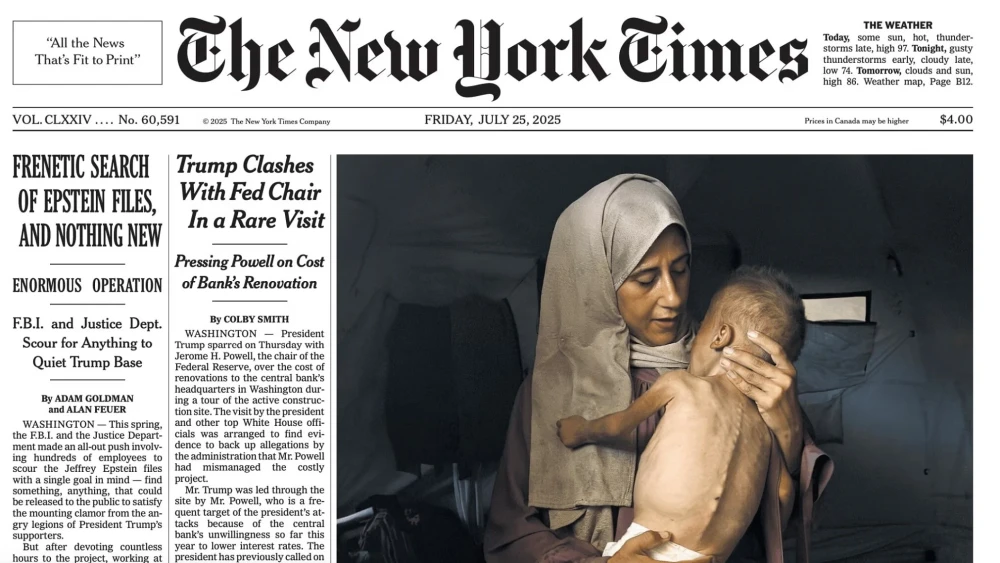
The front page of The New York Times on July 25, 2025. The newspaper of record later acknowledged that the boy had "pre-existing health problems." Source: Screenshot.
“The New York Times” front page on July 25, 2025. The paper later acknowledged that the boy had “pre-existing health problems.”

A New York Times contributor who took a picture of a skeletally thin Palestinian child in Gaza who suffered from cerebral palsy that was published with a front page article about civilians starving to death has been awarded the 2026 Pulitzer Prize for Breaking News Photography.

The child was born with cerebral palsy. The photo’s original caption said, “He was born healthy.”

The newspaper had to issue a correction for the story last year following a public outcry, but Palestinian photographer Saher Alghorra won the prestigious award anyway.

The prize committee said last week that it was honoring the photojournalist “for his haunting, sensitive series showing the devastation and starvation in Gaza resulting from the war with Israel.”

The picture of the boy, which went viral, became a symbol of the specious allegations of widespread starvation in the territory.

“One of the oldest lies in human history, that Jews deliberately harm children, is award-winning journalism,” Israeli Consul General to Toronto Idit Shamir tweeted on Friday.

“When so-called journalism receives an award for spreading fake news about Israel, it tells you everything you need to know about where the mainstream media currently is,” Sen. Rick Scott (R-Fla.) posted on X.

See more from JNS Staff
Abdulkadir Al-Jelani, 58, is due in court on July 1 and faces charges of making the threats and three counts of assault with a weapon.
The designations include Hezbollah-linked institutions that “threaten regional stability, international security, mutual interests and global trade,” the U.S. Treasury Department stated.
Gerard Filitti, of the Lawfare Project, told JNS that “lax immigration policy” has always been the main driver of importing “terrorist ideology” into the United States.
“The teachers we have, we don’t respect and support in the way that they deserve,” Paul Bernstein told JNS. “If we’re successful and we grow enrollment, that problem only gets bigger.”
“The message being sent is that you can get away with attacking someone in broad daylight because you disagree with their opinions, especially if it involves feelings about Israel,” Joshua Burt, of the Anti-Defamation League, told JNS.
“Not identifying Hamas as a terrorist organization is, I think, a failure, Marc Miller told the Canadian Press. “And not clearly stating that, for example, Hamas intended to kill Jews is, I think, an unfortunate error in curation and should be rectified.”