


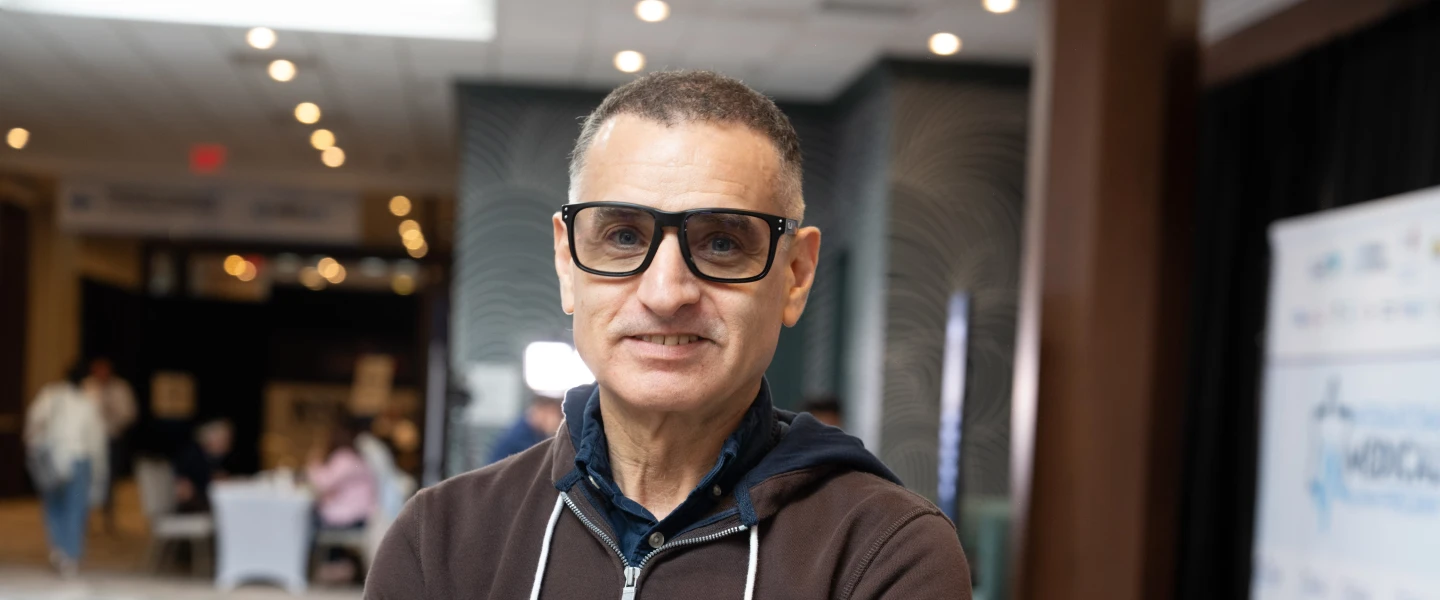
More than four decades after serving in Lebanon as a young Israeli paratrooper, Dr. Lance Dunlop, a psychiatrist from Alaska, returned to Israel in uniform once again—this time as an American soldier.
As the military transport flew over the Jewish state, the aerial view confirmed what he had felt for years.
“The minute I landed in Israel, I just knew I belonged there,” Dunlop, 60, told JNS from his home in Fairbanks, two days after receiving an honorable discharge from the U.S. Army.
“That feeling of looking down from that same plane, with the same sounds and the same vibrations, it was very visceral,” he said.
“Once I landed in Israel, there was no going back,” he said. “I knew that I belonged.”
Dunlop, who plans to make aliyah in August with his wife and son, was one of more than 350 medical professionals who attended the annual Nefesh B’Nefesh MedEx event in New Jersey on May 31.
The event brought together physicians, medical students, dentists and nurses from 31 medical specialties across North America who are planning to make aliyah in the coming months.
Hosted in partnership with Israel’s Ministry of Aliyah and Integration and Ministry of Health, the conference also saw more than 132 applications for medical license conversion submitted to the Health Ministry.
Returning to Israel in April 2025 felt like “muscle memory,” Dunlop told JNS.
He was flown out of a Kuwaiti Air Force base aboard a C-130 Hercules—the same kind of aircraft from which he once jumped as an Israeli paratrooper.
The smell of the jet fuel immediately transported him back to 1987.
“As soon as I saw Israel from the air, it hit me,” he told JNS. “As soon as we landed in Israel and I saw the Israeli flag, and I’m literally wearing an American Army uniform, it was just overwhelming.”
“It also felt right,” he said.
At the time, Dunlop was serving as a psychiatrist with the U.S. Army’s Combat Operational Stress Control Unit, which treats soldiers suffering from post-traumatic stress disorder.
He had spent four months in Kuwait in 2024 as officer in charge of the U.S. military hospital there.

He told JNS that he enlisted in the U.S. Army in his late 50s after the COVID-19 pandemic left him feeling stagnant. The experience helped him improve his health, lose weight and find a renewed sense of purpose, he said.
While in Kuwait, he was suddenly reassigned to Israel because of his fluent Hebrew and prior service in the Israel Defense Forces, after originally being assigned elsewhere.
Serving alongside Israeli troops, he often helped American soldiers better understand Israeli military culture. He explained the significance of Shabbat and Jewish holidays and how to act respectfully around observant soldiers.
After unsuccessfully trying to get an Israeli medical license a decade earlier, he decided to try again.
“Nefesh B’Nefesh just made it really easy,” he said.
For Dunlop, the MedEx event marked the culmination of a long journey back to Israel. For Israel, it is part of a broader effort to recruit physicians from abroad, as the country faces a growing physician shortage.
MedEx is part of the International Medical Aliyah Program, an initiative launched in 2024 with the goal of bringing 2,000 physicians to Israel by 2029.
The program aims to strengthen Israel’s healthcare system, particularly in the country’s northern and southern regions. Since its launch, more than 1,100 doctors have made aliyah, including 179 from North America.
MedEx events have also been held in Paris, Buenos Aires, London, Los Angeles, Sydney, Melbourne, Toronto and Montreal.
Dunlop traveled more than 14 hours from his home in Fairbanks to attend the New Jersey event, a trip that, he quipped, “took longer than it would to get to Israel.”

“Being one of a group of Jewish American and Canadian doctors who are coming from very similar backgrounds, but we’re all coming together for one purpose, was amazing,” he said.
“We realize that this is what we want to do for the rest of our lives, and we want to live in Israel,” he said.
Notaries were on hand to help attendees process paperwork and licensing documents, but the atmosphere was celebratory, he said.
“Many of the people who came—they had to bring all their documents, all their diplomas, their medical licenses and stuff like that,” he said.
“People were literally coming with boxes and suitcases full of this stuff, so it is kind of tedious,” he said. “But they made it a fun environment. There was good food—Moroccan food. It was fun.”
The next time he boards a flight to Israel, he will be bound for Haifa, where he has accepted a position at Rambam Hospital.
He also plans to serve four days a month in the IDF reserves, treating soldiers and their families.
“I tried 10 years ago to do this, and I just got myself lost in the weeds,” he said. “Now it’s easy. You call Nefesh B’Nefesh, and they take care of everything. You get your Israeli medical license. You get your board certifications recognized.”
Dunlop is excited to return to Israel as an Israeli.
Working there as an American soldier last year felt “weird,” he said. He was often mistaken for an Israeli soldier and found himself slipping back into old habits, including the way he walked and carried himself.
“One time, I was on one of these Israeli bases,” he said. “Obviously I was speaking Hebrew with the Israelis, and a really high-ranking enlisted soldier, very respected both in the U.S. Army and in the IDF, wanted to know why I was impersonating an American soldier.”
“I kept saying to him, ‘No, I am an American soldier,’” he said.
“What I realized now, looking back a year later, is that we both understood something. I really belonged in Israel,” he said. “I was carrying myself like an Israeli soldier. Even my commanders, as I was getting closer to them, were realizing that I was walking like an Israeli soldier. I was doing certain gestures.”
In Israel, he hopes to continue his work treating soldiers with PTSD, an issue he said has become more pressing since the Oct. 7, 2023 attacks.
Many of the men from his old IDF unit, with whom he remains in touch today, “have PTSD from 40 years ago that they’re just coming to terms with,” he said.
At Rambam Hospital, meanwhile, “there was a huge need for treatment of PTSD from Oct. 7 and from things that happened before.”
Leaving Alaska is bittersweet, Dunlop told JNS.
He believes that he is the only Jewish doctor in Fairbanks, though there is “a lot of Judaism” in the city, particularly thanks to the Fairbanks Jewish Center, which is run by Chabad emissaries Rabbi Heshy Wolf and his wife, Chani Wolf.
In addition, because of the community’s proximity to Eielson Air Force Base and Fort Wainwright, there are “a lot of soldiers stationed here who are Jewish,” making up a “big chunk of the Jewish community,” he said.
“Alaska and the U.S. have been amazing to me, really,” Dunlop told JNS. “I am so grateful. I’ve literally been able to become a doctor because of the U.S. It gave me an opportunity, but I feel comfortable in Israel. It feels right.”


