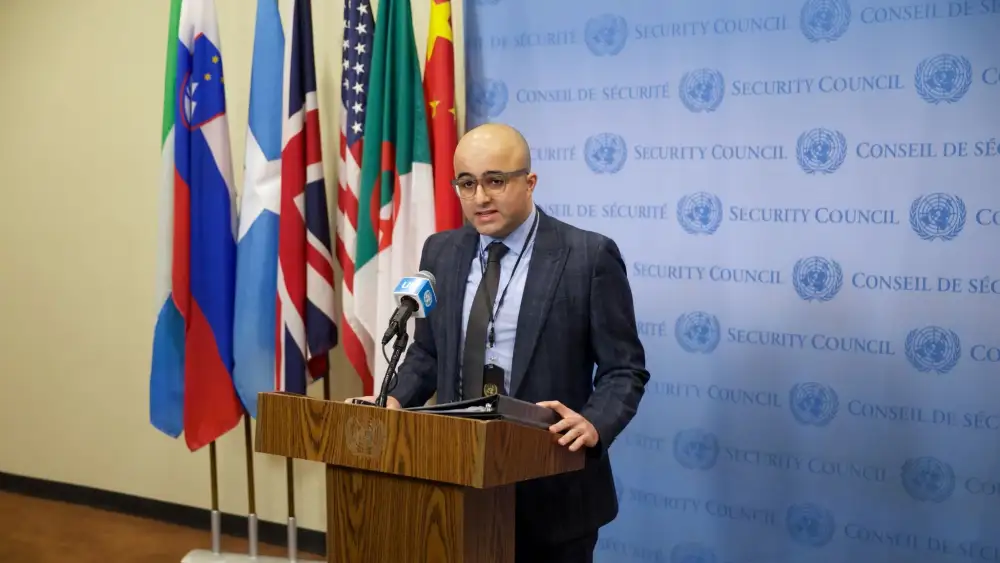
In 2024, Jonathan Harounoff came as a New York Post freelancer to a screening that the Israeli mission to the United Nations organized of the 47-minute footage of Hamas’s Oct. 7 atrocities. He posted about it on social media.
Gilad Erdan, who was then the Israeli envoy to the global body, saw his posts and contacted him. He accepted a job as international spokesman for the Israeli mission, but by the time he came aboard, Erdan had moved on and Danny Danon was named Israeli ambassador to the United Nations.
Danon is very different from Erdan, who is now president of Magen David Adom, according to Harounoff.

“Gilad was more someone who comes in blazing, very effective at what he does,” he told JNS. “He knows how to create those viral moments.” Danon is “more diplomatic,” he said, noting the envoy’s “very close” relationship with Mike Waltz, U.S. envoy to the global body.
“He’s very effective at building relationships with people and delivering speeches,” Harounoff told JNS. “At the time he joined, Israel needed someone who could hit the ground running straight away, someone who knew the lay of the land.”
Harounoff, 31, spoke to JNS during a walkthrough of the U.N. building, during which he told JNS exclusively that he plans to leave his job at the global body on July 1.
It was time to move on to “try other things” after two years at the United Nations, he said. “A lot has happened in those two years,” he said. “I hope we’re turning a new leaf.”
Before entering diplomacy, Harounoff covered Iran, Israel and the Middle East as a journalist. He came into the U.N. role with the goal of advocating for Israel and for the Iranian people, who have and continue to suffer under the Iranian regime.
“I wanted to make the most of my time here and use the platform of the United Nations not just to talk about Israel but also to highlight the humanity and commonality between the people of Israel and the people of Iran,” he told JNS.
“I’ve been able to broaden the focus not just on Israel but on allies and the Iranian people as well,” he said. “I don’t think that’s happened before.”

During his tenure at the United Nations, he penned the book “Unveiled: Inside Iran’s #WomanLifeFreedom Revolt.”
Growing up in London, Harounoff dreamed of becoming a professional soccer player. That never came to pass for him, but he captained the Jewish state’s team in the U.N. member-wide soccer tournament, he told JNS.
The British-Iranian journalist said that playing for Israel in the U.N. games helped him connect with diplomats from other countries.
“We played against Arab countries, European countries, African countries, Asian countries,” he said. “For me, it was a lesson in how sports diplomacy and other forms of engagement can be really powerful in bridge-building.”
“We got to the quarterfinals, which, for Israel, getting to any kind of knockout stage is quite good,” he said with a laugh.
During the walk through of the building, Harounoff directed JNS to artworks and exhibitions donated by member states, including a series of silk portraits of former U.N. secretaries-general displayed near the entrance to the building.
The portraits, he noted, were a gift from the Islamic Republic of Iran.

“Most people don’t realize who these are from,” he said.
Iran has donated many items to the United Nations over the years, while Israel has just one permanent contribution on display—a stone lintel dating to the late Roman period, he said.
Most visitors pass it without noticing, Harounoff said, as he touched the glass vitrine protecting the artifact. He pointed to the menorah carved into the stone, a symbol of Israel;s aspiration to be a “light unto the nations.”
Harounoff also directed JNS to several pieces of furniture in the building that appeared to be in disarray. One of the main issues at the United Nations that does not get enough attention is the dire state of its finances, he told JNS.
“A lot of things are off,” he said, noting a row of shredded cushions in the General Assembly chamber.

“A lot of the elevators aren’t working,” he said. “You see a lot of furniture disappearing.”
The reason, he said, is that the United Nations is running out of money.
“Even the secretary-general has said the U.N. is on the verge of bankruptcy and facing collapse,” he said. “It’s seriously bad.”
The global body is like a club, in which participating members have to pay dues, but many countries including the United States have lost faith in the organization and are withholding payment.
With the process of electing a new secretary-general well underway, Harounoff hopes that new leadership will fix what he called a “broken” United Nations.
The rest of the year, and particularly the end of the year, “is going to be a make-or-break year for the U.N,” he told JNS. “Whoever takes over as the next secretary-general can really steer the U.N. back to its foundational goals of being that one forum in the world where countries can solve the world’s problems.”
“It’s important to have at least one place where every country can come and talk things out,” he said. “But it can’t be too politicized. I think that’s really where the U.N. has strayed.”
Despite his criticism of the organization, Harounoff has not lost faith in it as a whole.
He hinges his hope on the candidates for secretary-general, who have all “made it part of their platform to recognize that the U.N. is broken and that a lot needs to be done to regain the world’s respect,” he said.

“If they do the right thing, the U.N. could come back,” he told JNS. “It could be great again.”
Working at the United Nations has come with some moving encounters and experiences.
Harounoff prioritized inviting and supporting Iranian dissidents, including Raheleh Amini, whom the Islamic Republic shot in the eye and nearly blinded during the 2022 “Woman, Life, Freedom” uprising.
The issue is personal to Harounoff.
Raised in an Orthodox-Jewish community in northwest London by an Israeli mother and a British father, whose family emigrated from Iran, he grew up immersed in both Persian and Israeli culture.
“My grandparents are all from Iran,” he told JNS. “So I grew up with all the wonders of those cultures. The Persian language. The Hebrew language. Persian foods. Persian tapestries and carpets. Israeli food.”
“Many people assume Iran and Israel have always been at war. It’s not true,” he said. “Persia’s history spans thousands of years. The Islamic Republic has only been around for 47 years. Before that, it was a very different Iran.”

Another memorable guest, he said, was freed hostage Eli Sharabi, whom the Israeli mission brought to address the U.N. Security Council on March 20, 2025, less than six weeks after he was liberated from captivity in Gaza on Feb. 8.
“He was tiny,” Harounoff told JNS. “He looked smaller. He’d lost a lot of weight.”
Sharabi’s speech was powerful, but it was the moments afterward, when members of the Israeli mission staff approached him, that stood out the most to Harounoff.
“They didn’t know what to say,” he said. “They were crying, and he spent like an hour basically consoling everyone and hugging everyone.”
“This man was six weeks out of the worst thing ever,” he said. “The fact that he was here was a miracle, and he was hugging these people. It was really quite extraordinary.”
Harounoff plans to devote more time to the public relations firm, Noff Media, and to work on a book about a little-known story from the period surrounding the 1979 Iranian Revolution.
Looking back on his tenure, Harounoff is most proud of the relationships he built with journalists and diplomats, who had rarely interacted with Israeli representatives before.

Soccer helped, he said.
“Everyone is equal on the field,” he said. “Then you see those same people here in suits, and you’re no longer just the representative of a country. You’re someone they already know. You already have that commonality.”
He plans to take lessons from both diplomacy and soccer with him.
“It’s not like a football match or a boxing match where there’s an immediate winner after 90 minutes or after a knockout,” he told JNS. “Diplomacy is often a long game.”
“You have to build relationships. You have to build trust,” he added. “You’ve got to invest a lot of yourself and a lot of your time into building those relationships, and the results don’t always materialize immediately.”