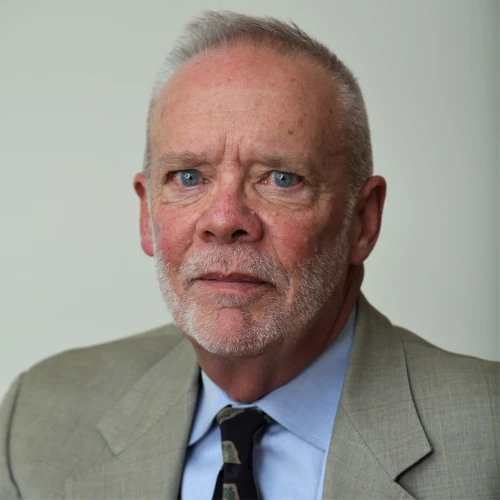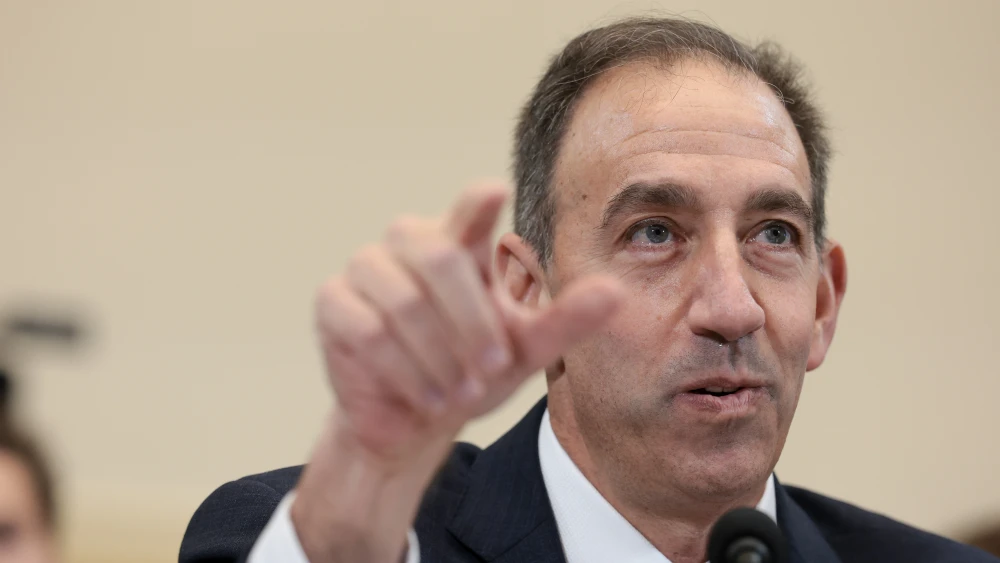
Jeff Bartos, U.S. representative for United Nations management and reform, has a statue of Sisyphus—the king in Greek myth condemned to roll a massive boulder up a hill daily, only to see it roll back down—on the coffee table in his office.
“To remind me every day that the task is not only not even close to being finished, but we have many more miles to go to push that boulder up the hill,” the Jewish real estate developer, lawyer and former candidate for political office told JNS.
Raised in southeastern Pennsylvania, Bartos interviewed for the job even though, as he told the Senate Foreign Relations Committee during his confirmation hearing, the United Nations may be “immune to reform.”
“My wife and my in-laws both said to me, ‘Why are you taking this job if it’s not possible?’” he told JNS. “What are you doing?”
But there has been notable progress, according to Bartos.
That includes, he said, key fiscal reforms that Washington introduced that drew consensus support, like cutting $1.1 billion from the U.N. budget, shedding more than 4,000 civilian jobs and eliminating a rule that perpetuated a liquidity crisis by returning unspent funds to member states irrespective of whether the states paid their dues.
“But here we are now, starting the negotiations on the regular budget for 2027, and I can say that the task ahead of us, for sure, is to reform the rot that lives within the institution,” he said. “The cultural, moral, ethical rot.”
Part of the rot is agenda item seven at the U.N. Human Rights Council. “Every session of the U.N. Human Rights Council features a standing agenda item targeting Israel,” the watchdog UN Watch says, of item seven. “No other country in the world—not Iran, Russia or North Korea—is singled out in this fashion.”
Bartos also said that the United Nations has “out of control special rapporteurs,” including Francesca Albanese, who frequently criticizes Israel and whom the Human Rights Council appoints. The United Nations has told JNS often that it doesn’t police the speech of rapporteurs, whom it considers “independent experts.”
Albanese is “not the only lunatic running around wearing the U.N. uniform and soiling the good name of the organization,” Bartos told JNS.
“We have an enormous task in front of us to reform the human rights pillar, to make meaningful reforms to the development pillar and to get the peace and security pillar of the U.N. back to its core mission of maintaining and preserving and protecting international peace and security,” he said.
The office of U.N. Secretary-General António Guterres has told JNS often that controlling and reforming the Human Rights Council and special rapporteurs is outside of his mandate.
“I think it’s B.S. I think it’s an excuse,” Bartos told JNS. “The number one thing you’ll hear around the U.N., no matter where you travel, when you ask these hard questions, is tre compliqué,” French for “very complicated.”
“It takes moral clarity. It takes steadfast leadership and it takes a focus,” he said.
Bartos said that the United Nations “should be very proud of what it does well.”
“It is an extraordinarily capable humanitarian organization,” he told JNS. “It is able to deliver life-saving aid at scale in remote locations with reliable, predictable and oftentimes reasonably priced supply chains. Amazing what they can do.”
He also praised the “brave men and women” of the U.N. peacekeeping forces who “go out there and protect civilians and risk their lives for total strangers.”
If he was a United Nations employee, he would “be incensed that my leadership throughout the organization has not said enough.”
“Maspik,” Bartos said, using the Hebrew for “enough.”
The United Nations is at a “crossroads,” Bartos told JNS. “It has to decide: does it want to continue to look the other way with these lunatics, or does it want to say, ‘We’re going to be the world’s best humanitarian organization in these particular danger spots?’”
It’s time to fire Albanese, and “the people who are hurting the reputation and the viability” of the United Nations, he said.
“We’re not going to take this anymore. We are going to say that a lunatic like Albanese, who puts on the U.N. uniform and who represents herself as a U.N. employee to the world, spoils our good name,” he said. “I’m risking my life as a humanitarian in the field, and I have to hear that people don’t want to support the organization because of this lunatic. That’s crazy, and so we say ‘no.’”
The recent U.N. high-level meeting on the 25th anniversary of the Durban Declaration, the conference during which delegates from the United States and Israel walked out over drafts and rhetoric singling out Israel and equating Zionism with racism, and which featured open displays of antisemitic materials and rhetoric, is part of the “rot” at the global body, according to Bartos.
“The Durban Conference really turned out to be the foundation for a lot of the rot we’ve seen spread through Western academies, universities, college campuses, high schools, now down to grammar schools, too many of our cultural institutions, Hollywood and elsewhere,” he told JNS.
“That rot really started in Durban, and it has had a 25-year arc where it has just continued to grow,” he said.