Ask Anat Meir how she’s doing three years after her husband was killed in the Hamas-led massacre on Oct. 7, 2023, and she’ll tell you that she and their son are doing “okay.”
Shaked is 3-and-a-half, a happy child who climbs everything and attends Ninja classes. She has established a routine that works. They have family and friends around them.
“But at the same time, it’s also very much not okay,” she told JNS in an interview ahead of the anniversary of that terrible day. “David’s presence is constantly missing.”

Maj. (res.) David Haim Meir, 31, a reservist in the elite Sayeret Matkal unit, was killed fighting Palestinian terrorists at Kibbutz Be’eri on Oct. 7, 2023.
Shaked was 7 months old. David never saw him walk or heard him talk.
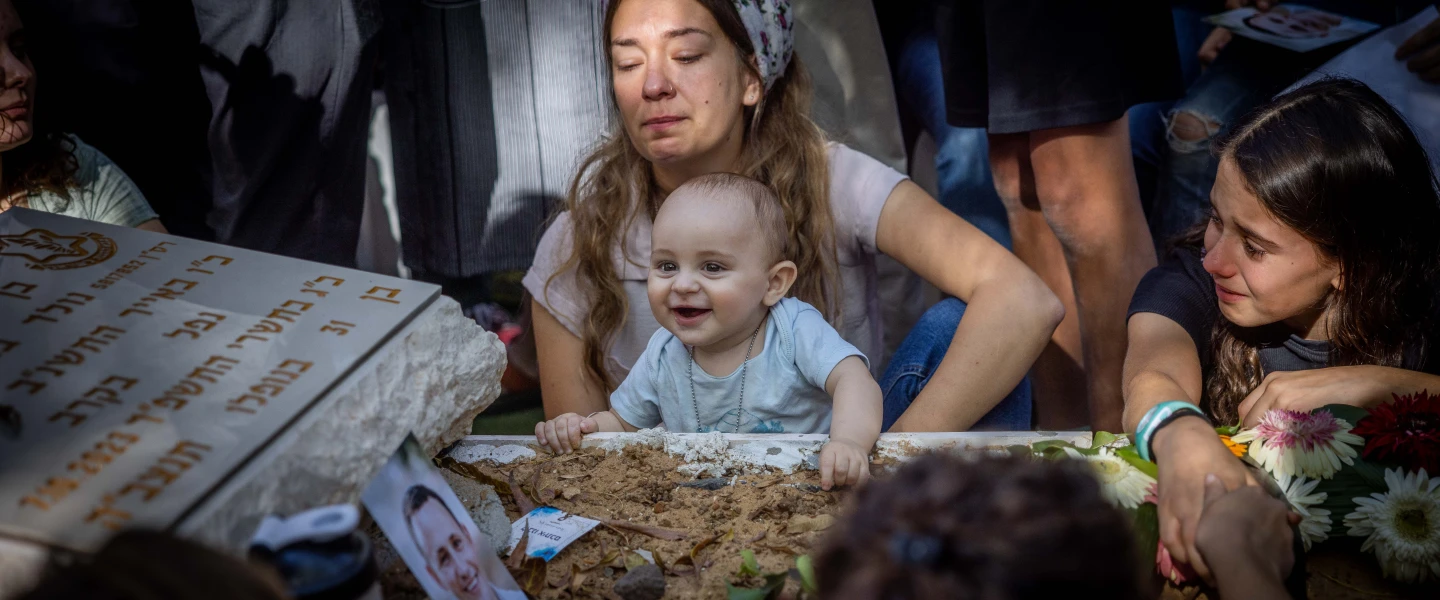
One of the most heart-wrenching photos of the war shows baby Shaked grinning at his father’s graveside next to his brokenhearted mother, one month after David’s death.
Of the seven short months David had with his child, Anat says: “He was a father who was completely in love. All his tenderness came pouring out.”
He would say, she recalls, “I wish everyone could have a child as perfect as mine. I have the most perfect child in the world.”
“I’ve now been raising Shaked on my own for longer than I raised him together with David,” she says painfully.
In the first year after David’s death, Anat barely managed to leave the house. She had no desire to get dressed in the morning. Gradually, her reality shifted. Now she might want to go to a restaurant, buy a shirt or socialize.
“The pain remains the same pain, and the longing remains the same longing,” she says. “But life grows around it.”
“Over time, you start saying to yourself, ‘This is my life. He is never coming back.’”
Anat realizes that, for Shaked, that understanding is only beginning to take root. She has to keep explaining to him that David will never again be a physical part of their lives.
She recalls an incident when they were on their way to a family day held by David’s military unit. An excited Shaked said: “Maybe my dad will be there.”
“Sweetheart, Daddy won’t be there,” she had to explain. “If Daddy were somewhere here, he would come home. But he isn’t. He isn’t anywhere. He can’t come back. He was killed in the war. His body stopped working.”

David should be here
Asked what she misses about their life together, Anat talks about the simplest, everyday rituals, like their daily coffee dates.
“There was no way we would go without sitting down together for a cup of coffee in the evening,” she recalls.
“It’s all those smallest, smallest moments of life and of being together.”
Anat is quick to dispel the perfect image that can form around someone who dies a hero. They argued, she says, like any married couple. But if David came home and found her sad, he would ask, “What could make you happy today?”
And there are times when she simply misses having an extra pair of hands.
She describes a Shabbat walk with friends, a steep hill and Shaked asking to be carried. She had no strength to pick him up. She knows that David would have lifted him easily onto his shoulders, carrying the little ride-on toy in his other hand.
“And I’m thinking angrily, where is he? Why the hell isn’t he here? Why do I have to do this alone?”

At home, there are photographs and conversations about David. Family and friends talk about him constantly. Shaked knows that his father was a hero, but Anat worries about giving him only that version of the man.
“It’s difficult to grow up only in the shadow of someone who was the greatest hero, the greatest person, the best at everything, because ultimately David was a human being,” she says.
“It’s very difficult to convey a person when, in the end, he didn’t really know him and won’t remember him,” she adds.
Adjusting to young families
Anat is not alone in her daily struggles and challenges.
She is among 355 widows, and Shaked among 880 children, who have lost a husband or parent serving in Israel’s military and security forces since Oct. 7, 2023, according to Defense Ministry figures released ahead of the third anniversary.
The IDF Widows and Orphans Organization (IDFWO), which supports Anat and Shaked, has had to adjust its work to the many young families bereaved since the massacre.
Founded in 1991, it provides emotional and financial assistance, community programs and advocacy for the spouses and children of fallen soldiers and other security personnel.
Anat welcomes the fact that IDFWO support and programming is tailored to a child’s age. Shaked is still too young to go off to activities by himself. Through its Otzmama program, the organization brings together children up to age 6 and their widowed mothers; older children can join its Otzma community for ages 6 to 18.

An essential sisterhood
For almost three years, Anat has also been cultivating friendships with women she did not know before their husbands died—other women like her receiving support from IDFWO.
Anat feels that the program gave her the respite she needed from the intense reality of bringing up a young child on her own.
“It’s constantly me against him and him against me, and there’s no one who can step in for a second and balance things out,” she says. “There isn’t a father who comes in and helps balance things, or a sibling who is there.
“We’re very, very close and connected and everything, but there are also very significant challenges in that.”
She doesn’t believe she would have been able to get through the last three years without her new sisterhood.
“The thing that has given me the greatest strength to survive is this—this togetherness,” she says of the powerful new friendships she has built.
Three years on
Asked what people may not realize three years after David’s death, Anat says: “Even when you look well, even when you smile, even when you laugh, even when you go out with friends, it can be that 10 minutes later you’re sitting in the car, falling apart and crying because of a song you heard.”
“It happens all the time,” she admits.
What does she want people to remember about David? Anat says one of his unique qualities was his sensitivity to those around him.
“These people weren’t born heroes because of Oct. 7,” she says of those who died in battle. “It began with small acts of courage and all the little things they did throughout their lives.”
“David was that kind of person. He was always aware of what was happening around him.
“He genuinely cared about the smallest things.
“And I think that’s also what led him to do the very, very, very big thing that he did on Oct. 7,” she concludes. “Ultimately, it’s about how you treat the little things, and it starts with the way we live our everyday lives.”