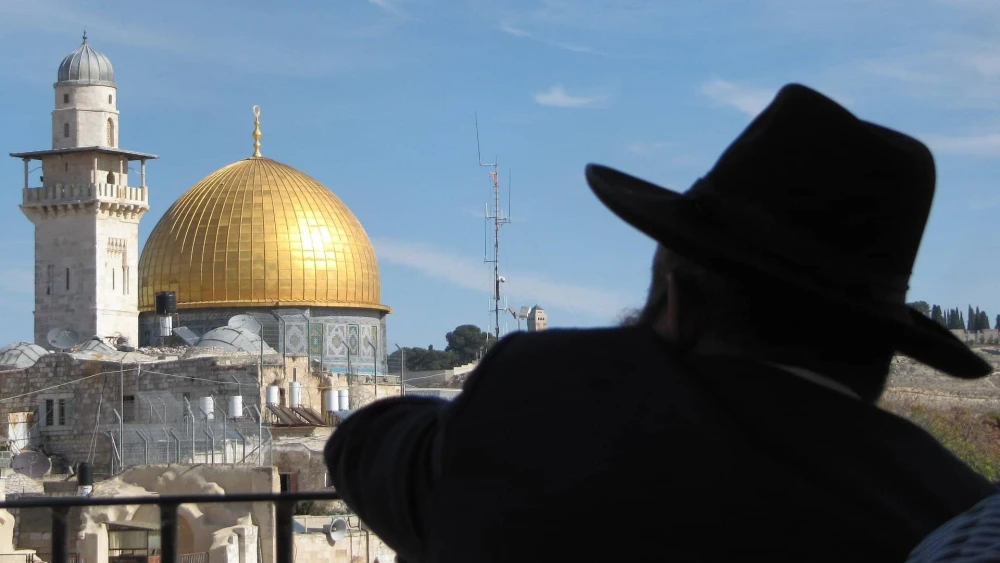

Last Sunday morning, Jewish worshippers ascended the Temple Mount carrying Jewish prayer books. That this is news should itself be astonishing.
Israeli National Security Minister Itamar Ben-Gvir confirmed that Jewish men had been permitted to bring them onto the Mount. Journalist Arnon Segal, who published a photograph of worshippers praying from the siddurim, said there is still no blanket permit, describing the move as an initial experiment. Segal later reported that the trial involves just 15 visitors and has received the approval of Police Commissioner Dani Levy.
So the prohibition has not disappeared. But another part of it has cracked.
Consider what Israel is actually “experimenting” with: whether Jews may carry Jewish prayer books onto Judaism’s holiest site.
The Temple Mount has stood at the center of Judaism for thousands of years. The First Temple stood there nearly 3,000 years ago, followed centuries later by the Second Temple. Jews have prayed toward Jerusalem for generations and still mourn the Temples’ destruction every Tisha B’Av.
Through centuries of exile, that connection never disappeared. Jews around the world repeated the same words at the end of the Passover seder and Yom Kippur: “Next year in Jerusalem.”
Long before the State of Israel or modern Zionism existed—and centuries before Islam existed—the Temple Mount stood at the center of Jewish faith and national consciousness. That makes the modern reality extraordinary: Jews could finally return to the mountain their ancestors had prayed toward for generations and be told that bringing the book containing those prayers was unacceptable.
Binding Jewish prayers together in a book suddenly makes them dangerous.
After Israeli forces captured the Old City and Temple Mount during the Six-Day War in June 1967, the site was once again under Jewish sovereignty.
What followed was one of Israel’s most consequential postwar mistakes. Israeli Defense Minister Moshe Dayan left the Islamic Waqf in control of administrative matters on the Mount. Muslims would continue to worship there, while Jews and all non-Muslims could visit but not pray there.
Dayan feared that Jewish prayer could inflame the Muslim world. Instead of establishing guidelines that all faiths worship peacefully under Israeli sovereignty, Israel responded to potential Muslim outrage by restricting Jews.
What began as a political decision became an almost untouchable doctrine. There was nothing sacred about Dayan’s choice. In fact, it was a deeply foolish one.
Israel had regained sovereignty over the most sacred site in Jewish history, only to accept that Jews exercising a basic religious right there could not be tolerated. Nearly 60 years later, Israel is finally beginning to undo that mistake.
In practice, the arrangement has been openly discriminatory. Muslims have been permitted to worship on the Temple Mount, while Jews, Christians and all other non-Muslims have generally been prohibited from doing so. Muslims can enter through nine gates; non-Muslims are limited to one, with far more restricted visiting hours. Jewish religious items such as siddurim and tefillin have been barred, while Israeli flags have faced restrictions of their own.
Jewish visitors enter after extensive security checks. For years, visibly praying, bowing or even moving one’s lips could lead to removal from the Mount or even arrest. These are two very different standards of religious freedom at the same site.
Earlier this year, police allowed Jewish visitors to bring specially approved printed prayer sheets onto the Mount. One printed Jewish prayer was acceptable, but binding those prayers together in a book suddenly makes them too dangerous.
A discriminatory policy does not become just because it has existed for decades. Muslim religious freedom has been treated as the default; non-Muslim worship as a potential disturbance.
The argument for restricting Jewish prayer was never that Jews lacked a connection to the site, or that Jewish prayer itself harmed Muslim worshippers. It was that others might react violently to it. That is a dangerous basis for religious policy. Once the threat of unrest determines who may pray, intimidation becomes a veto over civil rights.
For decades, Israel restrained peaceful worshippers rather than challenge the premise that their prayers were the provocation. That was the fundamental failure of the old status quo.
The old rules have begun to erode. Jewish prayer has become more visible. Earlier this year, printed prayer sheets became permitted. On Sunday came the next step: siddurim.
Expanding Jewish religious freedom does not require restricting Muslim worship. Israel can safeguard Muslim prayer while rejecting a system in which peaceful Jewish worship is treated as provocative. Equal rights are not an attack on anyone.
There is still a long way to go. There is no blanket permit for siddurim. Tefillin, Torah scrolls and other Jewish religious items remain restricted, and Jewish access remains limited.
But Sunday matters because something once treated as unthinkable is starting to become normal. A printed page was allowed. Now, a siddur has made it through.
The question is why an arrangement that discriminated between religions and turned threats of violence into a tool for restricting Jewish rights was allowed to survive for so long.
There is nothing provocative about a Jew carrying a prayer book onto the Temple Mount or praying where generations of Jews directed their prayers. What is extraordinary is that, nearly 60 years after Israel returned to the site, such basic religious freedom still requires an “experiment” to see whether the Middle East will tolerate it.
The Temple Mount status quo is beginning to crumble. It’s about time.