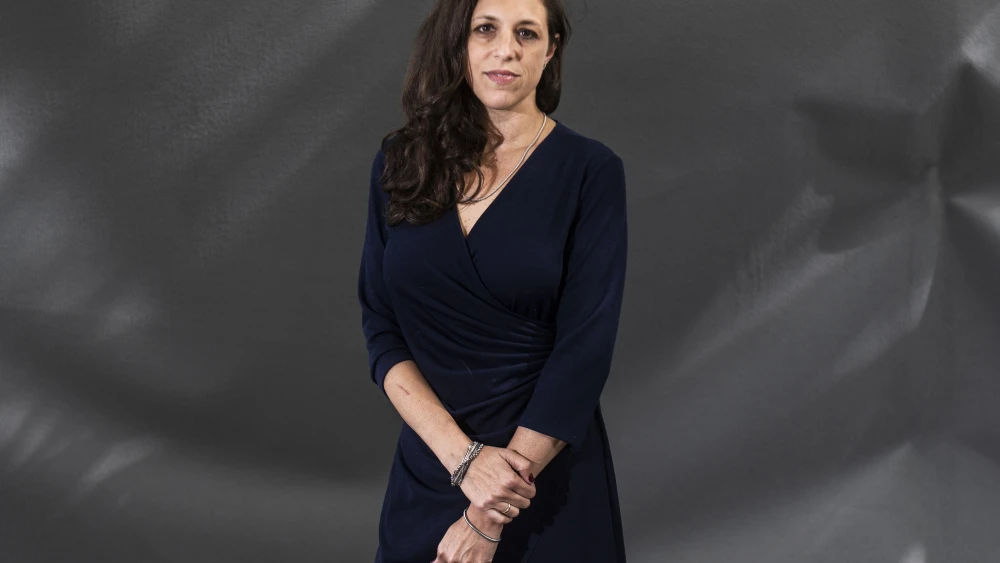
Spain’s main Jewish organization on Wednesday circulated a manifesto signed by more than 350 cultural figures opposing the exclusion of an Argentine-Jewish novelist from a literary festival in Granada following her opposition to boycotts against Israel.
The organizers of the CULTUR ALH de Granada festival, who canceled a scheduled Sept. 26 discussion featuring novelist Ariana Harwicz, need to “transparently explain their decision, acknowledge the harm caused and offer Harwicz appropriate public redress, while also recognizing the damage done to public debate,” the manifesto reads.
The conflict underlines diverging attitudes toward Israel in the Spanish-speaking world. In Latin America, Israel has several outspoken allies, including Argentine President Javier Milei. Spain’s government under Prime Minister Pedro Sánchez has promoted anti-Israel policies and rhetoric. Sánchez last year called Israel a “genocidal state” in parliament.
Harwicz, who gained international recognition with her debut novel, “Mátate, amor” (“Die, My Love”), said her exclusion was antisemitic. “They’re canceling me for being Jewish, to turn me into a pariah,” El País quoted Harwicz as saying. Her 2012 novel, which explores motherhood, desire and psychological turmoil, was longlisted for the 2018 International Booker Prize and adapted into a 2025 film starring Jennifer Lawrence and Robert Pattinson.
Patricia Escalona, the festival’s co-director, told El País last week that “Harwicz’s firm opposition to the cultural boycott of Israel was what prompted the rejection.” The newspaper reported that a letter from Granada’s University Network for Palestine prompted the cancellation.
In a 2024 interview with Infobae, Harwicz said about attempts to boycott Israeli cultural institutions: “I see only hostility toward Jews and a totalitarian attempt to censor art.”
Writers should not “be excluded from a cultural event because of their public positions,” the petition circulated by the Federation of Jewish Communities of Spain (FCJE) states. The petition’s text warns that “defending freedom of expression only for those who think like us is not defending it: it is replacing the free exchange of ideas with ideological screening.”
Among the petition’s signatories are French former prime minister Manuel Valls, who is also a citizen of Spain; Spanish philosopher Fernando Savater, a Planeta Prize winner; Mexican writer Margo Glantz, a recipient of the FIL Literary Award; Colombian poet Piedad Bonnett, winner of the 2024 Reina Sofía Poetry Prize; and Peruvian novelist Santiago Roncagliolo, whose “Red April” won the Alfaguara Prize and the Independent Foreign Fiction Prize.
The controversy follows several high-profile cases where Jews, Israelis or people accused of sympathizing with them were excluded from cultural events in Spain, and Europe more broadly.
In May, two Israeli women were ejected from an event at Sauna Thermas after being questioned about Zionism. One of them was wearing a Star of David pendant. The venue subsequently apologized and barred the event organizers.
Last month, a member of the klezmer band Dobranotch said anti-Israel hecklers prevented his ensemble from performing at a large folk festival in Galicia, Spain. Hecklers threw stones and other objects at the performers, targeting the band over recent concert appearances they made in Israel, band member Mitia Khramtsov wrote in an op-ed published by The Forward.
escândalo em Pardinhas, algum sionista no palco pic.twitter.com/yh6JNZDZEY
— maNu 🌰 (@nuMaGz) August 2, 2026
In Belgium, the Flanders Festival canceled last year the Munich Philharmonic’s concert with Israeli conductor Lahav Shani, citing his leadership of the Israel Philharmonic and uncertainty over his position toward Israel’s government.
In Amsterdam, the Netherlands, the Concertgebouw concert hall demanded that Israeli cantor Shai Abramson be replaced at a Chanukah concert because of his service in the Israel Defense Forces reserves. The venue eventually reversed the ban amid an uproar and agreed to private performances following protests and threatened legal action.