
In 2011, Thailand’s Princess Chulabhorn visited Jerusalem to discuss scientific cooperation, including cancer and brain research. A scientist with a doctorate in chemistry, she had professional reasons for making the journey. But during a meeting, she expressed something more personal.
“In my heart I feel half-Israeli,” she declared. “I think like an Israeli.” She even added the Israeli name Tzila to her signature in the presidential guest book.
The warmth was striking. So was the setting. For centuries, Jews had traveled to Thailand to trade, earn a living and sometimes escape persecution. Now a Thai princess was seeking scientific partners in a Jewish country.
Israel’s establishment changed more than diplomatic arrangements between Thailand and Israel. Jews could continue to build lives in Thailand, while Thais could turn to a Jewish state for opportunities of their own. Eventually, thousands would come to work on Israeli farms, placing part of their families’ future in Israel’s hands.
The roots of that relationship stretched back centuries, to a time when Jews first began making their way to Siam, as Thailand was once known.
In 1601, Spanish missionaries reported Jewish merchants living in Ayutthaya, then the capital of Siam. They reportedly maintained a synagogue and were “zealous in the Law of Moses.”
Among the earliest Jews recorded by name in Siam was Abraham Navarro, an interpreter for the English East India Company who visited King Narai’s court in Lopburi in 1683.
The modern community began taking shape around 1890, when Eastern European Jewish families settled in Bangkok. Among them were the Rosenbergs, who helped open some of the city’s first modern hotels.
Haim (Henry) Gerson brought a different set of skills. A Russian Jewish architect fleeing Communist persecution, he reached Siam in 1920 and secured a commission to carry out interior work at the Royal Palace. His furniture and construction business subsequently employed many Thais, and he became a Jewish communal leader.
His family’s involvement lasted well beyond his own career. His daughter-in-law, Ruth Gerson, later coauthored Jews in Thailand with Stephen Mallinger, documenting the community’s history.
Haim Gerson’s experience hardly suggests that Jews were dependent on the generosity of their hosts. They brought skills, created employment and helped develop the country in which they settled.
But that did not make Siam immune to European prejudices. In 1914, King Vajiravudh, known as Rama VI, published Jews of the Orient. His target was the Chinese minority, but he borrowed European antisemitic stereotypes to portray that minority as greedy, disloyal and unwilling to become part of the surrounding society. The small number of actual Jews in Siam had not prevented anti-Jewish ideas from reaching the royal court.
The Jewish Association of Thailand was established in 1964, and American military chaplains helped serve local Jews during the Vietnam War.
Two decades later, approximately 120 German Jews fleeing Nazism found refuge in Thailand. Local Jews helped them gain admission despite objections from the German embassy. Several were physicians.
Elizabeth Rosenberg Zerner, the Thai-born daughter of the hotel-owning family, was among those who intervened. Whenever she heard that a ship carrying refugees was arriving, she went to the port to help. According to community accounts, German diplomats pressed Thai officials to exclude people whose passports bore a “J” for Jude, or Jew. Zerner somehow persuaded officials that the letter meant something else, enabling the refugees to enter.
She later donated property for a synagogue in Bangkok. It was named Beth Elisheva in her honor.
Other Jewish refugees from the Nazis benefited from Thai assistance without ever reaching the country. In 1940 and 1941, Robert Vimont-Vicary, Siam’s consul in the French port of Marseille, issued visas and travel documents that helped Jews escape persecution in Vichy France. Many used the papers to reach Portugal rather than Thailand. Even the possibility of admission to a distant kingdom could help open a route to safety.
Within Thailand, the Japanese invasion of December 1941 brought new dangers. Some Jewish residents were interned as enemy aliens. At least 150 Jewish Allied soldiers were held at a Japanese prisoner-of-war camp at Kanchanaburi, associated with the construction of the Thailand-Burma Railway.
The community continued to change. Syrian and Lebanese Jews settled in Bangkok during the war, often entering the textile trade. Americans and Jews from Iraq, Afghanistan and Iran followed in later years. The Jewish Association of Thailand was formally established in 1964, and American military chaplains helped serve local Jews during the Vietnam War.
For generations, Jews in Thailand were concerned with the usual issues: admission, employment, worship, education and the ability to raise a family. Israel’s establishment added another possibility. Thailand could now deal with Jews not only as residents and newcomers, but through a government representing a sovereign Jewish country.
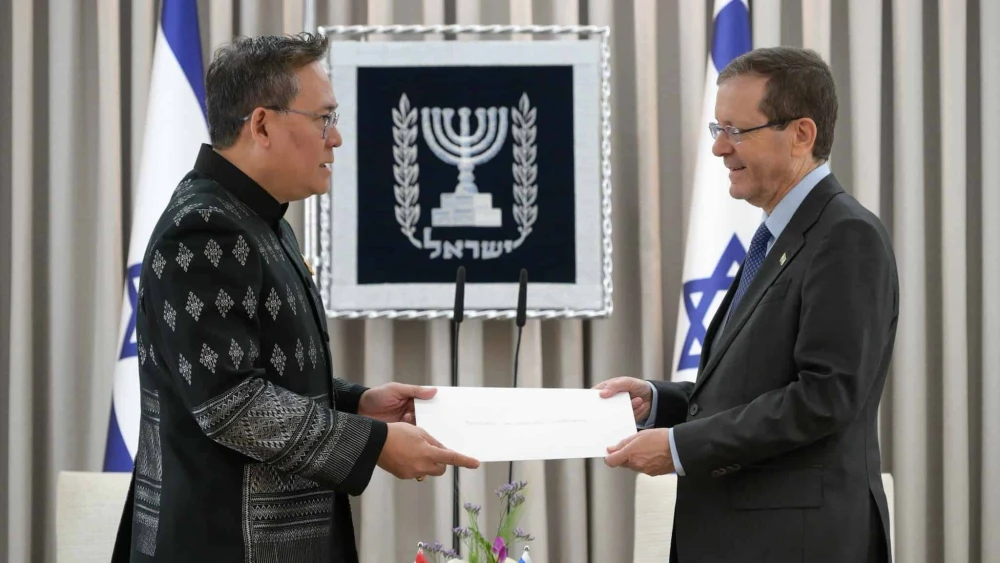
Bilateral diplomatic relations were established in 1954, and Israel opened its embassy in Bangkok four years later. From the 1960s, Thai professionals traveled to Israel for training in agriculture, water management and education through MASHAV, Israel’s international development agency.
But the growing relationship was put to the test in December 1972, when four Palestinian Black September terrorists seized the Israeli embassy in Bangkok and took six Israelis hostage. Thai officials, working with Egypt’s ambassador, negotiated their release. After approximately 19 hours, all six were freed unharmed. The terrorists were flown to Egypt.

Princess says she felt ‘half-Israeli’
The relationship between Jerusalem and Bangkok continued to develop in practical ways.
In 2004, Princess Maha Chakri Sirindhorn, a daughter of Thailand’s King Bhumibol Adulyadej, inaugurated an Israeli-Thai agricultural project at Khon Kaen University in northeastern Thailand. It demonstrated irrigation and water-saving methods suited to the region’s conditions. When severe floods struck Thailand in 2011, Israel sent specialists to assist.
The local Jewish community remained active. Chabad Rabbi Yosef Chaim Kantor arrived in Bangkok in 1993 with his wife, Nechama Dina, and their baby daughter. His work included religious services and providing kosher food and Jewish education, increasingly serving Israeli travelers alongside resident families.
After the December 2004 tsunami, Kantor walked along the devastated beach at Khao Lak and noticed broken toys among the wreckage. He organized an international toy drive, enlisting children from more than 120 schools and communities to help their Thai counterparts. Toys were shipped from New York, and the project included a day of activities for children affected by the disaster.
Such work continued a tradition of Jewish residents contributing to Thai society. Alongside it, however, an increasingly consequential relationship was developing in the opposite direction.
By 2023, roughly 30,000 Thai laborers worked in Israel’s agricultural sector. Many came from rural northeastern Thailand, leaving families behind to earn money abroad. Israel had become a place where they could seek the sort of economic opportunity that had once drawn Jewish newcomers to Bangkok.
On Oct. 7, 2023, Hamas terrorists invaded Israel and massacred more than 1,200 Jews. They also murdered dozens of Thai workers and abducted 31 Thai nationals to Gaza. Among those kidnapped was Surasak Rumnao, who had left Thailand’s Udon Thani province to work in southern Israel. He was released in January 2025, together with four other Thai hostages, after 15 months in captivity.
His mother watched his release on a Facebook livestream. At first, she barely recognized him. Overcome with emotion, she could not eat the food his father brought her.
At Shamir Medical Center near Tel Aviv, Israeli doctors and nurses joined Thai and Israeli representatives in welcoming the five freed men. Flags were waved, and the men were greeted with cheers.
Oct. 7 revealed just how deeply Thai and Israeli lives had become intertwined.
That may be the most striking aspect of Thailand’s Jewish story, which was never that of a large or powerful Jewish community. Instead, it was built through a succession of encounters: merchants in Ayutthaya, refugees seeking sanctuary, businessmen and rabbis who made Bangkok their home, Thai students training in Israel and, eventually, Thai workers caught up in Israel’s darkest day.
Princess Chulabhorn’s declaration that she felt “half-Israeli” may have been unusually personal, but the connection behind it was hardly superficial.
For a country that many Israelis know mainly as a vacation destination, Thailand has occupied a far larger place in Jewish history—and Israel in Thailand’s—than most people realize.