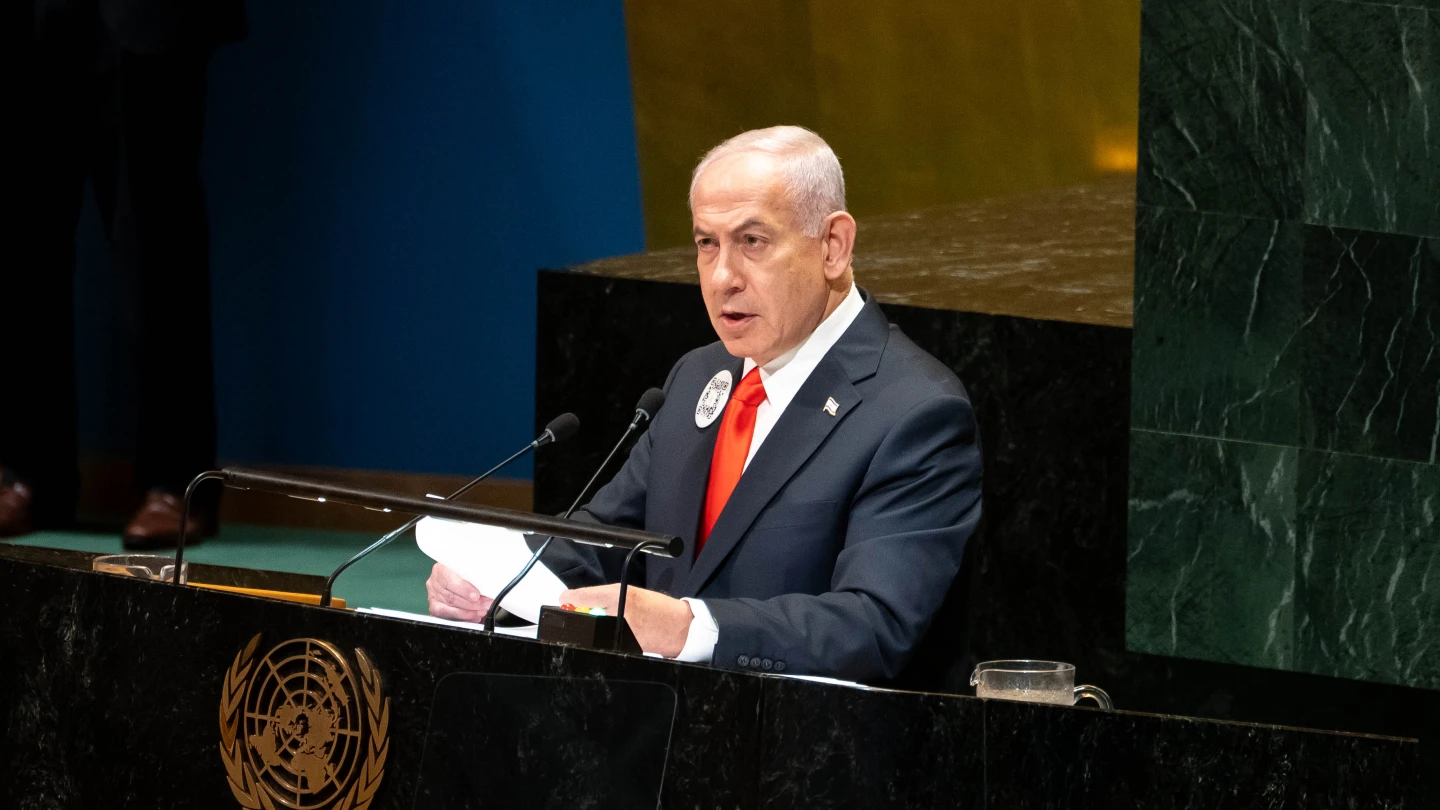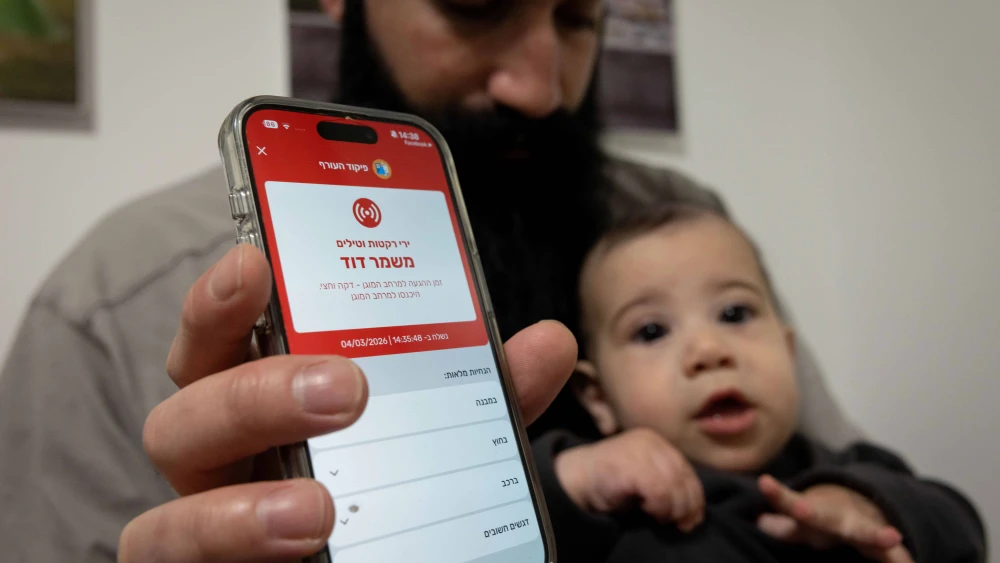
Danny Danon, Israeli ambassador to the United Nations, played a recording of three shrieking sounds on his phone in front of the U.N. Security Council on Tuesday, just hours after Hezbollah shot a rocket from southern Lebanon and killed an Israeli woman.
“When you hear this siren, you have 15 seconds to seek shelter,” the envoy told the Security Council.
He turned a desk clock around to face the council. It started counting down from 15 seconds.
“Imagine you are at home. You have three children. Which one do you take with you first? Do you go back for the others?” he said, as the clock ticked down to zero. “Do you carry your elderly parents? What if you are outside now?”
“Fifteen seconds,” he said. “That’s it.”
The council meeting addressed several issues on the Israeli-Palestinian front, including the Board of Peace, the situation in Judea and Samaria and the war with Iran.
Nickolay Mladenov, the Board of Peace’s high representative for Gaza, told the council that “essential services are operating at a fraction of pre-war capacity.”
“The health care system is in collapse. There is no functioning economy,” Mladenov said. He called the situation “very, very difficult,” despite “significant improvements” during the completed first phase of the Israel-Hamas ceasefire.
A former U.N. official, Mladenov told the council that the National Committee for the Administration of Gaza, the Palestinian panel acting as a transitional government in Gaza, has made progress on vetting thousands of civilian Gazan police candidates.
“The national committee exercises authority solely on an interim basis,” Mladenov said. “The end state is a reformed Palestinian Authority capable of governing Gaza and the West Bank, and ultimately a pathway to Palestinian self-determination and statehood.” (Some officials and states refer to Judea and Samaria as the “West Bank.”)
Israel opposes Palestinian Authority control over Gaza and a Palestinian state.
As part of the second phase of U.S. President Donald Trump’s 20-point peace plan, Hamas is supposed to disarm in exchange for a withdrawal of Israeli forces from the Strip. Hamas officials have repeatedly said they won’t disarm, though talk has turned to “decommissioning” their weapons.
“Decommissioning proceeds in parallel with staged withdrawal. This is fundamental to the credibility of the entire process,” Mladenov said.
He urged council members “to use all means at their disposal to urge Hamas and all Palestinian factions to accept the framework without delay.”
Mladenov told the council that there is no credible path to Palestinian statehood while Hamas controls Gaza.
“That is why everyone—every member of this council, every state in the region, the Palestinian National Authority and every Palestinian faction that cares about peace has an interest in the implementation of the 20-point comprehensive plan,” he said.
Mike Waltz, U.S. ambassador to the United Nations, told the council that “Gaza can become a destination for investment and real growth.”
“It’s now or never,” he said, of uniting and supporting the Board of Peace.
“Hamas has no future in the governance of Gaza,” said James Kariuki, the United Kingdom’s ambassador to the United Nations. “It and other militant groups must demilitarize.”
Jérôme Bonnafont, the French ambassador to the United Nations, said that it would be “suicidal” for Hamas to refuse to disarm.
Danon told the council that Iran can launch missiles much further than previously thought. “Your capitals are within reach,” he said. “The threat we are facing is existential.”