Newsletter
Newsletter Support JNS

Trump erupts over Iran strike on Qatari gas field, issues stark warning to Tehran

The Islamic Republic’s missile assault came in retaliation for what it said was an IAF strike on its part of the same field; Israel has not taken credit for that attack.

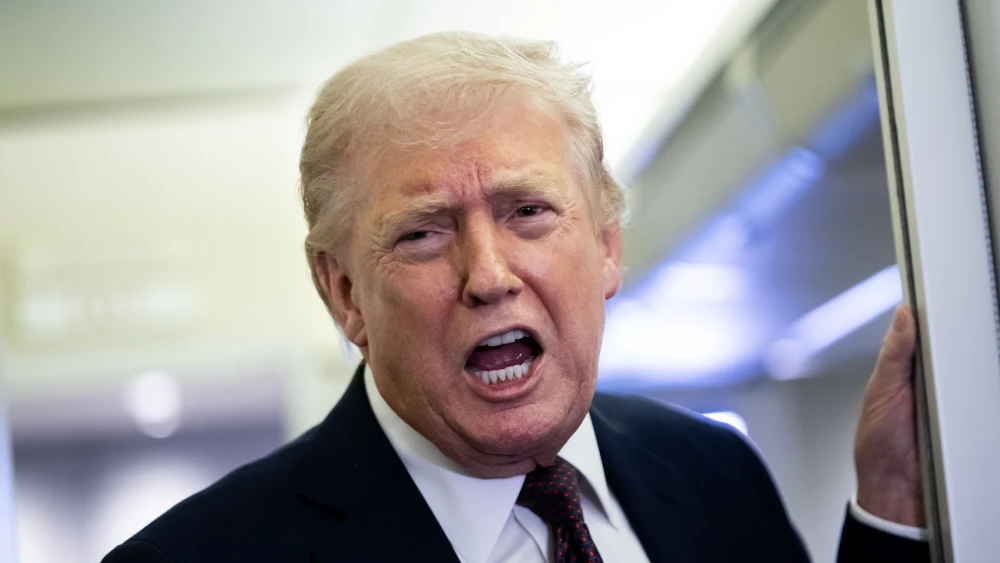
U.S. President Donald Trump speaks to reporters onboard Air Force One on March 15, 2026. Photo by Nathan Howard/Getty Images.

U.S. President Donald Trump reacted angrily late Wednesday to an Iranian missile attack on Qatar’s Ras Laffan Industrial City, which processes gas from the Arab state’s part of the South Pars Field, the largest natural gas field in the world.

Iran’s attack was in retaliation for what it said was an Israeli strike on its part of the same field, which is located in the middle of the Persian Gulf. Israel has not taken credit for that attack.

Trump, in a post to Truth Social, distanced himself from the attack, saying Israel had “violently lashed out” at the natural gas field without U.S. knowledge.

“The United States knew nothing about this particular attack, and the country of Qatar was in no way, shape, or form, involved with it, nor did it have any idea that it was going to happen,” Trump posted.

In a warning to both Israel and Iran, he said, using all caps, that “NO MORE ATTACKS WILL BE MADE BY ISRAEL” on the South Pars Field. If Iran “unwisely decides to attack” despite this, the U.S. “will massively blow up the entirety of the South Pars Gas Field at an amount of strength and power that Iran has never seen or witnessed before.

“I do not want to authorize this level of violence and destruction because of the long term implications that it will have on the future of Iran, but if Qatar’s LNG is again attacked, I will not hesitate to do so,” he said.

Ras Laffan Industrial City is responsible for roughly 20% of the global LNG supply.

Explore Senior Israel Correspondent David Isaac’s expert analysis on Jewish history, politics, and current events at JNS.
Four Republicans joined with nearly every Democrat to direct U.S. President Donald Trump to remove American military forces from the conflict with Iran in a non-binding resolution.
“Despite his statements, it is not Israel, America or the Republican Party that has changed but Carlson himself,” Rabbi Yaakov Menken, executive vice president of the Coalition for Jewish Values, told JNS.
“Antisemitic language does not become acceptable simply because it appears within boycott messaging or political advocacy,” tech nonprofit CyberWell stated.
Eric Dinowitz and Inna Vernikov, co-chairs of the New York City Council’s bipartisan task force on Jew-hatred, both decried the way Rep. Dan Goldman was treated.
According to the Pew Research Center, 64% of religiously unaffiliated people who participated in a recent study favored student-led group prayer in public schools.
The Education and Workforce Committee will mark up 11 bills, including measures that would require institutions receiving federal funds to strengthen responses to antisemitism complaints.
Benny Gantz, JNS editor-in-chief Jonathan S. Tobin, Gilad Erdan, Mosab Hassan Yousef, Nissim Black and leading voices in security, diplomacy, media, law and Jewish communal affairs headline the summit’s third day in Jerusalem.