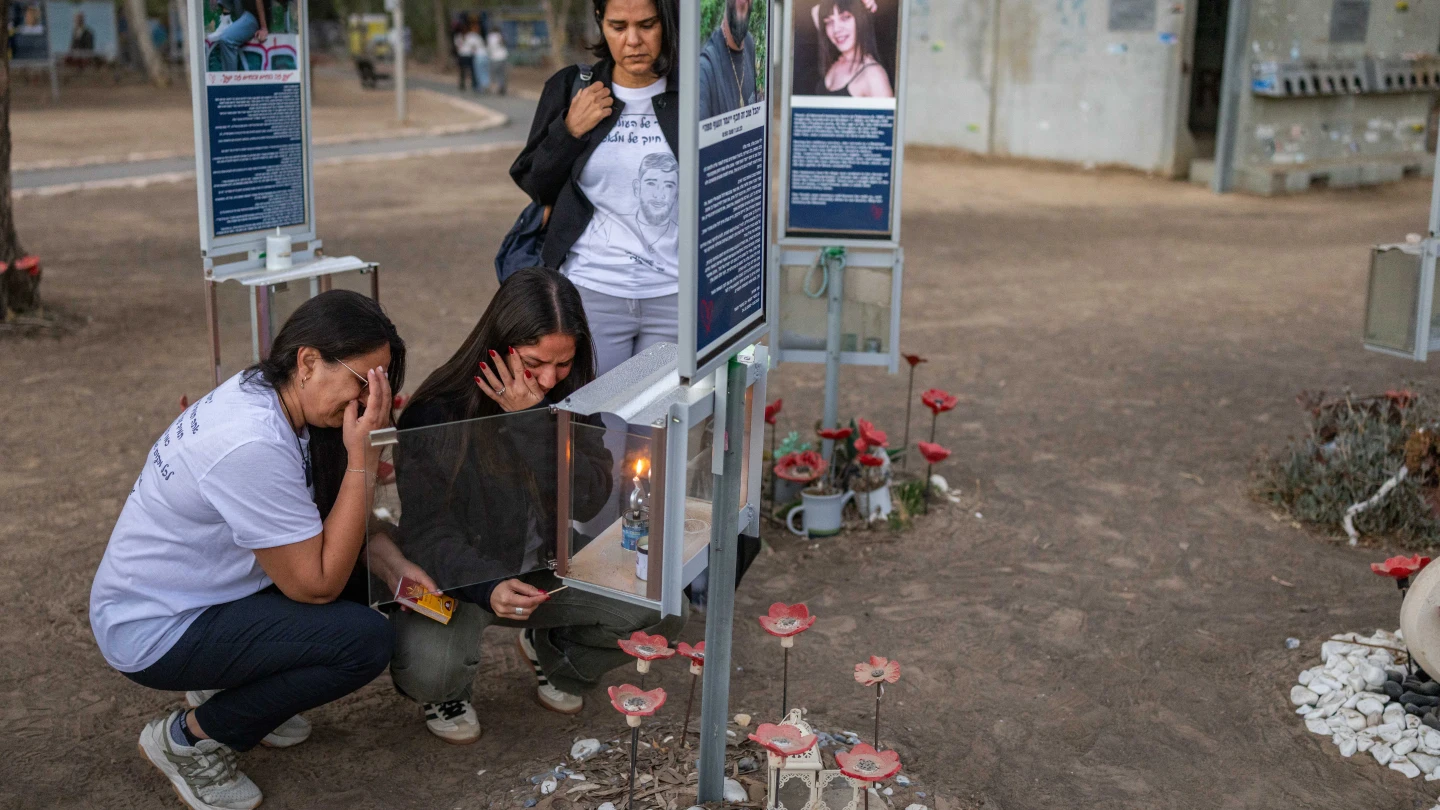
Gunmen opened fire on families celebrating the first night of Chanukah at an event on Sydney’s Bondi Beach on Dec. 14, killing 15 people who ranged from an 87-year-old Holocaust survivor to a 10-year-old child. The attack followed an 893% increase in antisemitic incidents in Australia over the past decade.
In the United States, the Anti-Defamation League documented 9,354 antisemitic incidents in 2024—the highest in 46 years of tracking, with physical assaults up 21%. That’s more than 25 incidents per day. This isn’t abstract data. It’s Jews burying family members.
The resurgence follows a pattern intelligence analysts recognize: convergence on a high-value target by actors with disparate objectives. Antisemitism has become operationally useful across the ideological spectrum. For the far-right podcaster, it’s a monetizable business model. For Iran, it’s asymmetric information warfare. For Qatar, it’s diplomatic leverage. For China, it’s a destabilization vector targeting American institutions. For domestic grifters and ideologues, it’s the conspiracy theory that explains everything while requiring no evidence. For the media, it is clickbait and a ratings boost.
The Turning Point USA conference revealed how this convergence manifests domestically. The central question: Are there any voices on the right espousing rhetoric too hateful to be platformed? The answer increasingly appears to be no, not even those voices trafficking in Holocaust denial.
Ben Shapiro, a conservative political commentator, stood virtually alone in calling out this normalization. He criticized former Fox News host and current podcaster Tucker Carlson for platforming self-avowed neo-Nazi and Holocaust denier Nick Fuentes, who has called for executing Jews. He challenged conservative media personality Megyn Kelly and others for refusing to denounce far-right conspiracist Candace Owens’s theories about Israeli intelligence murdering Turning Point co-founder Charlie Kirk in September.
The response was predictable: conservative political strategist and pundit Steve Bannon called Shapiro “a cancer.” Kelly declared their friendship over. Carlson mocked him from the stage.
U.S. Vice President JD Vance’s position exemplified the problem. Days after the conference, he told the British outlet UnHerd that Fuentes could “eat s**t” for attacking his wife, Usha Vance, of Indian descent, with racial slurs. But when it mattered, on Sunday on the main stage at the conference, he chose coalition management over moral clarity.
Vance argued that U.S. President Donald Trump “did not build the greatest coalition in politics by running his supporters through endless self-defeating purity tests” and declared that “we have far more important work to do than canceling each other.”
Consider the threat indicators that went unaddressed. Owens urged millions of followers to read Der Talmudjude, an 1871 antisemitic forgery that even Jew-hating Germany exposed as fraudulent, but that the Nazis recognized as a source text. Myron Gaines, a far-right podcaster, influencer, and author, wore a “Cookie Monster” oven sweatshirt to the conference, a Holocaust-denial meme where cookies represent Jews and ovens represent crematoria. He posed for photos with influential conservatives. No one objected.
Gaines (real name Amrou Fudl) isn’t subtle about his objectives. He boasts his Fresh & Fit podcast is “the biggest platform talking about the JQ” and monetizes Holocaust denial through his storefront, where he advertised the sweatshirt with a discount code “271k” for “6% off.” He offers 6% off for merchandise mocking the factually verified total of 6 million murdered Jews, while the “271k” discount code is a dog-whistle nod to the baseless, alternatively lesser total of 271,000 Jews killed during the Holocaust that is promoted online by neo-Nazi, far-right or Holocaust-denial social-media accounts.
Gaines has called the Holocaust a “hoax,” praised Adolf Hitler as “a revolutionary leader” and routinely uses “fat Jew” as a slur. The business model works because the attention economy rewards escalation. Controversy generates engagement, engagement generates revenue, algorithms optimize for watch time.
The foreign-influence dimension follows established patterns. Iran’s Masaf Institute launched hashtag campaigns exploiting USS Liberty conspiracies (an incident during the 1967 war) with more than 2,000 accounts pushing antisemitic narratives. Those narratives migrated from Iranian information operations to the conference floor at Turning Point, where young activists now confront Jewish conservatives with similar talking points.
Carlson’s trajectory illustrates how influence operations cultivate American voices. He recently appeared at Qatar’s Doha Forum, declaring his intention to buy property there. Qatar hosts Hamas leadership and has spent billions promoting Islamist extremism through Al Jazeera and affiliated networks. Carlson now argues that the Gulf State should replace Israel as America’s primary Middle Eastern ally, calling Israel’s actions “mass murder” by an “evil regime.” Whether this represents sincere conviction or successful cultivation, the operational effect is identical.
The left presents a mirror image. Neville Roy Singham’s Chinese Communist Party-affiliated network organized campus groups after the Hamas-led terrorist attacks in southern Israel on Oct. 7, 2023. I testified before Congress about this constellation of nonprofits exploiting regulatory loopholes to bankroll what congressional investigators described as “radical, antisemitic entities,” including National Students for Justice in Palestine. House Republicans documented how Singham’s organizations (The People’s Forum, ANSWER Coalition, International People’s Assembly) function as “conduits through which CCP-affiliated entities co-opted pro-Palestinian activism to advance anti-American, anti-democratic and anti-capitalist agendas.”
These groups organized “Shut It Down for Palestine” campaigns featuring eliminationist rhetoric and attacks on critical infrastructure.
The threat picture: Iran amplifying far-right antisemitism through social-media operations, Qatar cultivating conservative influencers through access and economic incentives, Russia weaponizing deceptively edited content, and China bankrolling radical antisemitic campus networks. Different vectors, same target. This is antisemitism’s operational advantage: Its utility transcends ideology. A Nazi and a Marxist, a theocrat and an atheist, a grifter and a communist operative can all deploy identical conspiracy theories while advancing separate strategic objectives.
This is how institutional defenses fail—not through the initial breach but through immune system collapse. When calling out Holocaust denial makes you the target rather than the threat actor, then you’ve already lost. When boundary enforcement becomes boundary violation, there are no boundaries. The attack chain from “perfidious Jews” to “death penalty” to “Cookie Monster” ovens to mass-casualty events isn’t theoretical. We have the historical case studies. The progression is consistent and accelerating.
When this hatred achieves mainstream acceptance (amplified by podcasters with millions of followers, weaponized by hostile state actors, defended as “free speech”) and produces attacks like Bondi Beach, you’re not observing normal political friction. You’re watching the mechanics of how democracies fail to protect their most vulnerable citizens.
The threat requires decisive action. Platforms must enforce existing terms of service against coordinated inauthentic behavior. Law enforcement must treat incitement to genocide as the criminal act it is, not protected speech.
Both conservative and progressive institutions must choose between coalition maintenance and moral clarity. Right-wing leaders must decide whether platforming Holocaust deniers is an acceptable price for audience growth. Left-wing activists must confront how foreign adversaries have weaponized their movements to advance antisemitic agendas. Americans with platforms across the political spectrum must understand that silence functions as operational support.
The historical pattern is clear, and the contemporary threat indicators are impossible to ignore. Antisemitism has been repackaged as a multipurpose political and economic tool: profitable for podcasters, strategically valuable for hostile states and algorithmically optimized for maximum reach. What began as ancient hatred has evolved into modern infrastructure—and that infrastructure is producing body counts.
The question is whether American institutions, left and right, will respond to these threat indicators before the next attack, and the one after that, and the one after that.