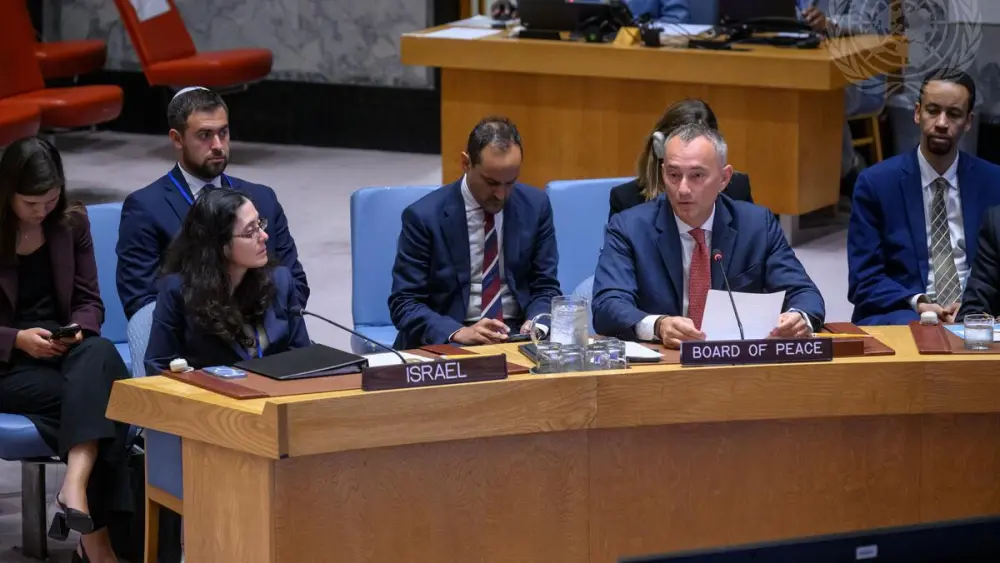
The Board of Peace’s public face blamed both Israel and Hamas for stalled peace efforts in Gaza in an appearance at the United Nations Security Council on Wednesday.
Nickolay Mladenov, the U.S.-backed board’s high representative for Gaza, told the council during a briefing on the Israeli-Palestinian file that “ceasefires that deliver nothing visible are not sustained by patience.”
“They are only exhausted by it,” he said.
Mladenov said that Hamas and other Gazan terror groups agreed to give up their arms and yield power to a new Palestinian governing authority, but he also decried Hamas for not living up to its commitments to disarm, based on a “roadmap” to peace to which Israel and Hamas agreed, at least in principle.
“Every weapon carried, every tunnel still worked on and every convoy still obstructed, sets the process back,” Mladenov said. “It will be Palestinian civilians, women and children, who will bear the consequences.”
Jerusalem did not emerge unscathed. He denounced Israel for continued military action in Gazan territory and for failing to use the deconfliction mechanism in place to address imminent threats.
“Will another strike on a munitions depot stop Hamas from rearming or tightening its grip on Gaza?” Mladenov asked rhetorically. “It will not.”
Israeli Prime Minister Benjamin Netanyahu has said that Hamas will not disarm based on the provisions of the roadmap alone. That would appear to mean Israel wouldn’t need to withdraw security forces, in a phased manner, from the Strip.
Mladenov said on Wednesday that Israel is not being asked to do anything beyond what it already obligated itself to do when it agreed to U.S. President Donald Trump’s 20-point peace plan last September.
Mladenov appeared to be most critical of issues related to shelter for Gazans.
“Winter is around the corner, and Israel’s present policy on quality shelter is not acceptable,” he said. “The Board of Peace urges the state of Israel to allow better shelter into the Strip for dignity, for health and for safety.”
‘Disarmament must come first’
While Mladenov was looking ahead on the calendar, Israel’s representative looked back in time.
Noa Furman, who recently returned as Israel’s deputy ambassador to the United Nations, addressed the council for the first time in about five years.
The last time she was in the chamber, she said that she warned about Iran’s nuclear ambitions, advanced missile production and support for terror proxies throughout the Middle East, as well as Hezbollah’s growing presence in southern Lebanon. She told the global body at the time that the threats wouldn’t disappear just because the global community opted to direct its attention elsewhere.
She said on Wednesday that the United Nations must not repeat the same mistakes.
“The plan cannot succeed while Hamas remains armed. Disarmament must come first,” she said.
Food entering the Strip is beyond humanitarian requirements established by the United Nations, and Israel has formed a working group with the Board of Peace to improve humanitarian conditions, Furman said.
“Aid alone is no substitute for what must ultimately be done,” she said. “Hamas and other terrorist organizations must be disarmed so that Gazans can rebuild their lives and have a future free from its control.”
Furman also disputed the way that the United Nations characterized Israel’s seizure this week of the Qalandiya Vocational Training Institute, which was the final remaining facility run in Jerusalem by the U.N. Relief and Works Agency, or UNRWA, which Israel banned.
Furman “personally participated in meetings” with then-UNRWA commissioner-general Philippe Lazzarini in 2022 and 2023, she said, “to seek an arrangement that would allow a school to be built on the site” to serve Arab students.
She said that UNRWA rejected the request “amid political pressure from local employees opposed to cooperation with Israel.”
Jerusalem municipal authorities are building a school there in time for the new educational year.
“It is shameful that the U.N. put political considerations ahead of the educational and humanitarian needs of Kfar Aqab’s children,” Furman said, of the neighborhood where the compound sits.
Mike Waltz, U.S. ambassador to the United Nations, took one of the council’s civil society briefers, Athena Rayburn of the Association of International Development Agencies, to task for failing to mention Hamas’s violent tactics against its own people while critiquing the Board of Peace’s framework.
“Let’s sum this up. Last fall: war, hostages, suffering. And now, less than a year later, after the passage” of the Security Council resolution forming the Board of Peace, “there are no hostages in Gaza,” he said.
“Aid, by the U.N.’s own figures and report, are reaching those in need,” Waltz said. “Not enough but far more than it was.”
“Hamas has agreed to disarm in full. The IDF is pulling back,” and the board’s Palestinian technocratic transitional governing authority “is authorized to move in,” Waltz said. He urged the council “to put politics and agendas aside” and “support this new way.”