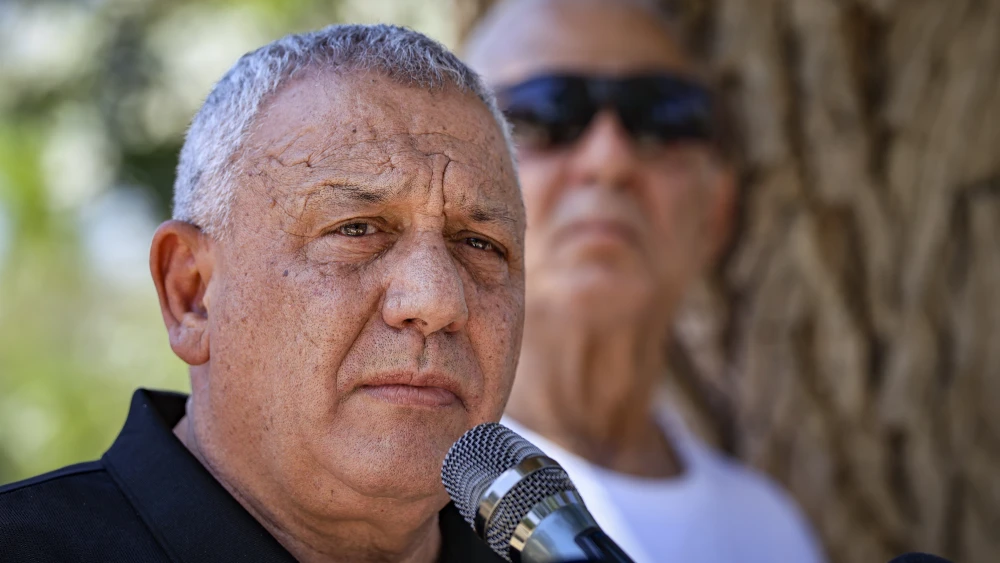
Lt. Gen. (res.) Gadi Eisenkot on Thursday said that he is against the timing of the construction tenders in E1, an area east of Jerusalem and within the municipal boundary of Ma’ale Adumim.
The Israel Land Authority last week announced it would market to contractors and entrepreneurs the first 1,400 housing units of E1 (“East 1”), a strategically significant area in Judea. Contractors who win the bids will construct the units.
Speaking to Israel Hayom, Prime Minister Benjamin Netanyahu’s main challenger in the upcoming Oct. 27 general election said, “Not now. It is a mistake that comes at an international cost. I would note that Netanyahu himself opposed it for a long time, but yielded because of coalition pressure and approved it.”
Eisenkot is a former Israel Defense Forces chief of staff and head of the newly formed Yashar Party.
His response drew a sharp rebuke from Finance Minister Bezalel Smotrich, who oversees the body responsible for approving construction and handling other bureaucratic matters in Area C of Judea and Samaria.
“The truth is out. The concessions by the Eisenkot-Liberman-Golan government began even before it came to power,” Smotrich wrote. “The construction I am advancing in the E1 area is cutting short the dream of establishing a terror state next to Jerusalem. Anyone who opposes construction in E1 supports the establishment of a Palestinian state—even if they lie to you and try to present a different position.”
The importance of E1 lies in its location. The 12-square-kilometer (4.6-sq.-mile) area sits between the built-up part of Ma’ale Adumim, a Jewish city of about 40,000 in the Judean Desert, and Jerusalem.
Once built up, E1 will connect Ma’ale Adumim to the capital, forming a larger metropolis, preventing the Palestinian Authority from surrounding Jerusalem with its own metropolis, which would include Ramallah, eastern parts of Jerusalem and Bethlehem. (The P.A. intends to wrest from Israel eastern sections of Jerusalem for its own future capital.)
On Thursday, Eisenkot stated his opposition to a Palestinian state alongside Israel, saying its creation would be a “grave mistake” and reflect “delusional” thinking after the Hamas-led Oct. 7, 2023, massacre.
“The two-state solution is a grave mistake. Arab-Palestinian terrorism against Israel is deep-rooted and profound, and stems in part from religious motives. The first victim of Arab terrorism here was murdered as early as 1851, exactly 175 years ago—Rabbi Avraham Tzoref, may his memory be blessed, one of the leaders of the Jewish community in the Jewish Quarter—and it will not end any time soon,” he said.
“Anyone thinking about a two-state solution after Oct. 7 is simply delusional,” Eisenkot added.