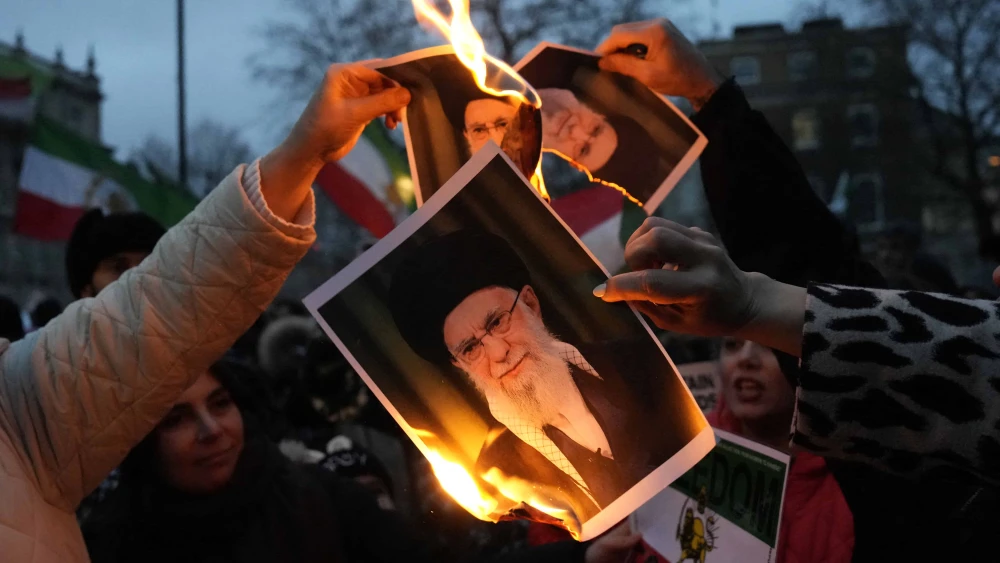

The people of Iran call Mojtaba “Moosh Tabah” ... In Iran, some critics have used the nickname “Moosh Tabah” for Mojtaba. This is a deliberate play on words, rather than a literal meaning of his name. “Mojtaba” in Arabic/Persian means “the chosen one” or “the selected,” and it is also a respected religious title.
Iranian society is fractured and disintegrated—a society that has lived since 1979 under a religious dictatorship born out of Khomeini’s terrorist upheaval and the supporters of Mossadegh. (Mossadegh was a demagogic and seditious prime minister who liked to perform in the role of a victim like an actor. Throughout his premiership, martial law prevailed and torture spread in Iran. It was he who both shut down the people’s parliament, and set fire to opposition and critical newspapers; 50 years later, Mahmoud Ahmadinejad repeated the same playbook in demagoguery.)
A form of social and psychological disorder is evident in Iranian society. A slaughter of civilians occurred in January. If the Holocaust of the Jews took place between 1933 and 1945, and 6 million innocent men, women and children were victimized by the Nazi regime, in Iran, in less than 48 hours, more than 45,000 patriots and freedom-seekers were subjected to genocide by the Shi’ite Islamic Caliphate.
Iranian society believes in moving beyond the catastrophe of Shi’ite clerical rule—a society in which the mullahs have brought war, destruction, darkness and poverty. This massacre and genocide have made the transition in Iran from despotism and kleptocracy to democracy extremely difficult and fraught with obstacles.
The clerical institution in Iran is an obstacle to the institutionalization of democracy in Iran. And perhaps Iranians, like the Germans who, after the defeat of Nazism, banned Nazi clothing, propaganda and symbols, must—with the collapse of Khomeinism and theocracy and Islamic terrorism—act in the same manner.
With the existence of the clerical institution, the transition in Iran is not peaceful, and the underground networks of mosques and clerics are inclined toward civil war and domestic terrorism, and even the fragmentation of Iran. A profound social rift exists between the occupying, repressive, plundering and savage ruling power, and the people of Iran. The people of Iran are in mourning and grapple with numerous problems, possessing a fragile spirit and a disturbed mind.
The concern is that if Israel and the United States are content with a temporary ceasefire, then a bloodthirsty, rabid regime will turn upon the people and proceed with greater repression. In January, the great uprising and social aspiration of Iranians served as a return to Iran’s historical identity. But the clerics thought of preserving power and domination, and for that reason committed killings. Today, a central square in Tehran has effectively become a stage for the presence and projection of Iran-linked militant networks—part of the Islamic Republic’s transnational terrorist proxy architecture across the Middle East and the Shi’ite Crescent—with some elements reportedly entering Iran to reinforce domestic repression.
In January, the regime carried out an organized and premeditated massacre. It sought, by creating a “Great Terror,” to deter the people during a potential war from aligning with that war. For them, the survival and stability of the regime were paramount, and under the pretext of cooperation with Israel and the United States, hundreds of people in the prisons of the Islamic Republic are awaiting execution. With this outward religiosity and fabricated sanctity in reality and at its core, Tehran is driven by power worship and domination. And because of these horrific repressions by the hard core of the Shi’ite regime, the psychological condition of society under the yoke of despotism has disintegrated.
The young generation of Iran is also different from that of 1979; it shows favor toward one figure: Crown Prince Reza Pahlavi. He appears to embody the lost pride and identity of Iranians since the revolution. This generation is no longer religion-inclined, dictator-approving or desirous of a supreme leader and dictatorship—and is not enslaved by religious thought and superstition. In this respect, Iranian society has profoundly transformed, and this fluctuation will intensify. The conscience and social awareness of Iranians have brought them closer to unity and the consensus that this destructive and detested regime must be transcended.
Yet law remains missing for Iranians, and no form of law governs the country. The people of Iran have endured half a century of living in humiliation under the era of Shi’ite clerical rule—a ruling power that, beyond expanding superstition, has contributed nothing to the growth of culture. From 1979 to today, all the capital, savings, wealth and assets of the Iranian nation have been spent and squandered by incompetent rulers and criminal ayatollahs for exporting the destructive ideology of Khomeinism and expanding the domination of the Islamic Republic in the Middle East.
The plundering ruling power has blocked all paths to reform, peaceful transition and the rule of law; it has inflicted such damage on civilian society that its repair may not be possible even in the next half-century.
The regime knows that Israel and the United States were not seeking regime change, do not have the capacity for a prolonged war and do not want to incur the costs. But the regime is oblivious to the point that the international community has gradually realized since 1979 that in this status quo, freedom, peace and stability cannot be achieved. In reality, 1979 stripped Iranian society bare. Citizens were confronted with a self-autocratic religious regime that performed a striptease and revealed its true reality.
In the first 10 years of Khomeini’s dictatorship, and later, in the 37 years of Khamenei’s dictatorship—for a total of 47 years—two Islamic caliphs could not tolerate failure, and held mistaken and delusional perceptions of Iran and world politics. Today as well, beyond cardboard images, there is no trace of Mojtaba Khamenei, the third caliph. Among Iranian society, he and the other two caliphs are similarly figures of stupidity, symbols of folly, embodiments of shamelessness, goddesses of malice and unparalleled models of dishonor. His fragile palace of delusions is collapsing, and until his image is broadcast live and directly, he must be presumed dead. And the evidence indicates that the IRGC and a junta run the country, and this very point creates the groundwork for civil war as well.
Today, political developments, war and economic collapse have gradually mobilized the poor and the hungry of society. The poverty line in Iran has expanded to such an extent that ultimately the army of the hungry in a ruined society, with this disturbed psychological state, will move toward confrontation with a failed, humiliated and isolated ruling power. Without harboring a distorted imagination or a skewed view, it must be said that no policy, plan or law has changed after the death of Khamenei, in addition to a significant group of military commanders and security officials. The regime continues to exist parasitically with a criminal junta cadre, proceeding with arrogance and delusion in its rogue conduct.
The nightly displays of thugs and hooligans affiliated with the ruling circle, coupled with the propaganda apparatus inside and outside the country, inflict psychological torture upon the people of Iran. Like tireless laborers, they work from within the darkness to preserve despotism. Society has distanced itself from a traditional space, yet still remains distant from modernity.
Right now, it’s not clear whether the joint U.S.-Israeli effort will fulfill its promise. Will their forces finish the job? Will Europe provide artificial respiration to the choking republic? Will they all abandon the people of Iran seeking a new existence? Even then, a very difficult transition lies ahead.